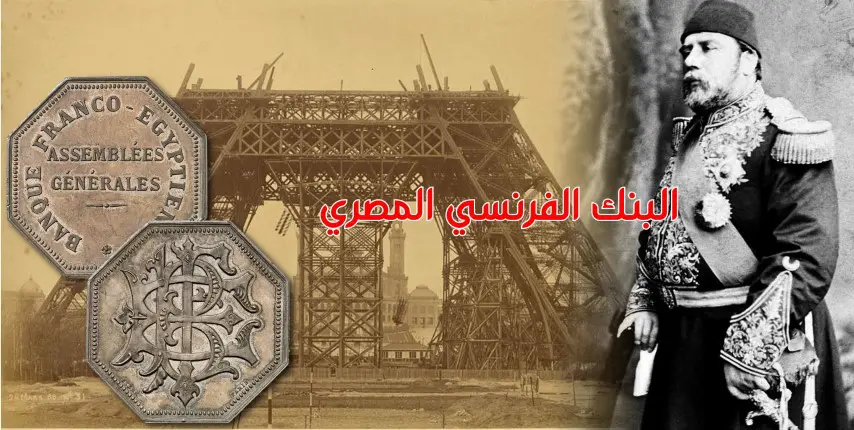
French Egyptian Bank
What were the circumstances surrounding the establishment of the French-Egyptian Bank?... And how did Egypt come to own half of the Eiffel Tower in France?
Ottoman and Egyptian public debt
The Ottoman state budget witnessed its greatest turmoil throughout its history, due to the Crimean War, when the Ottoman state took out its first loan with European financiers to finance its war. Between 1854 and 1879, the Ottomans took out 18 loans with a total value of 245 million Ottoman liras, with effective interest rates reaching 9% in most of the loans, and the accumulation of debts began to become a debt that burdened the Ottoman Empire and Egypt.
The Ottoman public debt crisis worsened with increased borrowing during the two decades following the first loan, and by 1875 the Ottoman government announced its decision to partially stop paying interest on its debts. This situation did not last long, however, until the government announced at the beginning of the new year in April 1876 that it had stopped paying all interest on its foreign debts, which practically meant the bankruptcy of the Ottoman state.
Suez Canal
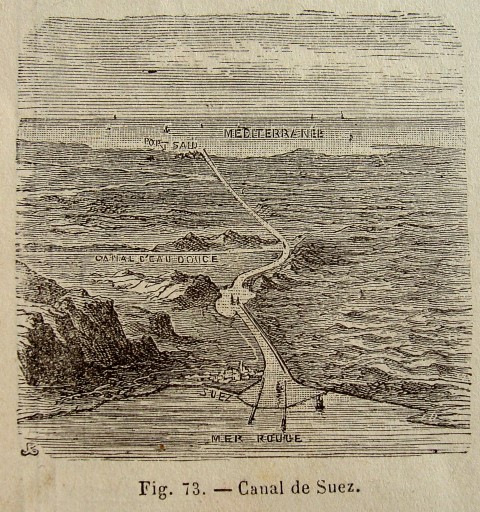 In 1856, the Khedive of Egypt, Muhammad Said Pasha, granted the French engineer Ferdinand de Lesseps the second concession to dig the Suez Canal. The concession stipulated that de Lesseps would be granted a concession to dig and operate a maritime canal linking the Red and Mediterranean Seas for a period of 99 years, starting from the date of opening the canal to maritime navigation. Ferdinand de Lesseps quickly established the Universal Company of the Suez Maritime Canal with a capital of 200 million French francs distributed over 400,000 shares, with the value of each share being 500 francs. The company's shares were offered on the international markets in November 1858, and the French subscribed for about 207,111 shares, which is equivalent to half of the shares, while the Khedive subscribed for about 177,642 shares, and the rest of the subscribed shares were distributed on the international markets.
On April 25, 1859, De Lesseps inaugurated the digging of the canal during the reign of Khedive Said, and work on it was completed ten years later during the reign of Khedive Ismail, who traveled to Europe on May 17, 1869, to invite kings, princes, heads of government, and men of politics, science, literature, and art to attend the opening ceremony of the canal, which he intended to hold on November 17, 1869.
The opening ceremony of the Suez Canal was estimated to cost 2.4 million Egyptian pounds at the time, in addition to the cost of the excavation work, which lasted for ten years. This burdened Egypt with debt and negatively affected the Egyptian public debt, to the point that Egypt was forced to sell its share of the canal’s stock to Britain for 100 million francs on November 25, 1875.
Attempts at monetary reform
In the midst of the crushing financial crisis of both Egypt and the Ottoman Empire, several European banks emerged to find a place for themselves within the lands of the Ottoman Empire by subscribing to purchase and negotiating loans, where the commissions and interest offered at that time amounted to 10 to 12%. This scenario succeeded in establishing itself well in Egypt to pay off the debts of the Suez Canal, and a new era was created called ”the Eastern Mirage” for those banks that operated in London, Paris, England and Austria.
Many of these banks were established, such as Société Générale, Banque BNP Paribas, Crédit Lyonnais, Crédit Foncier, Bank of Egypt, Austrian Egyptian Bank, French Egyptian Bank, and other European banks.
It seemed that the only solution to the debt crisis was to borrow again at a higher interest rate. Khedive Ismail was restricted from borrowing according to the terms of his loan in 1868. On the other hand, the loans and their size attracted the attention of the Sublime Porte, so it tried to put a limit on them, and prohibited the Khedive by virtue of a decree in 1869 from borrowing except with its permission.
Learn more about Khedive Tawfiq and the reform of the Egyptian currency in 1885
French Egyptian Bank
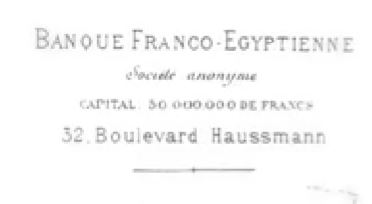
The French-Egyptian Bank was established in 1870 by Louis Raphael, a member of the Bischofsheim family, with a capital of 50,000,000 French francs, primarily for the purpose of financing Egyptian debt. Khedive Ismail contributed to financing half of the bank's capital, 25,000,000 francs, by mortgaging his lands.
Khedive Ismail saw no alternative but to take out a loan for his own account, so in April 1870 he borrowed from the French-Egyptian Bank the sum of 7,142,860 at an interest rate of 8.92%, which was later called the loan of the Sunni Circle, as Khedive Ismail borrowed a loan from the French-Egyptian Bank with his own lands as collateral, in addition to the lands that he had previously mortgaged, and therefore this was called the second loan of the Sunni Circle.
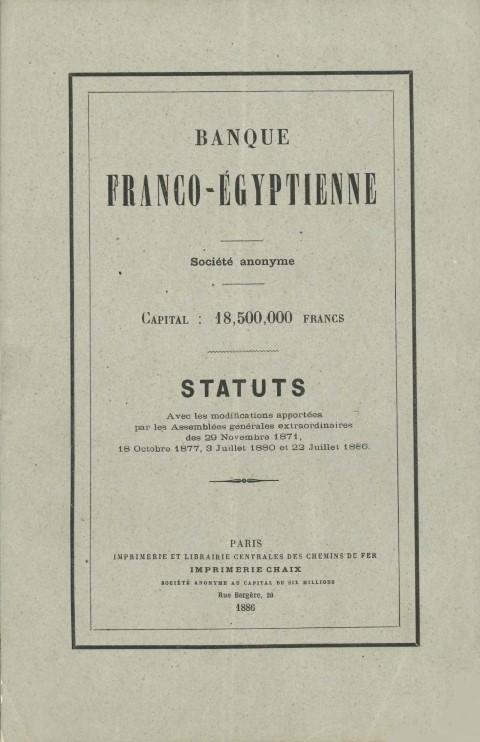
In 1875, the bank was invited to the Egyptian Debt Scheduling Committee to become a contributing member in 1879. The bank's presence in Egypt ended in 1889 after the establishment of the National Bank of Egypt was announced. On May 17, 1889, the French-Egyptian Bank contributed its capital to the establishment of the International Bank of Paris.
In 1901, Banque Internationale de Paris merged with Banque de l'Afrique to form an investment bank headed by former Finance Minister Maurice Rouvier, becoming the Banque de l'Commerce et l'Industrie (BfL). This bank merged in 1922 with Banque Nationale de L'Credit and later became BNP Paribas. BNP Paribas.
The French Egyptian Bank and the Eiffel Tower
The Eiffel Tower was built to commemorate the 1889 Paris International Exposition. EXPO Which coincided with the centenary of the outbreak of the French Revolution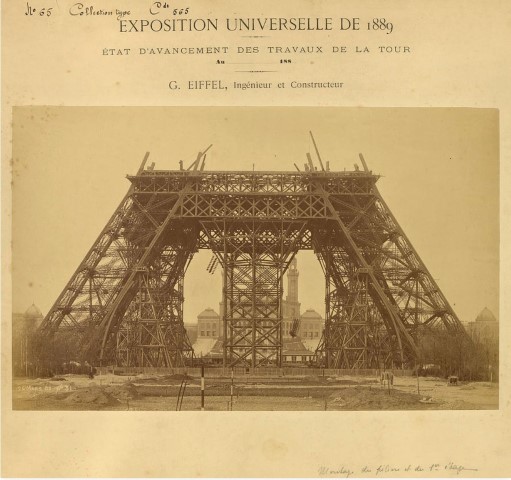 Construction of the Eiffel Tower began on January 26, 1887, and continued for 26 months. In 1888, the cost of building the Eiffel Tower was estimated at 6.5 million francs, with the public authorities only able to cover 1.5 million francs of this cost. With the completion of the first floor, Gustave Eiffel contacted the banks to raise an additional 5 million francs to complete the project.
Given the reluctance of the French national banks, he turned to private banks to finance the construction of the tower, and Gustave Eiffel eventually found a willing partner in Ernest May, director of the French-Egyptian Bank, and the bank committed to the project by signing a memorandum of understanding on July 26, 1888.
In order to share the risks of the operation and potential losses, Ernest May then turned to other banking institutions: Crédit industriel et Commercial (CIC) and Société Générale. The three banks then formed a consortium and signed the final contract with Eiffel on September 3, 1888. The Franco-Egyptian Bank took the lead in the operation.It was officially opened on March 31, 1889 and was named the 300 Meter Tower at the opening.
The financing project faced numerous criticisms from the French people, who ridiculed the idea, considering that the money of the French would later be deposited in the treasury of Egypt, after banking institutions, led by the French Egyptian Bank, bought half of the capital of the company that manages the Eiffel Tower (Société anonyme de la Tour Eiffel) for 2.5 million French francs.
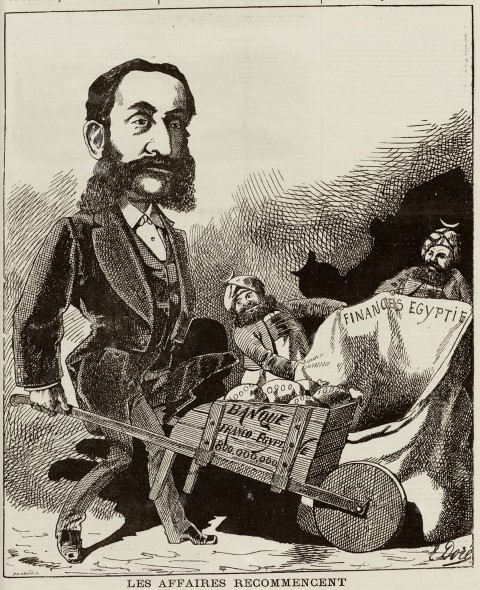
Token Bank of Egypt
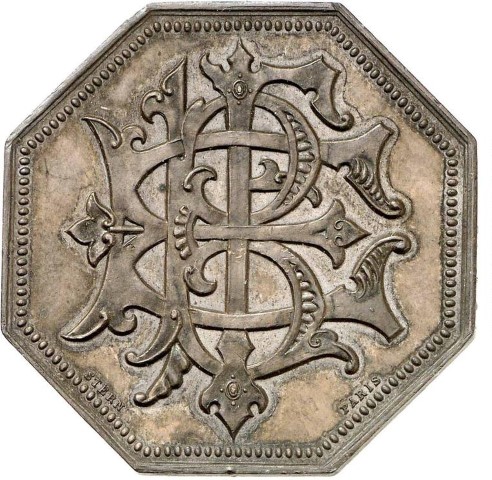
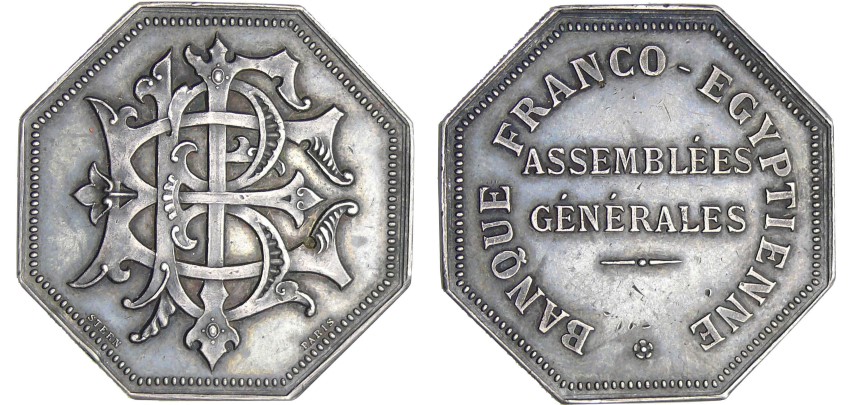
It is one of the rarest tokens or symbolic currencies of that era in Egypt. The token was designed in the form of an octagon and was intended as a reward that could be exchanged for money for members of the General Assembly.
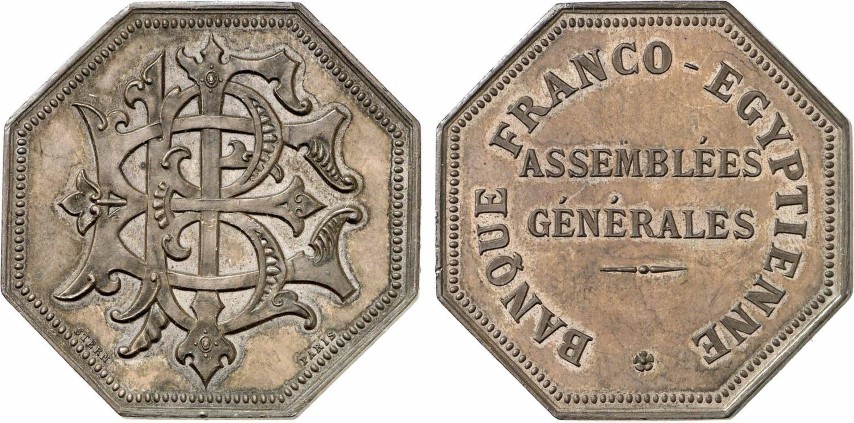
face
The front panel bears the name of the French-Egyptian Bank written in French on the edges: BANQUE FRANCO-EGYPTIENNE
In the middle, the words "Assemblées Generales" are written on two lines and mean "General Assembly".
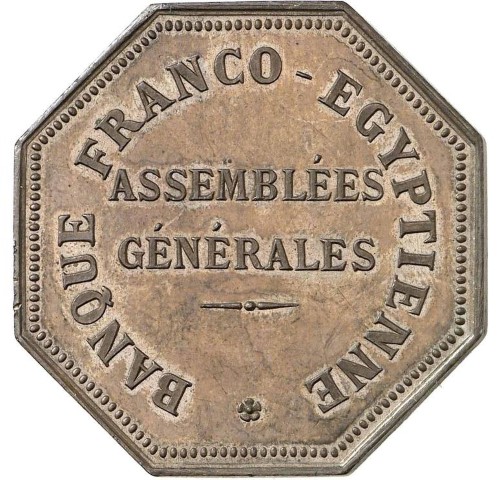
noon
As for the token’s face, it bears the initial letters in French for the words BANQUE FRANCO-EGYPTIENNE (BFE), written in a distinctive, intertwined, and decorative style.
The back shows the designer's signature, STERN (7 o'clock), and on the opposite side, the name of the city of manufacture, Paris (5 o'clock), appears.
Metal, weight and diameter
The following versions of this token have emerged:
1- Copper
Date: Undated (after 1880)
Diameter: 36 mm Weight: 18.19 g
Edge: Smooth
2- Silver (large size)
Date: Undated (after 1880)
Diameter: 39 mm, Weight: 36 g
Edge: Smooth
3- Silver (small size)
Date: Undated (after 1880)
Diameter: 36 mm, Weight: 20.9 g
Edge: Smooth
Prepared by: Dr. Mazen Ibrahim
Special thanks to: Mr. Hatem El-Gendy
Sources:
- Abdul Rahman Al-Rafi’i (The Era of Ismail)
- Ahmed El-Hetta (Economic History of Egypt)
- Gamal Hamdan (The Genius of Egypt)
- histoire.bnpparibas
- Wikipedia
You can find more similar topics on the Arab Collector website via this link. the next:
Port Said's currency…the unknown history