Tabora gold, the German currency minted in the jungles of Africa
In the late 19th century, Germany aggressively pursued its ambitions to compete with the major colonial powers, seeking to secure raw materials and resources to fuel its burgeoning industry. To this end, it extended its influence over the Great Lakes region of East Africa (comprising present-day Tanzania, Burundi, Rwanda, and parts of Mozambique), sometimes under the guise of humanitarian concerns such as combating the slave trade, and at other times under the pretext of economic interests such as protecting German investments. This region became a colony known as “German East Africa“It made the coastal city of Dar es Salaam its capital.
The siege of Dar es Salaam and the escape inland
As the drums of World War I began to beat in August 1914, Britain used its naval dominance to sever supply lines between Germany and its distant colonies. Dar es Salaam was bombed and besieged, forcing the German administration to retreat and fortify itself in the African interior town of Tabora. Despite daring attempts to use airships to break the isolation and deliver supplies, all such efforts failed, leaving Tabora completely cut off from Berlin.
The necessity of innovation: Minting gold in the heart of the jungle
This disruption led to a severe monetary crisis; imperial coins ran out, paralyzing trade and the payment of wages, particularly those of military mercenaries. This gave rise to "emergency money"; in addition to printing local banknotes, the authorities decided to mint gold coins with extraordinary effort.
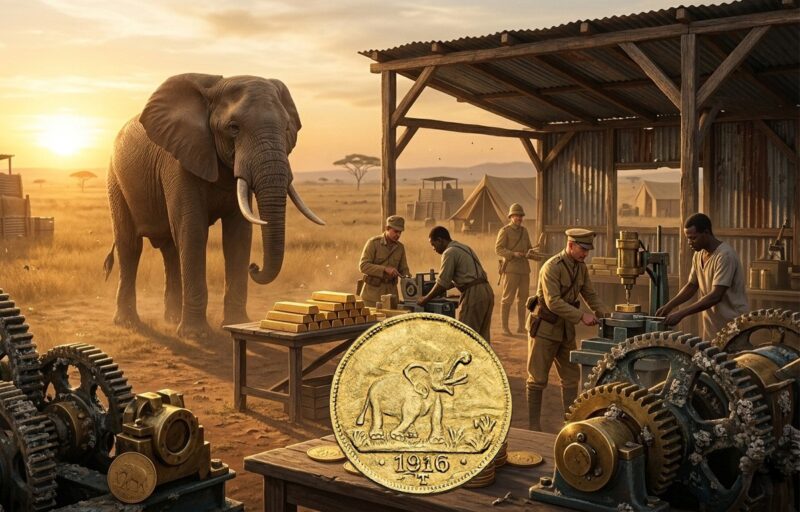
With a combination of engineering determination and local expertise, German engineers salvaged minting equipment from the wreck of a sunken warship, enlisting the help of local goldsmiths and a German mining encyclopedia. The gold was extracted from the nearby Kirunda mine and melted down to create one of the rarest pieces in monetary history.
15 Rupees: The elephant with the letter T
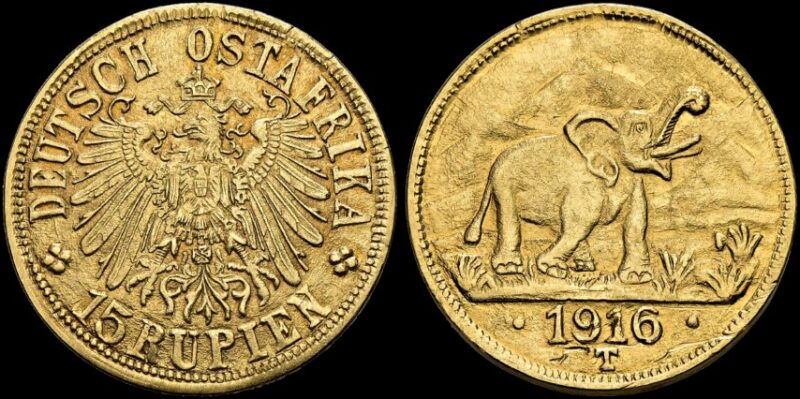
In 1916, a gold coin with a simple and unique design was introduced; on its face was engraved a majestic African elephant, and on its back was the emblem of the German Empire with a nominal value of 15 rupees.
What makes this coin historically unique is its bearing the letter “T,” a symbol not found on any other German coin, which refers to the temporary mint in Tabora. This piece stands as a testament to an era of struggle and innovation under siege.
Why is “15 Tabora Rupees” considered a treasure for collectors?
-
Mint mark (T): It is the only German currency in history to bear the letter T, a reference to the city of Tabora, as imperial coins were usually minted in Berlin (A) or Hamburg (J).
-
Primitive design: Due to being minted by manual and local means, the features of the “elephant” and the mountains in the background vary slightly from one piece to another, giving each piece a unique character.
-
Scarcity: Very limited quantities were minted (only about 16,000 pieces), and many were lost during the chaos at the end of the war, which makes their price today exceed thousands of dollars at international auctions.
For more similar topics, you can browse the Arab collector's website through the Link the next: