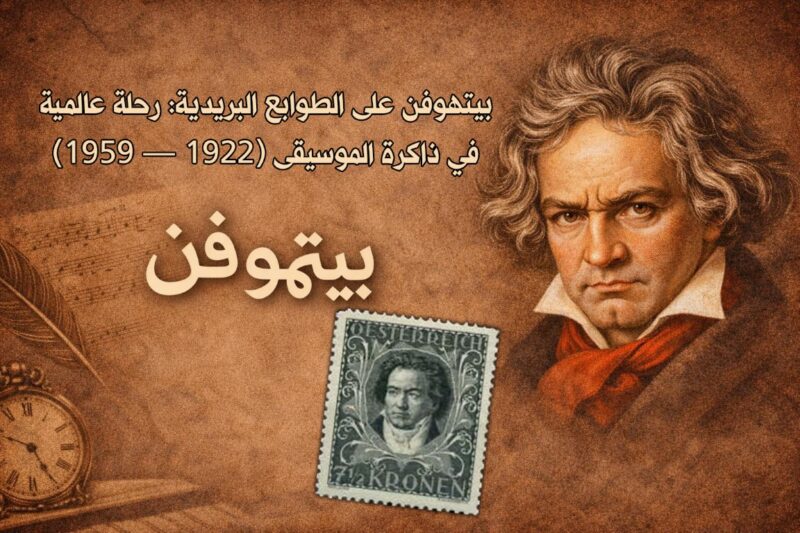
Beethoven on postage stamps: A global journey through the memory of music (1922 - 1959)
To commemorate the anniversary of the death of the world-renowned composer Ludwig van Beethoven, this study offers a philatelic analysis that seeks to document the enduring presence of this musical figure in the global postal memory. It traces his appearances on postage stamps over nearly a century, from the early 20th century to recent decades. This study not only lists the stamp issues associated with his name but also analyzes their historical and cultural contexts, interprets their visual dimensions, and understands their role in shaping Beethoven's image within the global collective consciousness.
Why is Beethoven on postage stamps?
It formed Ludwig van Beethoven One of the most prominent musical figures in human history, his works have transcended the boundaries of time and geography, becoming part of the world's cultural heritage. His influence was not limited to the musical realm alone, but extended to the fields of thought, art, and literature, where his name became synonymous with the values of creativity, freedom, perseverance, and triumph over challenges. Therefore, it is no surprise that postal administrations around the world have been keen to immortalize his image in their stamp programs, recognizing him as a global cultural icon deserving of a lasting presence in the visual memory of nations.
Since the beginning of the 20th century, postage stamps have become an effective means of honoring cultural and artistic figures, their small size transforming them into works of art conveying profound cultural messages. Stamps associated with Beethoven serve as a clear example of this cultural role, not only displaying his image but also presenting visual symbols reflecting his musical world, such as musical scores, instruments, scenes from his concerts, and depictions of places connected to his life, like the German city of Bonn and the concert halls where his works were performed.
A review of the Beethoven-related commemorative issues reveals a long historical trajectory reflecting the evolution of global cultural thought. These issues began within a limited geographical scope in Europe before gradually expanding to include countries across different continents, reflecting Beethoven's transformation from a European musical icon to a global cultural symbol. These issues also demonstrate a close connection to major historical events, particularly the centenaries of his birth and death, which marked significant milestones in the history of stamp issuance.
Methodology of the study and digital analysis
The importance of this study lies in the fact that it does not merely present the issues in a narrative manner, but rather adopts an analytical approach based on dividing the timeline of Beethoven’s presence into successive stages, beginning with the early foundational stage, passing through the stage of gradual spread, and reaching the major global peaks that witnessed the highest density of issues, especially in the years 1970 and 2020, which constituted two pivotal stations in the history of commemorating Beethoven on stamps.
This study also relies on a comprehensive numerical analysis of the issues to understand patterns of chronological recurrence, identify periods of peak philatelic activity, and track the geographical distribution of countries that issued stamps bearing Beethoven's image. This analysis reveals a total of 133 documented philatelic issues associated with him, a figure that clearly reflects his widespread presence in global postal culture.
This study, in its general structure, represents an attempt to read cultural history through a small but profoundly influential visual medium, where postage stamps are transformed into artistic and historical documents that preserve the memory of world music and reintroduce it to new generations in a symbolic form that carries meanings of creativity and continuity.
First axis: The early beginnings of Beethoven's appearance on postage stamps (1922 - 1959)
The appearance of Ludwig van Beethoven on postage stamps in the first half of the twentieth century represents an important foundational stage in the history of documenting cultural figures through postal media, as this early presence was linked to European efforts aimed at highlighting intellectual and artistic symbols as part of the cultural identity of modern states.
Austria and Germany: The cradle of stamp commemoration
The 1922 Austrian issue of the Austrian Composers – Charity Stamps series is one of the earliest examples of Beethoven's presence within a structured cultural context. His inclusion in this series came about during the reconstruction of Austria's cultural identity following the collapse of the Austro-Hungarian Empire, a time when there was a growing need to reaffirm cultural heritage as a unifying element that fostered national sentiment. Classical music, and especially the works of Beethoven, served as a symbol of cultural continuity and artistic excellence.
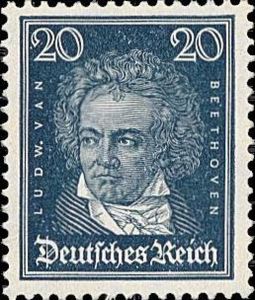
This early appearance was followed by several issues in Germany during the 1920s, most notably the 1926 issue in the Famous Germans series, which cemented Beethoven's place among the German figures considered national and cultural icons. This presence was further reinforced in 1927 by a special commemorative stamp issue for the International IAA Congress, reflecting the growing role of postage stamps as a promotional and cultural tool.
The 1950s transformation: expansion and international recognition
With the beginning of the 1950s, Beethoven’s presence on stamps witnessed a qualitative shift, as a stamp bearing his image was issued in 1951 in the Saar region, followed in 1952 by a number of issues in Berlin, the German Democratic Republic, and Czechoslovakia on the occasion of the International Music Festival, Prague, which reflects Beethoven’s transformation into a musical icon that transcends political boundaries.
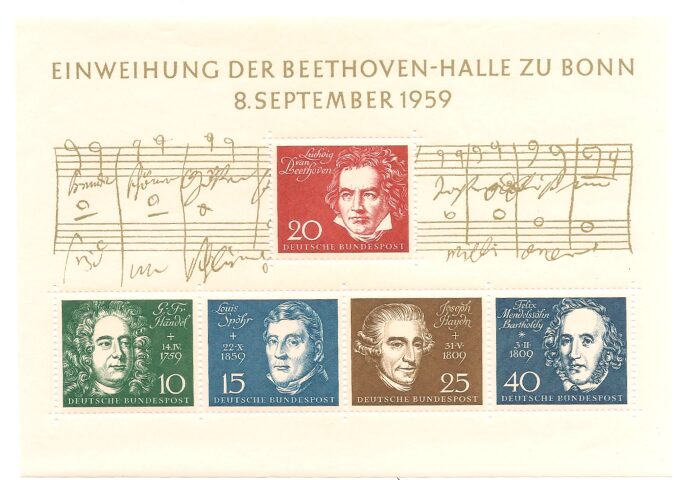
This phase concluded with the 1959 publication in Germany on the occasion of the Consecration of the Beethoven Hall in Bonn, a major cultural event associated with the city of Bonn, Beethoven’s birthplace, reflecting the relationship between cultural architecture and musical memory.
For more similar topics, you can browse the Arab collector's website through the Link the next





 EN
EN  AR
AR