
Beethoven on postage stamps: Continuity and visual modernization (1971-2016)
The period between 1960 and 1969 represents a particularly significant transitional phase in the history of Ludwig van Beethoven's presence on postage stamps. This period witnessed a gradual shift from the almost exclusively European character of the preceding formative phase to a more geographically and culturally diverse presence, with countries outside the traditional European sphere beginning to issue stamps bearing his image or related to his musical legacy. This phase can be seen as a direct prelude to the great global peak that would culminate in 1970 on the bicentenary of his birth.
Second axis: The stage of gradual spread (1960 - 1969)
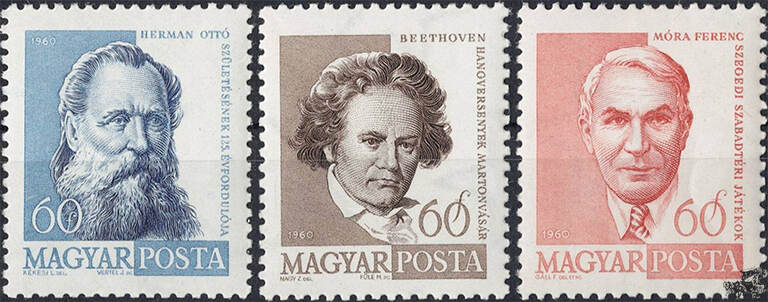
The year 1960 saw one of the most significant stamp issues, as Hungary released a stamp commemorating several cultural events, including Beethoven's concerts in Mártonvásár, a city historically linked to Beethoven's residence and his relationships with aristocratic figures who supported classical music. This geographical connection is a prime example of how postage stamps evolved from simply honoring individuals to documenting locations connected to the history of music.
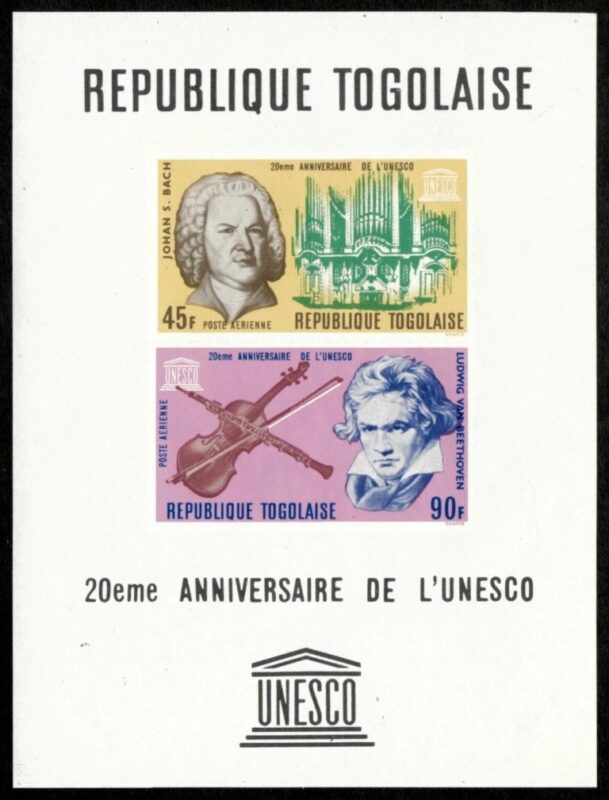
This period also witnessed the entry of international cultural institutions into the field of documenting musical figures, with UNESCO playing a prominent role in supporting cultural programs aimed at promoting intercultural dialogue through art and music. The 1967 Togo edition, commemorating the twentieth anniversary of UNESCO's founding, is a clear example of this trend, featuring a collection of international musical figures, including Beethoven, within a cultural vision that affirms the universality of artistic heritage.
Geographically, this period marked the beginning of a wider range of countries issuing Beethoven-related stamps. His image was no longer confined to Europe but began appearing in countries beyond its traditional sphere, reflecting his gradual transformation from a regional cultural symbol to a global icon. Visually, this period saw the emergence of new design elements, such as the integration of musical symbols within artistic backgrounds and a more varied use of color compared to previous issues. This artistic evolution paved the way for a more intense and distinctive phase of stamp issuance, culminating in 1970.
Third axis: The first great global peak (1970)
200th anniversary of Ludwig van Beethoven's birth
The year 1970 marked a significant milestone in Beethoven's presence on postage stamps, as the bicentenary celebration of his birth became a global cultural event involving numerous countries in one of the most extensive stamp campaigns of the 20th century. This event was not merely a musical occasion, but rather a global cultural project reflecting Beethoven's status as a universal icon of artistic creativity.
The available data indicates that a large number of countries issued commemorative stamps for the occasion, with issues appearing in Europe, Asia, Africa, and the Americas, reflecting Beethoven's global reach. Among the most prominent countries participating in this commemoration were Austria, Germany, Bulgaria, Romania, Hungary, Greece, India, Mexico, Monaco, and the Soviet Union, in addition to several African countries such as Niger, Senegal, Cameroon, and Dahomey. Issues also appeared in the Arabian Gulf region, including Sharjah.
This wide geographical distribution clearly demonstrates that Beethoven is no longer merely a European musical figure, but has become a global icon of classical art. Most of these releases bear a unified title commemorating the 200th anniversary of Ludwig van Beethoven's birth (1770–1827), reflecting a shared global cultural awareness of the significance of this occasion.
Visual evolution and cultural message of 1970
The 1970 issues were distinguished by a wide variety of artistic styles. Most designs were based on classical portraits inspired by famous historical paintings, and various musical elements such as musical notes and clefs also appeared, sometimes including scenes inspired by his own works. Some issues were also included in the airmail category, conveying the cultural message to a broad international audience, indicating that the stamp served as a cultural tool for disseminating artistic symbols across borders.

The year 1970 can be considered a rare global cultural moment, as multiple countries converged to honor a single figure simultaneously, thus cementing Beethoven's image in the global visual memory. This year marked the first peak, which would be repeated later in 2020, confirming that major centenaries are the primary drivers of stamp production.
Part one of the article Beethoven on postage stamps
Beethoven on postage stamps: A global journey through the memory of music (1922 - 1959)





 EN
EN  AR
AR