Khedive Tawfiq and the reform of the Egyptian currency in 1885
The reform of the Egyptian currency in 1885 was a landmark in the history of Egypt.
Khedive Tawfiq, financial collapse, war
Internal conditions in Egypt deteriorated after Khedive Tawfiq assumed power. Financial problems were the root cause of Egypt's decline and the primary reason for foreign intervention. For any effective control over Egyptian affairs, the first and most crucial step was to tighten the grip of the financial administration. Khedive Tawfiq's reign witnessed the return of the dual control system of the British and French financial departments, and the economic situation worsened as a result of allocating funds to repay debts to foreigners.
The British and French observers began to carry out a reform that extended beyond their direct tasks. Although the origin of this reform was due to the reasons of “financial collapse in Egypt,” the absolute truth was to penetrate deeply into the internal administration of the country and tighten control over regional officials. This resulted in the outbreak of the Urabi Revolution on September 9, 1881. Khedive Tawfiq sought the help of the British to support his position against Ahmed Urabi, and a British-French fleet arrived in Alexandria to demand that the Egyptian government change its policies.
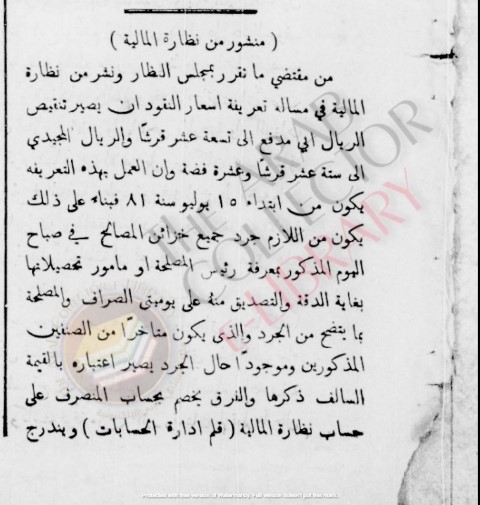
During that period, the standard of the Egyptian currency was measured in both gold and silver. However, with the decline in the value of silver globally, the value of silver coins, whether Egyptian or foreign, also declined. Egypt reduced the price of the tariff for both the Majidi Riyal and the Abu Madfa’ Riyal. The counterfeiting of silver currency spread in both Egypt and other parts of the Ottoman state. Therefore, news emerged in August 1881 about the Egyptian government’s intention to mint a quantity of new piastres to maintain the value of the current currency and to combat counterfeiting.
And that it had authorized the French government to mint those coins, and the Egyptian government sent a delegate (Monsieur Morizot) to Paris to begin minting Egyptian coins. He traveled on the evening of September 28, 1881, for 25 days. The Ministry of Finance collected for the Egyptian mint an amount of 10,000 Egyptian pounds of piastres that it had collected from circulation in order to send them to Paris in the new style, in addition to silver ingots worth 200,000 pounds, as it was planned that those pieces would be minted with a greater thickness than the amount that was in circulation and less in the country.
In the summer of 1882, political events unfolded rapidly, and the British and French fleets appeared in the waters off Alexandria. These ships were seen as an opportunity for England and France to intervene, and Egypt witnessed a war with Britain that ended with the defeat of the Egyptian army, led by Ahmed Orabi, at the Battle of Tell El Kebir. This resulted in Britain imposing its control over Egypt and strengthening the position of Khedive Tawfiq.
Therefore, although the Egyptian government under dual control had already begun in 1881 to reform the Egyptian currency and money through a special committee headed by Mustafa Fahmi, the committee’s work was disrupted as a result of the Urabi Revolution and it was dissolved.
The currency circulating in the Egyptian market and the chaos surrounding coins
The unit of account for Egyptian currency in Egypt at that time was the piastre, with the gold pound comprising 100 piastres. Foreign currencies were exchanged for their value in piastres, and this value was determined by market fluctuations. Although both gold and silver were considered legal tender, in reality, very little silver was used except for small change. The government attempted several times over the years to enforce the circulation of silver by paying a certain percentage of silver coins to its officials and creditors. However, these attempts were unsuccessful.
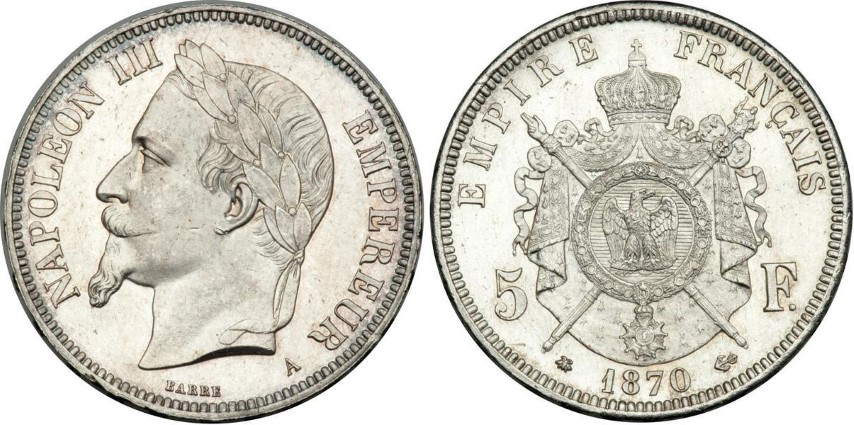
Due to the high demand for gold coins in Egypt, the British pound came to dominate the country's gold currency circulation, reaching a value almost equal to that of Egyptian gold pounds throughout the country. There was also a significant amount of French gold (bearing the image of Napoleon III) in circulation, but far less than British or Egyptian coins, and gold coins from other countries, though these were not frequently seen.
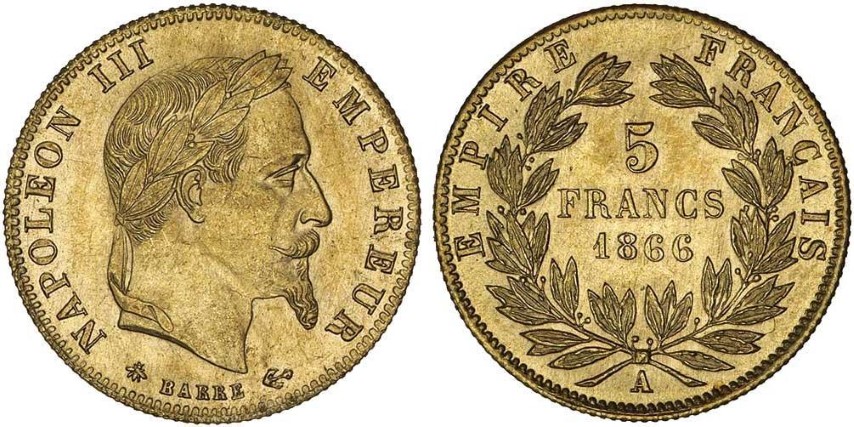
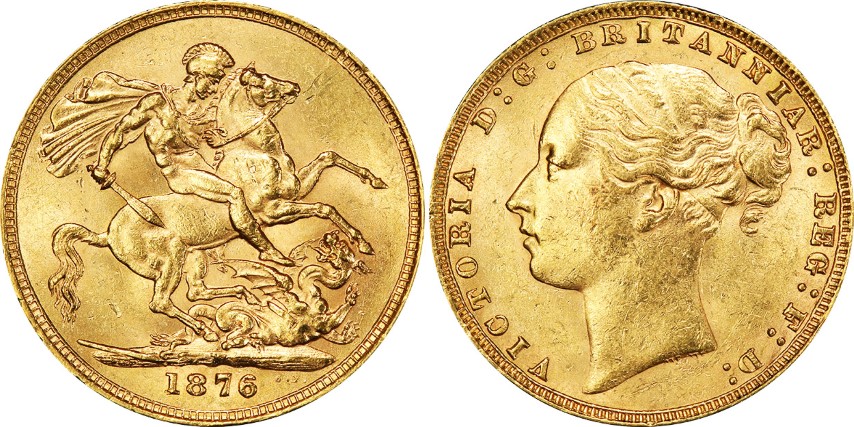
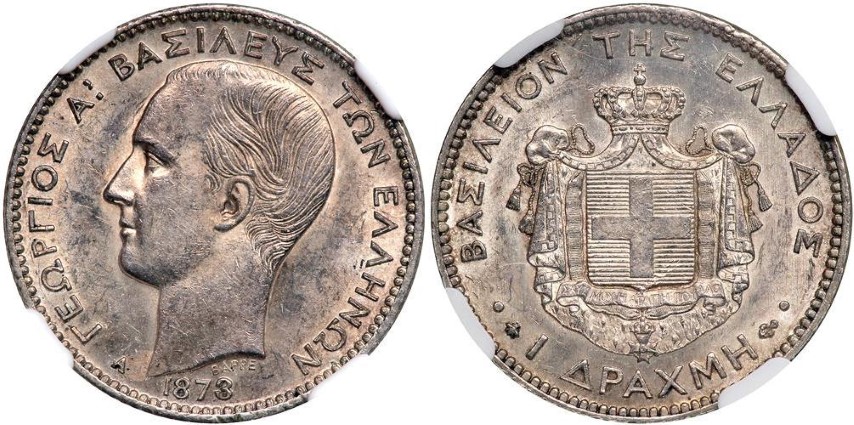
On the other hand, the range of silver coins in Egypt expanded, and many individuals resorted to using other metal coins for trading in the markets due to the general decrease in the value of silver coins in the Egyptian market. Silver francs, 2 francs, and 5 francs from France, Italy, and Greece were used to some extent for small transactions (change).
Observers and Financial Advisor
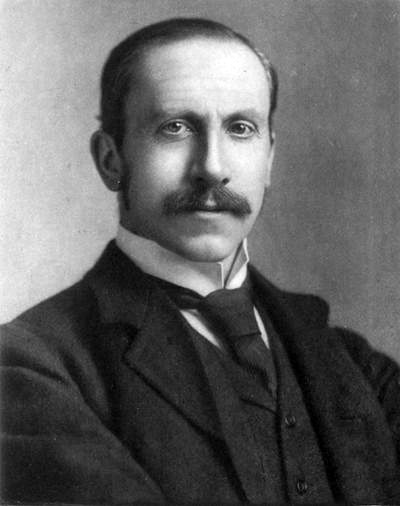
Lord Alfred Milner – Director of the British Colonies and Secretary of the Finance Office in Egypt – stated in his book ”England in Egypt”England in Egypt”A chapter on monetary reform in Egypt, which I recount in the following book:
“The comptrollers began adjusting the country’s budget; they were on the fast track to governing the country. But control failed due to a lack of material power behind it. England and France could not agree on the means to be employed. So France withdrew from the operation, leaving England alone to re-establish European control over Egypt’s finances. Having re-established it on its own, England naturally claimed to administer it alone. No one could dispute the fairness of this claim, even if there were no other excellent arguments for replacing the unilateral action of one power with the constant friction between two [jealous rivals]. In fact, France only protested, and not strongly, and at the end of 1882, England urged the Egyptian government to abolish the comptrollers and replace them with a single “financial advisor,” who, under these circumstances, was naturally English.”
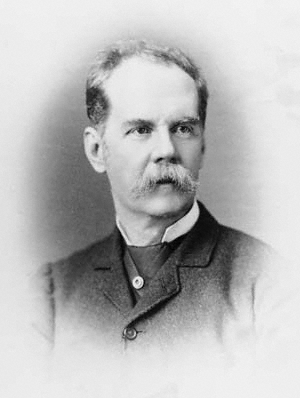
The financial advisor was the cornerstone of British influence within the Egyptian administration. His functions were gradually defined, and he quickly acquired widely recognized and very broad authority. Initially, it was agreed that he was not an executive officer, but on the other hand, all executive officers were obligated to provide him with any information he might request. Later, when some discussion arose regarding the degree of attention given to the financial advisor's recommendations, the British government clarified that "no financial decision should be taken without his approval," an explanation that was never open to debate with the Egyptian government. However, given that the most important government actions involved some financial matters, the position of the man with veto power over any financial measure was practically that of someone with veto power over everything; and the man with veto power over everything was the master of the situation.
Sir Auckland Colvin was the first occupant of the Office of the Financial Adviser, having previously been one of the Comptrollers. He held this position for one year, and when Lord Cromer became British Agent in Egypt, Colvin succeeded him as a Financial Member of the Viceroyal Council in India in August 1883.
Currency counterfeiting in Egypt continued to increase during that period, and not a day would pass without the discovery of a case of counterfeit currency. Campaigns were launched by the police to raid money changers' shops, and the situation deteriorated further. Based on these repeated cases of fraud, Khedive Tawfiq issued a declaration to organize the national courts on June 14, 1883.
Edgar Vincent
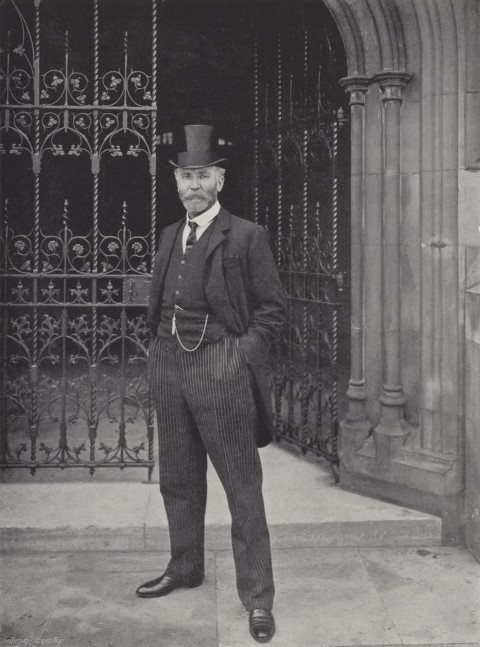
Sir Auckland Colvin was succeeded in his post by Sir Edgar Vincent, only twenty-six years old at the time of his appointment in November 1883. Vincent was not only a strong man, but also a man of strong leadership qualities, always encouraged by success, which drove him to play the game forward with unwavering determination. He needed all his qualities, for the task before him was extremely difficult. If Egypt was to improve permanently, Vincent was never deterred by any fear of unpopularity in his conviction that finances took precedence over all other considerations. Fortunately for the financial advisor, he possessed a charm and tact that mitigated, as much as possible, the inevitable harshness of such policies.
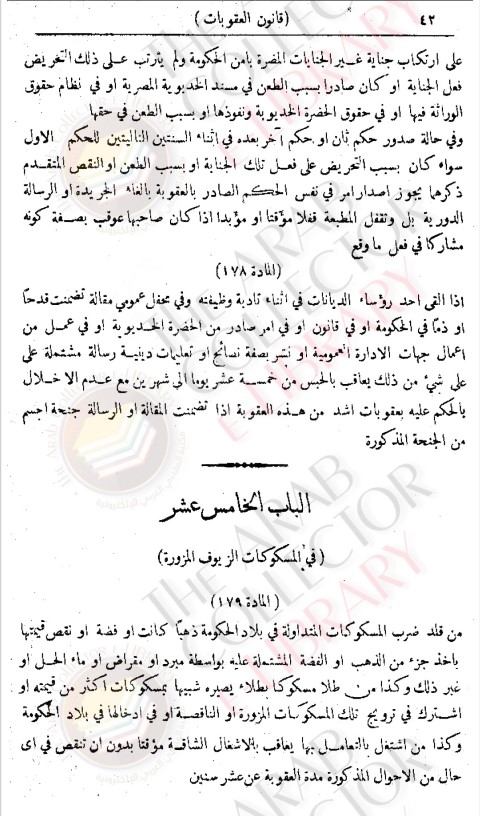
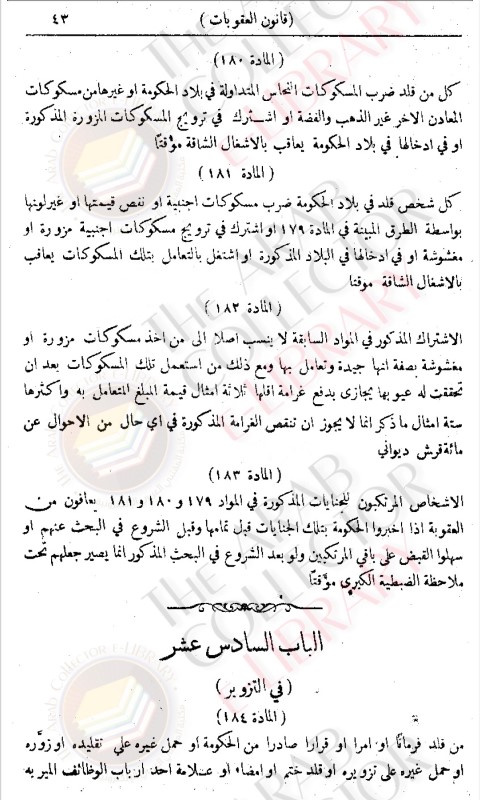
Lord Milner stated in his book that Vincent was one of the men who bore the brunt of those early days of stress and who deserved the principal credit for the eventual, unexpected success of the unpromising English experiment in civil government in Egypt. Vincent persuaded Khedive Tawfiq to include a separate section on counterfeit coins and forgeries (Chapter Fifteen) in the Egyptian Penal Code, which was promulgated on November 13, 1883. It included several articles criminalizing the counterfeiting of currency.
Meanwhile, Vincent armed himself with a formidable tool for checking for arbitrary spending, by means of the Finance Commission. This commission, which came into being as early as 1884, consisted of the Minister of Finance, two Englishmen (Vincent and Sir Gerald FitzGerald); one Austrian, Blum Pasha, who was at that time Undersecretary of State for Foreign Affairs; and one Frenchman (Monsieur Mazoc).
Sudan war and chaotic situation
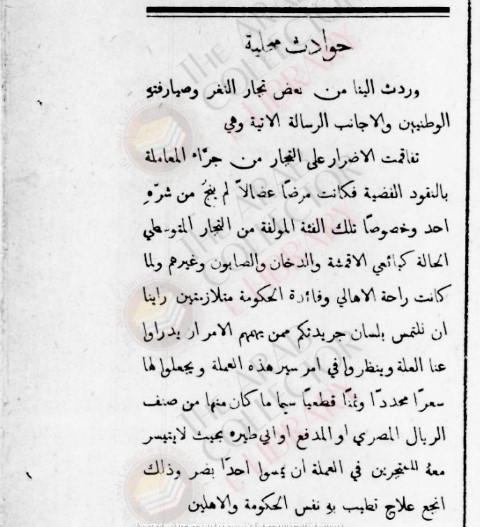
While Egypt operated under a bimetallic system, as outlined in the High Order of 1883, a rapid decline in silver prices was observed in 1884 and 1885, as both Egypt and Sudan became preoccupied with their wars in Sudan starting in early 1884 (see the relevant article). Money for the siege of KhartoumThis hindered the progress of monetary reform, and a fundamental difference of opinion emerged between Vincent and Nubar Pasha regarding the main question of fiscal policy that Egypt was facing at that time.
On the other hand, the British government granted Egypt a loan of £5 million to improve its financial situation and avert bankruptcy. Egypt was also allowed a slight reduction in interest rates on its debt for two years, but if it failed to resume full repayment by the end of that period, another international committee would be formed. With the end of the war in Sudan, the damage to traders in the markets worsened, as the price of silver coins fluctuated significantly.
The deterioration of the currency in Egypt continued, bond prices and public debt rose, and the Egyptian currency witnessed a greater decline in the value of the coin, which opened the way further for the dominance of the British pound and other foreign currencies. Thus, Egypt became in dire need of finding an Egyptian monetary system based on a monetary unit with the minting of auxiliary coins to replace foreign currencies.
Unifying cash transactions
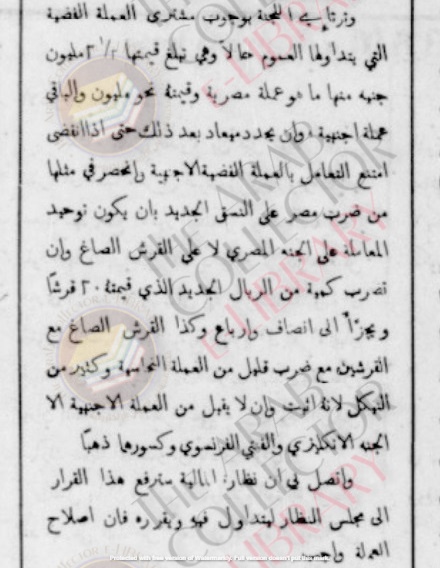
A committee was reconstituted by the government to examine the types of Egyptian currency in circulation on August 7, 1884. The committee consisted of the British financial advisor (Edgar Vincent) and the membership of Qadi Effendi, Sheikh al-Islam, Undersecretary of Finance, Supervisor of the Mint, Undersecretary of the General Administration of Customs, and Director of the Credit Bank in Alexandria.
The committee sought the assistance of the directors of the mints in London, Paris, Vienna and Germany, and finally, after a year of research, in August 1885, the committee submitted its report to the Minister of Finance, Nubar Pasha. The report showed a count of all the denominations of Egyptian silver currency in circulation in Egypt from the era of Muhammad Ali Pasha until that time. It appeared that the value of the Parisian riyal that was minted was about 52 million piastres, the value of the Egyptian riyal that was minted was about 7 million, and the value of the piastre that was minted was about 40 million.
The committee proposed converting the Egyptian monetary system to a single gold metal instead of silver and gold together, and minting new coins in a new style and design. It also stated that the purchaser of the silver coin currently in circulation, which amounts to 2.5 million pounds, of which about 2 million is Egyptian currency and the rest is foreign currency, must set a date after which dealings with foreign silver will cease and be limited to the same amount minted in Egypt in the new style, and that the unification of the Egyptian currency should be based on the Egyptian pound and not on the piaster.
A quantity of the new riyal, valued at 20 piasters, should be minted, and halves and quarters of it should be accepted, as well as the single piaster and the two piasters. A small quantity of copper coins and a large quantity of nickel should also be minted, as nickel is more reliable. Only the British pound and the French fennii, and their fractions, should be accepted as foreign currency.
Egypt's new currency and crucial financial decisions
The Ministry of Finance and the Council of Ministers approved the proposal of the Finance Committee and it was submitted to Khedive Tawfiq for his approval. On November 13, 1885, Khedive Tawfiq issued an order to add an official ten-tenths of a piaster coin of nickel to the Egyptian currency.
On November 16, 1885, the Khedive and the Ministry of Finance announced in the official newspapers a high order (Decree of November 14, 1885The decision of Khedive Tawfiq is considered one of the most important Egyptian monetary decisions in the modern era, by amending the Egyptian Monetary Law to make the Egyptian currency unit the Egyptian pound, which is divided into one hundred piasters, and the piaster is divided into ten tenths. This matter consisted of 19 articles that included mentioning the official Egyptian currencies for gold, silver, nickel, and bronze, with the precise determination of the weights and purity of each of the silver and gold coins.
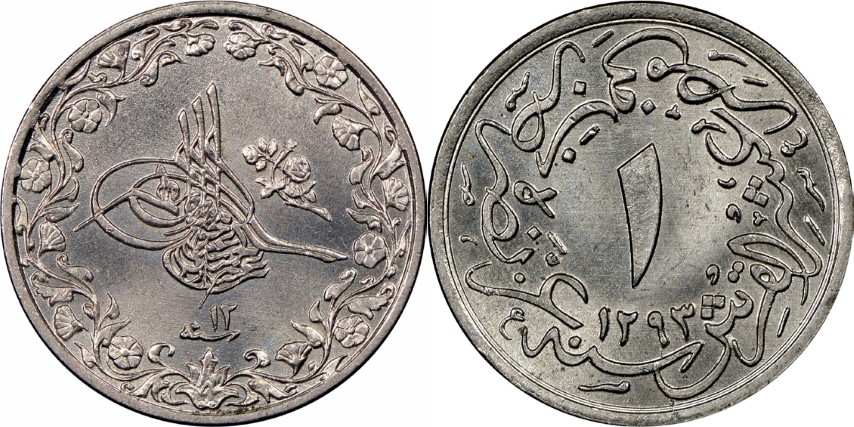
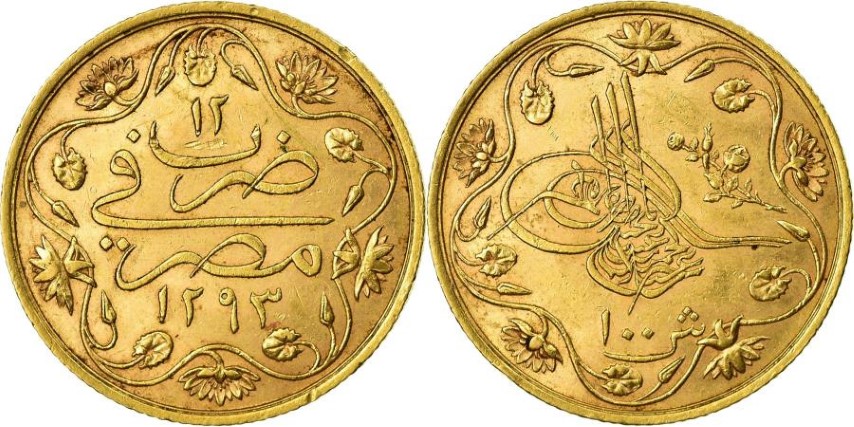
It was decided that the Sultan’s monogram, the year of the Sultan’s accession, the years that had passed since his accession, the phrase “struck in Egypt,” and the value of the piece should be engraved on all types of Egyptian currency. It was also decided to regulate the quantities of Egyptian silver coins so that most of them do not exceed forty piasters per person, and that the nickel and bronze coins issued should not mostly exceed eight piasters per person.
The use of the former Egyptian silver coins was made available and accepted according to an official tariff set by the government and according to prescribed percentages. A final date was set within one year for withdrawing those coins from official circulation, and it was authorized to exchange them for gold in special funds.
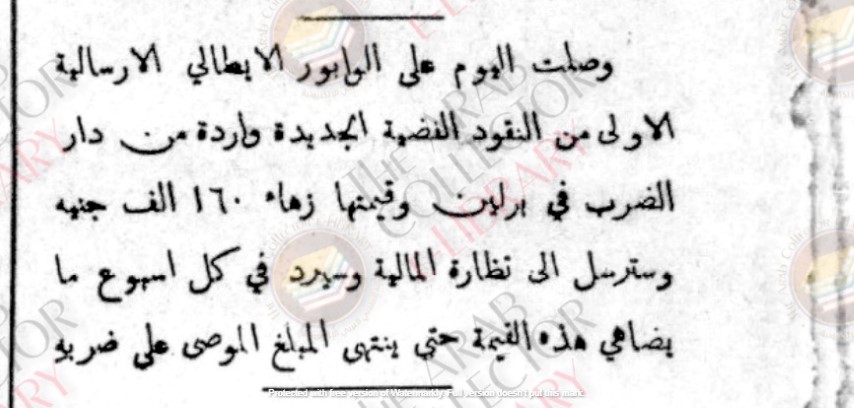
The new silver coins were struck at the mint in Berlin, and the first batches of those coins began to arrive on March 2, 1886, amounting to the equivalent of 160,000 pounds. They arrived in 103 boxes with the Italian steamer “India” at the port of Alexandria, carrying part of the new Egyptian currency denominations of the riyal. Customs kept 33 boxes and sent the rest to the Ministry of Finance in Cairo.
The new currency was put into circulation the following day, March 3, 1886. Then, on May 28, 1886, 105 boxes of Egyptian currency, equivalent to 66,000 Egyptian pounds, arrived. These boxes consisted of riyals, half riyals, quarter riyals, and coins of two and one piastre. On June 18, 1886, another 110 boxes of the new Egyptian currency arrived, consisting of 4-para, 8-para, and 20-para nickel coins.
Note: Further details regarding the minted coins will be mentioned in issue number 20 of Al-Muqtani Al-Arabi.
The mint and the completion of monetary reform
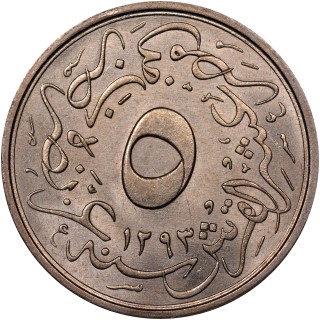
With the beginning of Ramadan in the year 1303 AH (June 1886), the arrival of small Egyptian currency pieces was delayed, as there were not enough two-piaster and one-piaster coins. The urgent need for small change coins in transactions began, so the public began talking about finding a way to provide them until the matter attracted the attention of the Ministry of Finance, which decided to open the mint on Thursday, June 24, 1886, to mint the new coins of one-piaster and two-piaster coins (according to Al-Ahram newspaper, issue 2550).
On August 2, 1886, the Council of Ministers issued a decision to abolish the ten-para and twenty-para pieces of Egyptian silver currency and replace them with the new silver and gold currency (this decision was later extended until July 21, 1887), and to reduce the value of the English shilling and the French franc as of June 1, 1887. In order to promote the new silver currency, gold coins were exchanged for the new silver coins for merchants and farmers.
On February 18, 1887, the government decided to mint twenty thousand kilograms of nickel in five-tenths of a piaster coin. Although the decision to add a ten-tenths of a piaster coin to the Egyptian Currency Act was made in 1885, the decision was implemented on November 15, 1887, as the Ministry of Finance relied on the existence of piaster coins made of silver, but they were not sufficient.
Vincent's Departure
 During Vincent's six years in office, he planted the seeds of monetary reform, which bore fruit and grew considerably. It was Vincent who proposed reforming the Egyptian monetary system, replacing the chaotic system of coins of all metals and from all countries circulating in Egypt with a simple and convenient currency. This system had caused much confusion and posed a significant obstacle to trade.
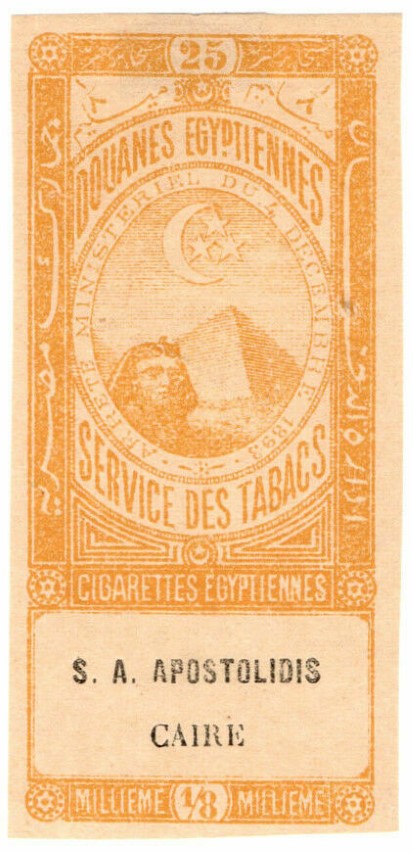
Vincent was the first to begin improving Egypt’s revenues by imposing duties on tobacco and by negotiating a trade treaty with Greece. Despite disagreements between him and Nubar Pasha, the Minister of Finance at the time, Vincent will always be remembered as the most talented and one of the most active men who saved Egypt’s financial resources.
Vincent believed this could be avoided, that Egypt, on a new basis, was capable of paying its debts, and doing so not just for a few years, but indefinitely. At the time, Egypt was still reeling from the cumulative effects of a series of disasters—the rebellion, the destruction of Alexandria, the cholera epidemic, and the loss of Sudan. But he believed that Egypt could endure even great hardship, at that time, to achieve the greater goal of a permanent solution to its financial problem. And so Vincent set about acting decisively, successfully establishing one of the most rigid economic systems in Egypt, enabling the full resumption of interest payments.
Sir Edgar Vincent left Egypt in the summer of 1889 on the orders of the British Colonial Director to go to India. He was succeeded by Sir Alwyn Palmer, who became the first governor of the National Bank of Egypt. Had Vincent not betrayed his post, we might have witnessed him sign the first Egyptian banknote.
Resources
England in Egypt England in Egypt Lord Alfred Milner – Director of the British Colonies and Secretary of the Finance Office in Egypt.
Various issues of the Egyptian newspaper Al-Ahram
Arab monetary legislation – Egypt – Arab collector
Annual report of the Director of the Mint
The Annual Report the deputy master of the Mint
The British National Archives
Arab currency: its past and present – Dr. Abdul Rahman Fahmy Muhammad (February 15, 1964)
Money – Hussein Abdulrahman