Money for the siege of Khartoum
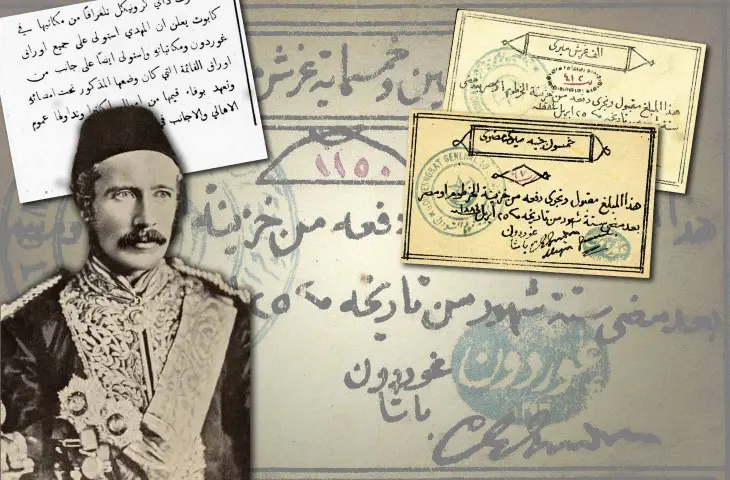
You may have wondered about those banknotes issued and called the "Khartoum Siege Money" during the British campaign in Sudan. Let's take a trip down memory lane to discover the story and truth behind those banknotes.
A historical overview of the siege of Khartoum
In the late 19th century, the British Empire stretched across the globe. It became known as the empire on which the sun never sets, and to maintain control over this vast empire, the British Crown was in a state of near-constant war, frequently sending troops abroad to suppress uprisings and protect English possessions.
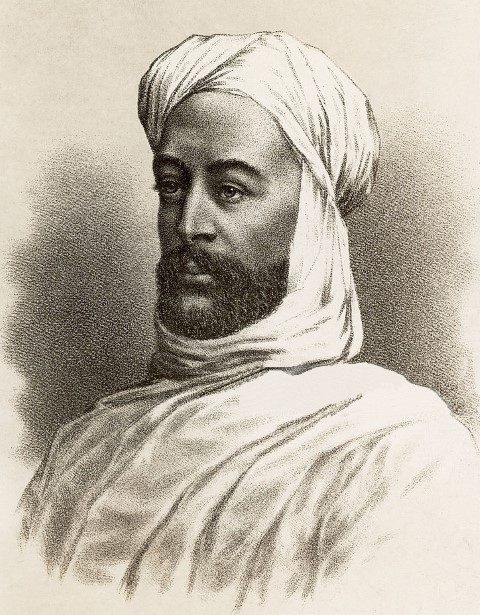
In 1882, the British launched a military campaign in Africa against Egypt (which at that time included Sudan), a de facto British protectorate. Before England could subdue Egypt, a revolution broke out in Sudan. The Sudanese people, many of whom longed for independence, found a leader in Muhammad Ahmad, who had proclaimed himself the "awaited Mahdi" in 1881 and claimed to be the savior of the Muslim nation. He enjoyed the support of many in Sudan who desired independence from their Egyptian rulers. By 1883, Muhammad Ahmad led a revolutionary force known as the Mahdi, which was able to defeat the Egyptian army and seize a vast amount of weapons and territory in Sudan.
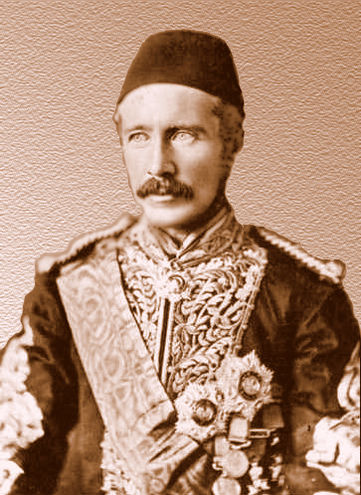
The Mahdist Revolution put Sudan at the center of the attention of the British government and people, especially Prime Minister William Gladstone and War Secretary Lord Hartington, who had no desire to intervene in Sudan and persuaded the Egyptian government to evacuate all its garrisons from Sudan and establish a self-governing state in northern Sudan, leaving the Mahdists to their own devices. Instead of sending an anti-interventionist, Gladstone and Hartington were pressured by the British public, the press, and even Queen Victoria to send one of the war hawks: General Charles Gordon.
Despite the stated purpose of organizing the evacuation, Gordon's ideas about Sudan differed radically from Gladstone's: he believed that the Mahdist revolution had to be defeated, or that he might win control of all of Sudan, and from there invade Egypt. Nevertheless, Gordon pledged to carry out the evacuation from Sudan; he had been given £100,000 and a promise from the British and Egyptian authorities of "the full support and cooperation of their respective authorities.".
Beginning of the siege
Gordon departed for Sudan on January 18, 1884, and arrived in Khartoum on February 18, 1884. However, instead of organizing the evacuation of the military garrisons, he set about administering the city. And instead of making evacuation his top priority, Gordon focused on building an army to defeat the Mahdi. Determined to "crush the Mahdi," Gordon requested a regiment of Turkish soldiers to be sent to Khartoum, as Egypt was still nominally a province of the Ottoman Empire. .
When this was refused, Gordon requested a unit of Indian Muslim troops and later 200 British soldiers to reinforce Khartoum's defenses. Gladstone's government rejected all these proposals, as Britain remained committed to its evacuation and categorically refused to be pressured into military intervention in Sudan.
By early April 1884, tribes north of Khartoum had risen up in support of the Mahdi, cutting off Egyptian traffic on the Nile and telegraph lines to Cairo. He quickly realized he could not muster a force large enough to defeat the rebellion, so he withdrew to Khartoum and decided to reinforce its defenses. Communications were not completely severed, as riders could still cross, but the siege had begun. Khartoum could only rely on its own food stores, which could last five or six months.
Economic activity within the siege
Later in April, General Gordon issued a series of banknotes in the form of bonds payable six months after issue to keep the local economy functioning. In a letter dated April 26, he explained that he had issued £2,500 notes redeemable within six months from the treasury in Khartoum or Egypt to pay the garrison. The British administration of Sudan printed various denominations of banknotes during the siege of Khartoum, ranging from 1 piaster to 5,000 piasters, in addition to a fifty-pound note.
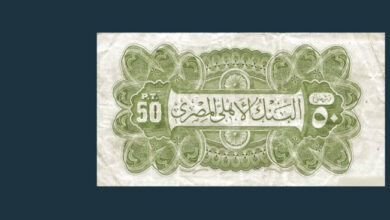
The one-piaster note (not shown in the current collection) is the rarest of all denominations and is not even mentioned in some major reference texts. Furthermore, its value is estimated to be about 50% greater than another banknote (the 50 Egyptian pound note), of which only 12 are estimated to exist. These banknotes were initially introduced as an economic relief measure and to stimulate trade, but their circulation began to decline by July. However, other estimates suggest that the number of notes printed ranges from 25,000 to 50,000 Egyptian pounds.
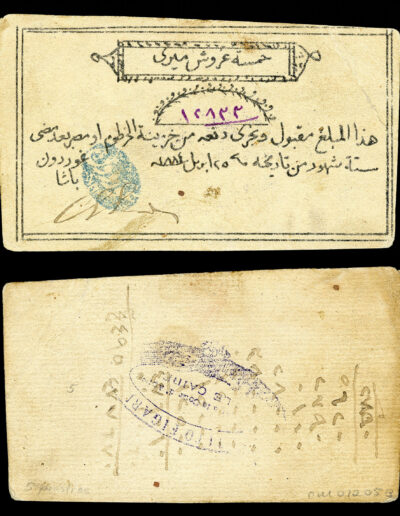
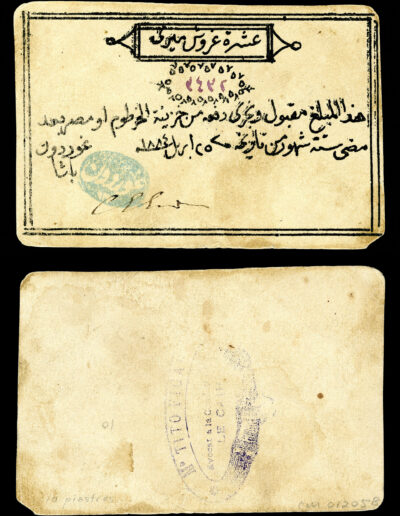
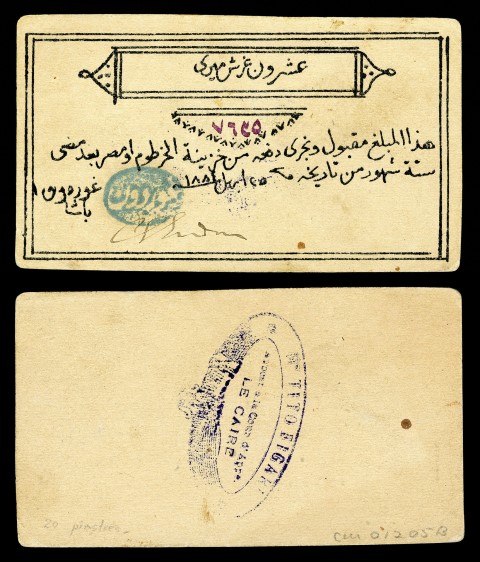
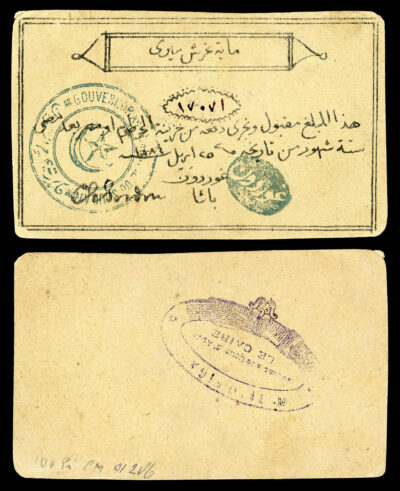
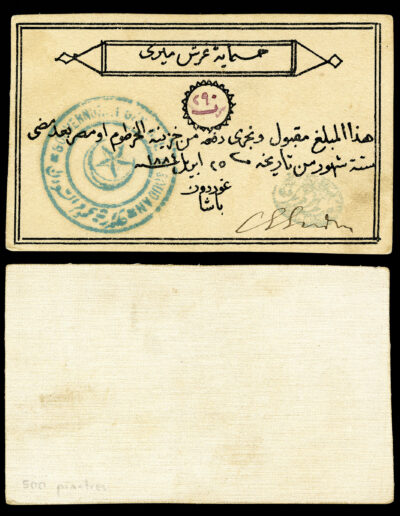
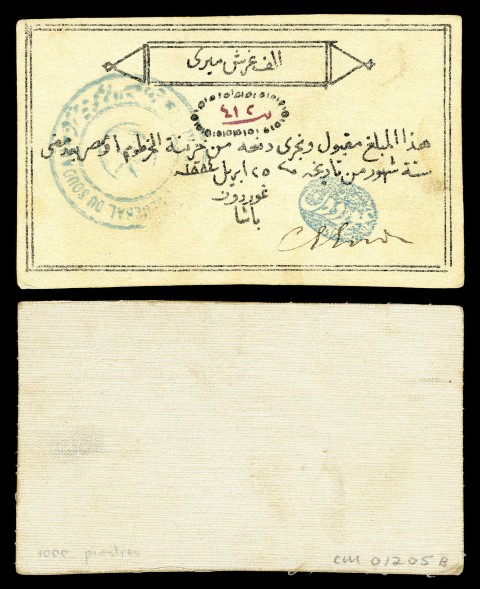
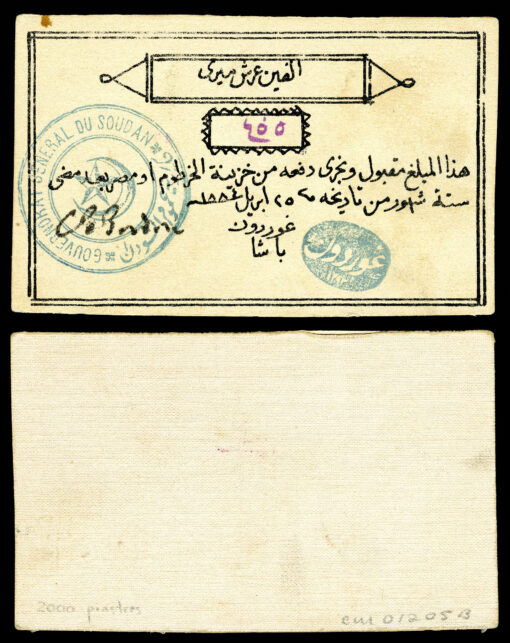
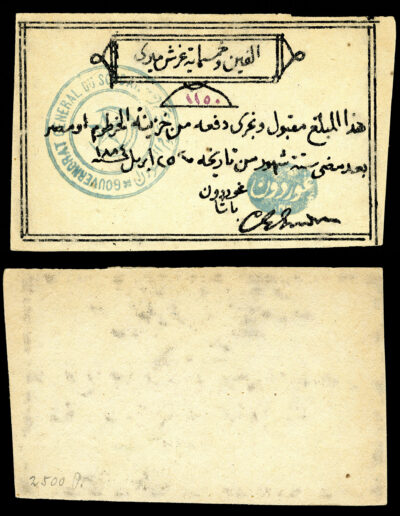
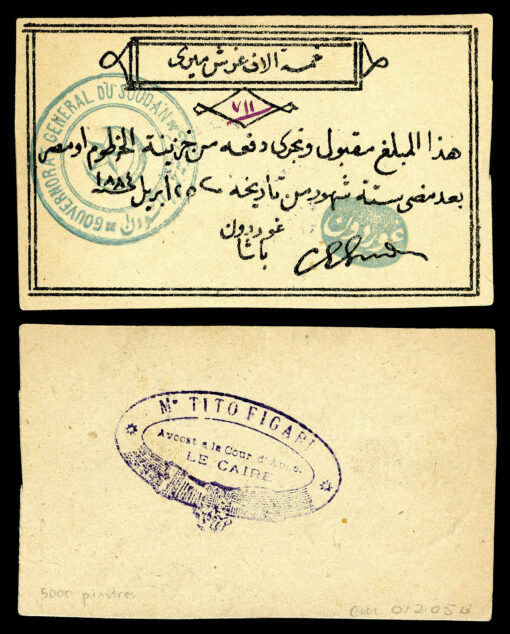
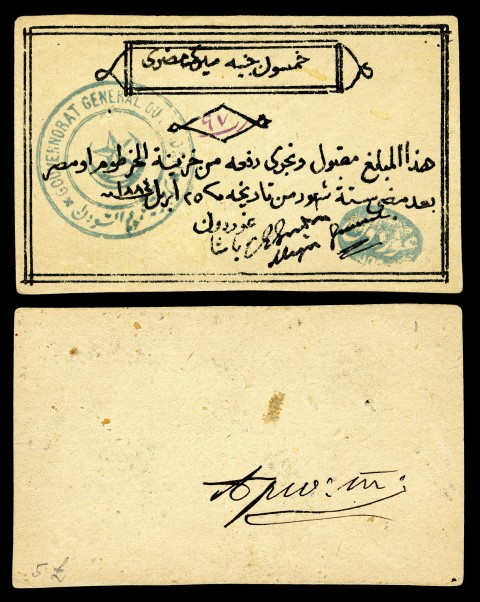
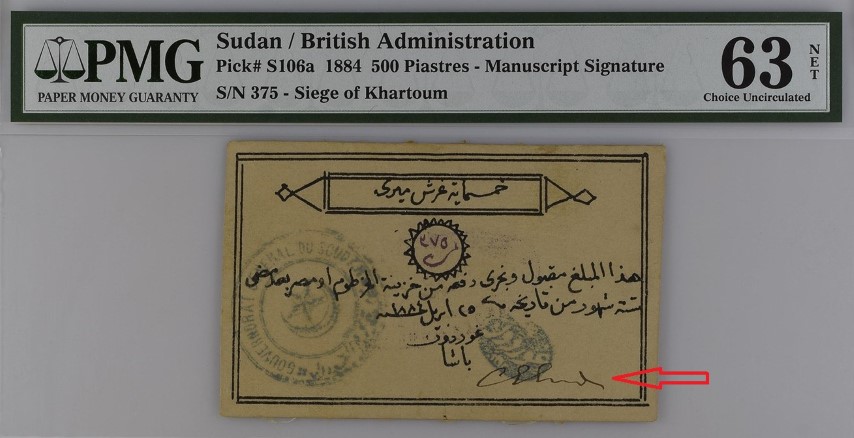
Engineer Magdy Hanafi explained in writing the Egyptian banknote that all these papers were written by hand by a calligrapher named ”Fadel” and the following formula was written on them:
”This amount is acceptable and we will make a payment from the treasury of Khartoum or Egypt six months after this date, April 25, 1884.”
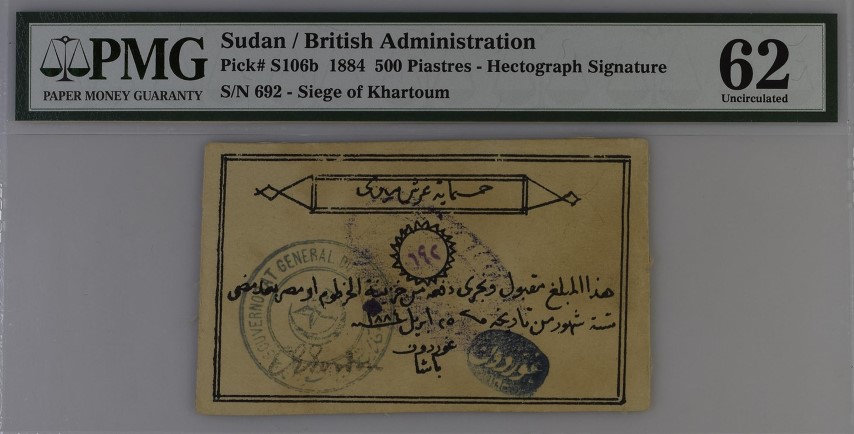
These papers were made of linen fibers, thicker than current banknotes, and were written on one side with Chinese ink. Most of them bear the seal of Gordon Pasha and the seal of the General Government of Sudan in French and Arabic (Soudan du general Government).
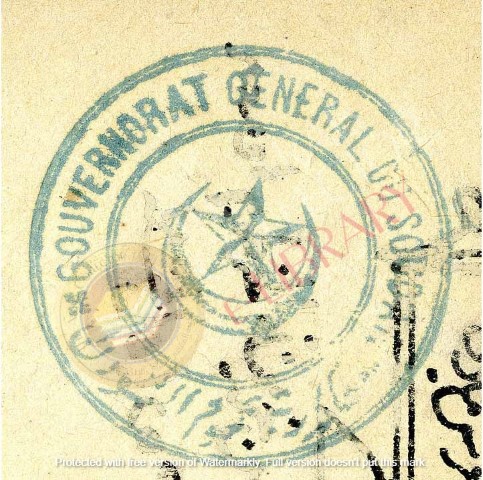
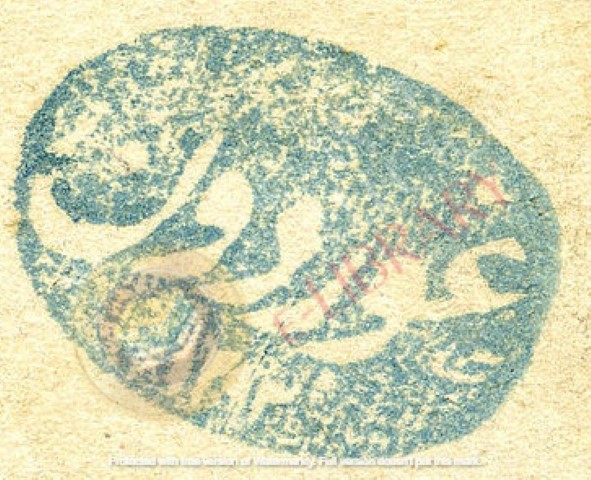
The dimensions of the pieces were standardized for all categories, which is 107 x 63 mm. In order to create a distinctive system of differentiation between categories during trading, the serial numbers of the currency were placed inside different shapes and drawings to clarify the difference between each category.
5 – The half-moon design points upwards
10- An oval design consisting of circles and angles in the center
20 – Half-moon design facing downwards
100 – A longer oval design with a wavy line and points in the center
500 – Toothed circle in the center
1000 – A more balanced oval design with circles and lines in the center
2000 – Rectangle with a toothed design in the center
2500 – A normal half moon rising with a smaller semicircular line descending through it at the center
5000 – Diamond design at the center
50 pounds – Diamond design at the center.
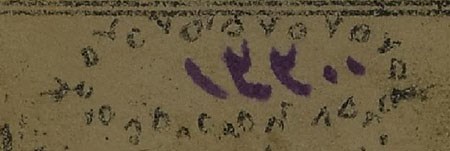
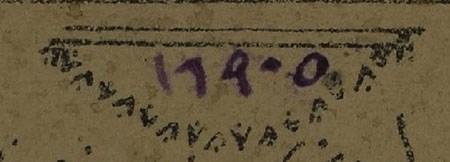
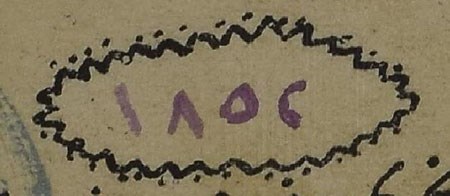
Another feature of the banknotes issued during the siege of Khartoum was the signature. Initially, Gordon personally signed all the notes, but as more banknotes were issued and Gordon's time became increasingly consumed by the siege, hetograph printing was adopted. Hetograph printing involves using gelatin to absorb the ink from the original and transfer it to a copy. Banknotes bearing Gordon Pasha's signature were considered more valuable than those issued without a signature using hetograph technology.
Other versions
The first issue of Sudanese piastres was printed in the following denominations: 1, 5, 10, 20, 100, 500, 1000, 2000, 2500 and 5000 piastres and also bears the same issue date as the 50 Egyptian pound note. The second type, which was issued on April 25, 1884, is the 20 pound note (very rare), with text in French and the signature of “Gordon Pasha”.
Finally, on 1 August 1884, the second issue of the 100-piaster note was printed (very rare). Presumably, there were fewer paper notes of the one-piaster note, the second type of 100-piaster note, and the 20-pound note.
Two further issues of banknotes were printed, also in 1884, one using the British pound instead of the Egyptian piastre and the other featuring an added decorative border. However, unlike the earlier issues, these two types are considered much rarer. A sample of banknotes was also offered at a Spink auction; this particular twenty-piastre note bore English script instead of Arabic.
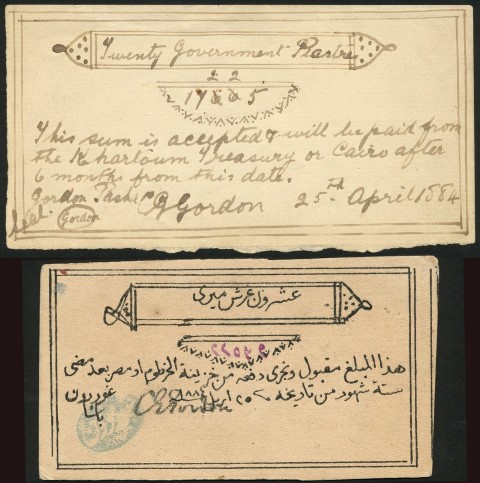
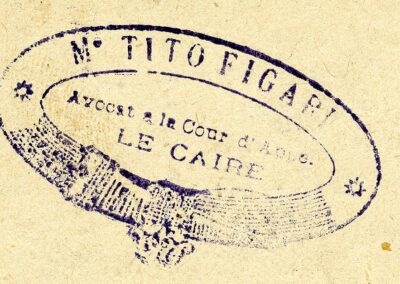
The merchants in Sudan refused to deal with the new money, so Gordon Pasha issued a military order obliging the merchants to accept these papers. A large quantity of these banknotes was collected by the merchants. Gordon also re-signed all the old papers with the addition of the seal of an Italian lawyer (Tito Figari) residing in Cairo on the back of most of the papers.
Fall of Khartoum
Unfortunately for Gordon, the funds he raised were insufficient to protect Khartoum from falling into the hands of the Mahdist army. After nearly 10 months of siege, the city finally fell in January 1885. Following a night attack, Mahdist troops flooded the city, besieged Gordon's headquarters, and ultimately killed the general. In Britain, General Charles Gordon was hailed as a hero and martyr. This eventually led the British to send an army in 1896, under the command of Horatio Herbert Kitchener, to retake Sudan and avenge Gordon's death.
The fate of the papers after the fall of Khartoum
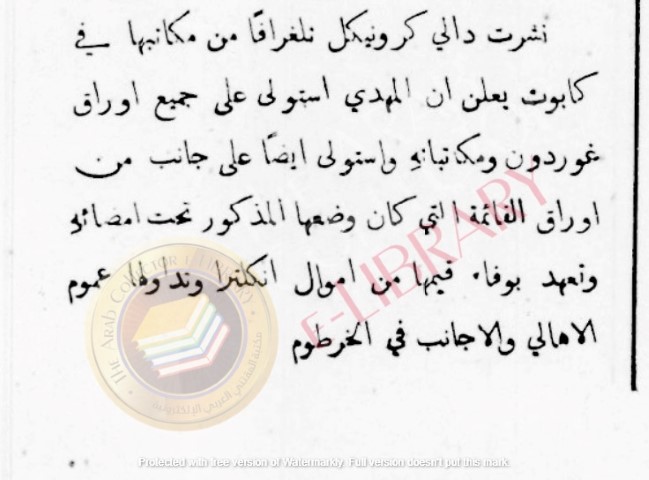
In March 1885, Al-Ahram newspaper published the text of a telegram announcing that the Mahdi had seized all of Gordon’s papers and had taken part of the list papers (banknotes) that the aforementioned had placed under his signature and pledged to pay their value from England’s money and circulate them among the general public and foreigners in Khartoum.
Some European newspapers at the time reported that the value of the banknotes issued by Gordon Pasha may amount to 40 million francs, as he had to satisfy the soldiers who were fighting with him. The British government at the time realized that the Mahdi had seized the rest of the money, as it explained that a limited number of the public had circulated those banknotes, and that the consequences would be dire if the printing equipment fell into the hands of the Mahdi.
As for England, it will have to pay for this paper, most of which is in the hands of Italian, French, and Union merchants. Then one of the newspapers explained that the soldiers who were with Gordon were keeping some of that money, and other English soldiers bought it from them for its price, and they bought from them a lead marker that General Gordon had placed to distribute to the people of Khartoum.
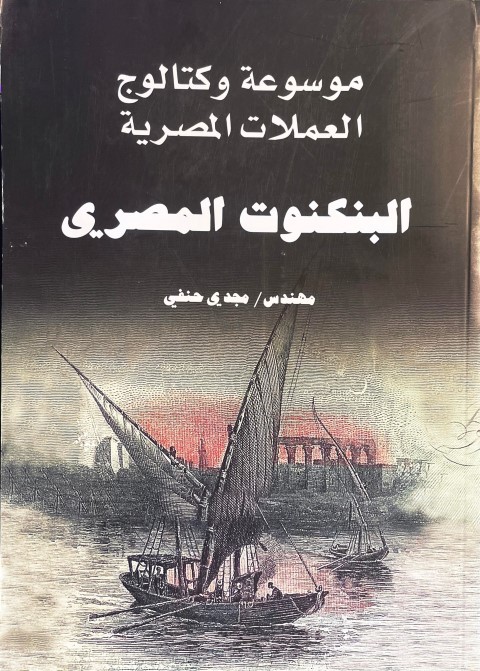
The engineer explained Magdi Hanafi In his book on Egyptian banknotes, he states that after the siege of Khartoum ended, a British officer purchased these notes from merchants for less than their face value, hoping to withdraw their full value from the Egyptian treasury for a substantial profit. He also notes that the rarest of these denominations was the one-piaster note, which the British officer did not bother to buy from Sudanese merchants to withdraw from the Egyptian treasury due to its low value. Furthermore, the fifty-pound notes were rare due to the limited number of notes issued.
The issue of Gordon's money (bonds) – or as Al-Ahram newspaper described them at the time, Gordon's bonds – took on importance for the Egyptian government, so it formed a committee in the Ministry of Finance to look into the matter, as the Egyptian government did not have organized books that informed it of the value of those bonds and their number. However, due to the financial commitment mentioned on those papers, the Egyptian government was forced to give up and begin to return the value of those papers in the second half of 1885.
On August 4, 1886, Al-Ahram newspaper explained that the Egyptian government did not delay in paying the remittances and banknotes that had been given by the late Gordon Pasha to some merchants and settlers in the Sudan region, because most of the value of those banknotes was, it is thought, for those immigrants who, out of fear of attacks by rebels in Sudan on the way, would hand over their cash to Gordon Pasha and receive remittances to the Egyptian government in return, which they would collect upon their arrival.
However, when the government saw that the number of those papers had increased and their value had reached a level that it did not expect, and that there were reports from General Gordon and no papers indicating the truth of that, it stopped paying some of those papers until they could examine them or pay the real ones, out of concern that there might be money that was real for him, so he would pay in addition to the large sums that it had paid so far. And since a large part of the aforementioned papers were found in the hands of people who were in great need of their value, this drew the attention of the Egyptian government to examine the matter well so that these needy people who had the correct papers would not lose any of their rights.
Later, the Egyptian government refused to disburse the remaining value of the banknotes, as in September 1888 the Mixed Court of Appeal issued a ruling invalidating the claim of some holders of those banknotes, and the Sunni government declared that it was not responsible for paying them, but it was reported that this claim would be brought before the Mixed Courts in a new panel.
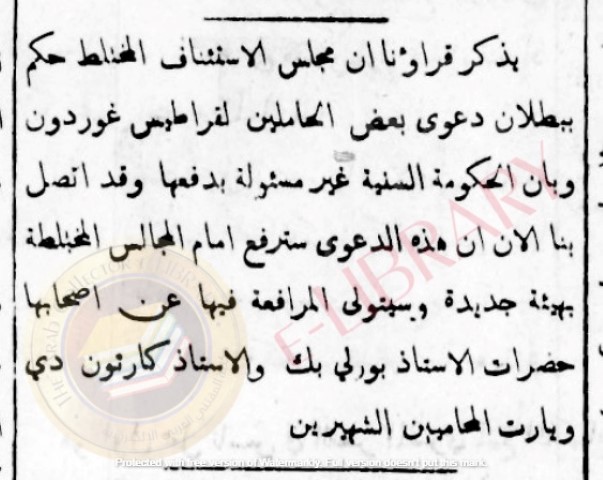
In February 1890, an agreement was reached between the holders of Gordon coins and the Egyptian government to settle the dispute between them regarding those coins. The matter was presented to the Public Debt Commission, which determined the amounts to be paid to the holders of these bonds for relinquishing their value. Engineer Magdi Hanafi explained in his book "The Egyptian Banknote" regarding this section that one of the plaintiffs in that case died before the case was decided, and the court ruled that compensation should be paid to him for part of the value of those papers, which was paid to his heirs.
The treasury bills issued by Gordon Pasha are considered the first paper currency for Egypt and Sudan. Gordon Pasha ordered the value of (168,000 Egyptian pounds), but he actually signed only 50,000 pounds and did not complete signing the rest of the issue after he was killed by the Mahdi forces. Just as Charles Gordon lives on as a famous figure during the imperial era in Britain, the paper money he issued remained in the money collections and served as important evidence of the past.
Dr. Mazen Ibrahim
———————————————————————————————————
Sources:
- https://www.pmgnotes.com/
- https://en.wikipedia.org/
- اEgyptian Banknotes - Encyclopedia and Catalog of Egyptian Currencies (Engineer - Magdy Hanafi)
- Al-Ahram Egyptian Newspaper Archive
- Bass, J. (2007) “Of Madness and Empire: The Rhetor as ‘Fool’ in the Khartoum Siege Journals of Charles Gordon, 1884,” Quarterly Journal of Speech, 93:4, 449-469, DOI: 10.1080/00335630701594004
- Judd, D. (1985) “Gordon of Khartoum: the Making of an Imperial Martyr.” History Today, 35, 19–25.
- Nicoll, F. (2010). “Truest History, Struck Off at White Heat”: The Politics of Editing Gordon's Khartoum Journals. Journal of Imperial & Commonwealth History, 38(1), 21–46. https://doi-org.ezproxy.lib.usf.edu/10.1080/03086530903538160
-
Encyclopedia of Sudan Banknotes 1856 – 2012
- The journals of Major-Gen. CG Gordon, CB, at Kartoum
-
Letters from Khartoum: Written During the Siege
For more similar topics, you can browse the Link the next:
Egyptian currency of 1938 and the state of confusion
Royal Christmas commemorative coins