Egyptian currency of 1938 and the state of confusion
What Egyptian currencies were not issued in 1938 and why was there a state of political and economic turmoil during this period?
Cairo – February 1937
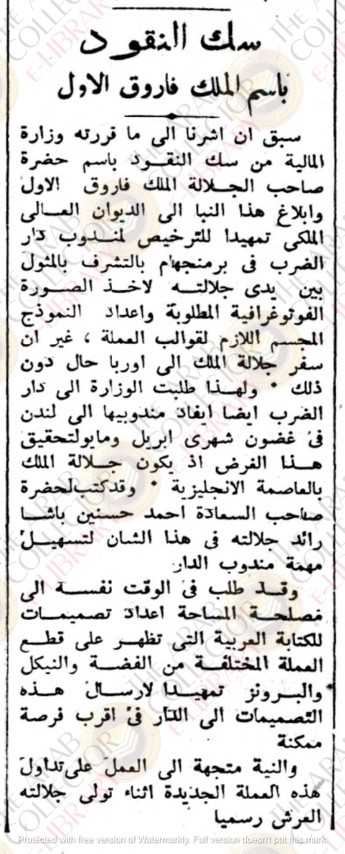 Our story begins when the Ministry of Finance announced the minting of Egyptian coins in the name of His Majesty King Farouk I, and the news was conveyed to the Royal Court in preparation for authorizing the representative of the Mint in Birmingham to have the honor of appearing before His Majesty to take the required photograph and prepare the necessary three-dimensional model for the minting dies.
At the same time, he asked the Survey Department to prepare designs for the Arabic writing that appears on the different currency in preparation for sending them to the House as soon as possible, and that the intention is to circulate the new currency during His Majesty’s official accession to the throne.
This was no easy task, as the Egyptian government was in a state of disarray that prevented it from minting 5,000 gold coins to be distributed as gifts during the celebration of King Farouk's ascension to the throne on July 29, 1937. Instead, arrangements were made to distribute previously minted silver coins. Meanwhile, Egypt was on the cusp of a significant event at the beginning of the new year: the legendary marriage of King Farouk and Queen Farida, an occasion that warranted the circulation of commemorative coins.
The Egyptian Survey Department had already begun preparing the designs for Egyptian currency, but it appeared that there was a technical disagreement between it and the Ministry of Finance, which was revealed in one of the publications in Al-Ahram newspaper, where the Ministry of Finance explained to the Royal Court its observation that the templates made by the Survey Department did not meet its expectations to the required extent. Therefore, the Ministry of Finance offered to have the British Mint do the work, and the Ministry of Finance reinforced its letter by stating that the Mint had noticed that the frequent circulation led to the erosion of the coins from the middle, so it suggested raising the edge around the coin in order to preserve the heart from being lost.
Through our review of some documents of the Mint and the analysis of some publications of both the Egyptian Gazette and Al-Ahram newspaper, we observed a state of controversy regarding some coin issues, as the idea of issuing some of them was cancelled. On the other hand, it was discovered that the minting plan was modified at one time and a special request was submitted to the Mint at another time, which resulted in the issuance of another coin that the Mint had not planned for while preparing the minting molds for Egyptian coins. This gave us free rein to imagine the existence of these coins if they had been minted or even if experimental coins of them existed in the future.
2.5 millime denomination (copper nickel)
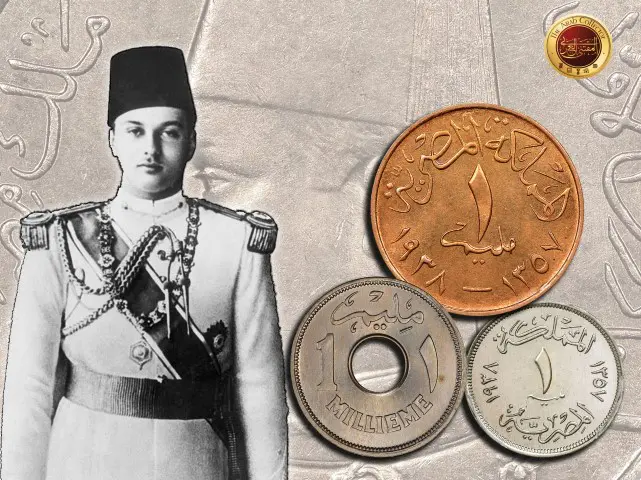
Arrangements began to make pieces of Egyptian currency, especially small denominations, from nickel and bronze metals for the Kingdom of Egypt after the completion of the minting of the silver pieces in 1937, after the Ministry of Finance of the Egyptian government submitted a request to the Mint in Birmingham on November 8, asking that it be printed with the image of the king as it is on the silver coins.
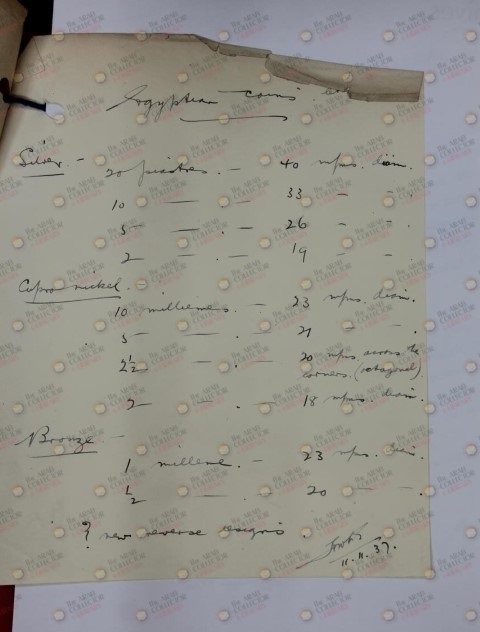
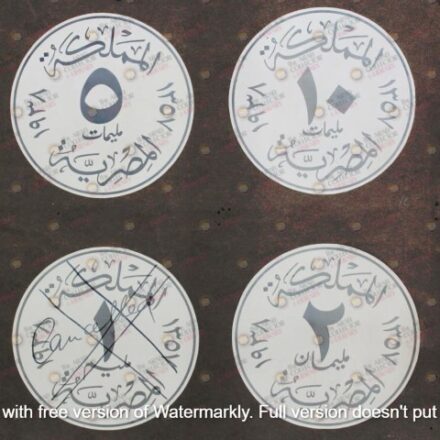
The Egyptian government did not specify the required denominations; therefore, the mint assumed it would produce coins similar in size and shape to those of King Fuad, and a draft was made on November 11, 1937, with the following denominations.
Made of cupronickel: 10 millimeters, 5 millimeters, 2.5 mm (polygonal) 2 millimes
Made of bronze: 1 millimeter and 1/2 millimeter
The Egyptian government has not confirmed any details regarding the four categories of cupronickel metal, and a message was telegraphed by the Royal Mint to the Egyptian Ministry of Finance to confirm the categories and sizes and whether they would send more details about the face of the currency.
They were told that only three denominations of cupronickel and two bronze denominations would be issued, and that the obverse design would be supplied by the Egyptian government. However, it was clear that the Egyptian government was deliberately delaying the decision to approve the issuance of the smaller denominations and the sending of the obverse drawings by the Egyptian Survey Department.
This is evident in one of the letters sent by the Birmingham Mint to the Royal Mint on May 16, 1938 – that is, 6 months after the start of communication with Egypt regarding this issue – from Mr. Brazner to Mr. Perry, which reads:
”Dear Perry,
We haven't heard a word from the Egyptian government about the new currency design they've put together with us. I wonder if you've heard anything at the Royal Mint.
If so, I would be happy if you sent me a letter.
I am confident that you are in good health.“
Mr. Brazner received a letter the following day explaining that he had not heard from the Egyptian government about the designs for the face since last November, and that he could not begin manufacturing the coins until he received the designs.
The designs for the Egyptian coins were sent by the Egyptian government later in June, and no design was made for the two and a half milliemes coin. We did not find an explanation for the cancellation of this coin through the correspondence between the Egyptian government and the British Royal Mint. However, by referring to the book of money by Mr. Hussein Abdel Rahman, it was clarified that the reason for issuing the two and a half milliemes coin in 1933, initially during the era of the late King Fouad I, was due to Law No. 64 to mint ten thousand pieces of nickel coins of the two and a half milliemes coin, as desired by the Chamber of Commerce and due to the conditions of trade and transactions. However, he clarified at the end of the text that the coins were not widely circulated due to the lack of demand for them, given the presence of the two and a half milliemes coins in the markets.
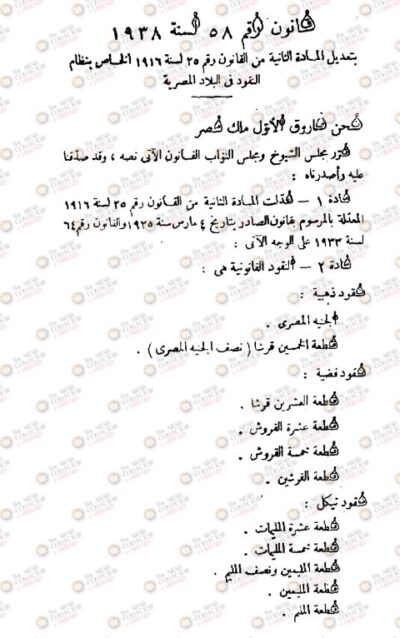
Most likely, there was no need to issue it due to the abundance of pieces of equivalent denominations, but despite that, the two and a half millieme denomination was mentioned in Law No. 58 of 1938 concerning the amendment of the currency in the country.
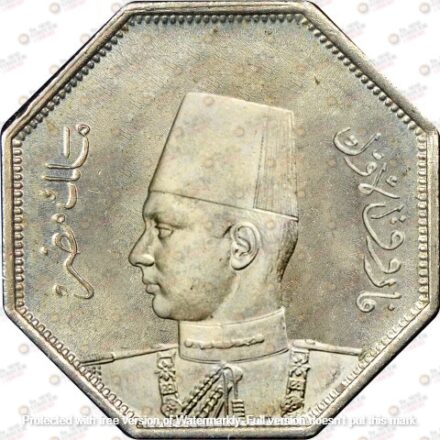
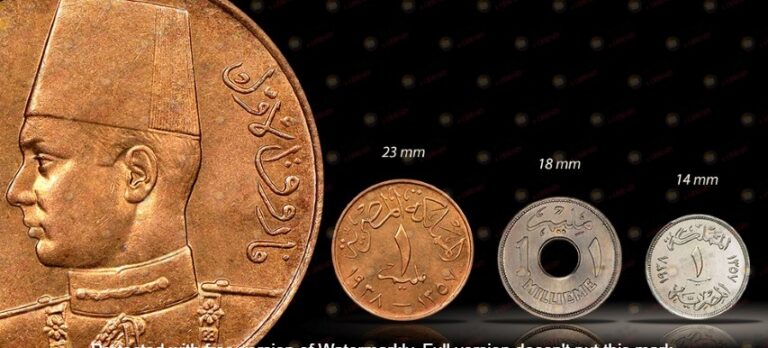
1 mm perforated and unperforated cupronickel
The Egyptian government sent the designs for the faces of some Egyptian coins on June 25, 1938, which were drafted by the Egyptian Survey Department. Surprisingly, a design appeared for a piece of the millieme denomination with a diameter of 14 mm, but it was not perforated! The drawings showed that the design was “Cancelled”.
Then she sent another letter in the first days of August of the same year requesting that coins of the millieme denomination be made and that they be perforated, which puzzled both the Royal Mint and the Birmingham Mint.
During the correspondence that took place between August 3 and the Royal Mint Director expressed his bewilderment at that perforated piece, but he believed that perforated pieces were more popular among Bedouins and farmers because of the ease with which they could be strung into chains, making them easier to carry.
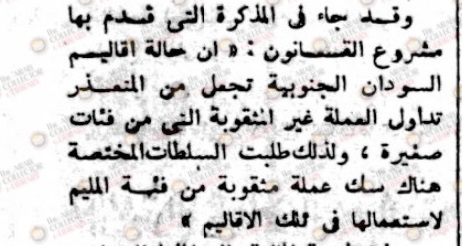 I was struck by a news item in Al-Ahram newspaper on June 12, 1938, about the monetary system in Egypt and Sudan, two days after the issuance of the draft law amending the Egyptian monetary system concerning Egyptian currencies, which stated that the memorandum accompanying the draft law stated that ”the situation in the southern regions of Sudan makes it impossible to circulate the unperforated currency of small denominations, and therefore the competent authorities there requested the minting of perforated currency of the millim denomination for use in those regions.”
The Finance Committee believes that, given the close ties between Egypt and Sudan, and the desire to maintain the unity of their currency, it agrees to mint the proposed currency, while continuing to mint millieme coins from bronze until both coins are in circulation in Egypt and Sudan.
Accordingly, the British Royal Mint was contacted to cancel the idea of the unperforated millieme and to work on changing the minting plan to make a different piece for use in Sudan.
Egyptian gold coins (five, one pound, fifty and twenty piasters)
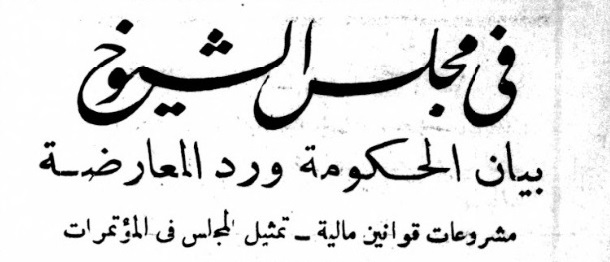
On June 29, 1938, during the presentation of the government's statement in the Egyptian Senate, the budget was discussed, in addition to the financial bills for the past fiscal year. During the session, the draft law amending the currency was presented for approval. One of the opposition members directed a question to the representative of the Finance Committee about the two gold coins of the five pounds and twenty piaster denominations, that they were not included in the Egyptian monetary system law and remained with their gold value, not their nominal value - see the text of Legislation No. 58 of 1938 amending the currency (top of page) - as neither of the two denominations mentioned was mentioned in the Senate's inquiry.
The other interrogation concerned the one pound and fifty piaster denominations, as it is known that the one pound coin was the first piece of Egyptian coins to have the denomination written on it (one pound) instead of (100 piasters) - according to the information mentioned in the Encyclopedia of Egyptian Coins of Coins by Engineer Magdi Hanafi - but it is clear that the interrogation was about the possibility of replacing the number engraved on it with the other! That is, replacing one pound to become 100 piasters or replacing 50 piasters with the words half a pound, but the government clarified that this is not possible as the designs were supplied to the Royal Mint in Britain.
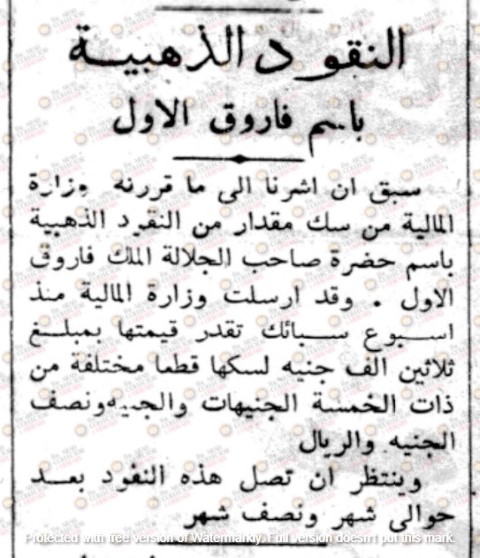
It is likely that the decision to mint Egyptian gold coins for King Farouk was postponed for nearly a year in order to wait for the approval of the state budget. The request to mint the coins was submitted in November 1937, but the gold ingots were sent to be minted in September 1938. This is evident in some correspondence, as the Egyptian Weights and Measures Authority prepared the gold ingots in January 1938. The certificate stated that they would not be allowed to be exported except after the approval of the Ministry of Finance, which came after the approval of the country's general budget. It is worth mentioning that these pieces arrived in Egypt in 1939.
Unfortunately, it's unclear why the Egyptian government was so confused about this issue of Egyptian coins. One possibility is that the period was fraught with political and economic turmoil in Egypt after the young King Farouk ascended to the throne at such a young age, given the limited powers he possessed at the time. Regrettably, I haven't found an explanation for the absence of some of the coins to this day, and I hope more information will come to light in the future.
Dr. Mazen Ibrahim
Sources:
British National Archives (Correspondence from the Mint regarding Egyptian currency)
The Book of Money by Mr. Hussein Abdul Rahman
Al-Ahram Newspaper Electronic Archive
Encyclopedia and Catalog of Egyptian Currencies – Coins, Engineer Magdy Hanafy
Arab monetary legislation – The Arab collector
Egyptian Facts
For more similar topics about Egyptian currency, you can browse the Arab Collector website. the Link the next::
https://arabcollector.com/%d9%85%d8%aa%d9%8a-%d8%aa%d9%85-%d8%aa%d8%af%d8%a7%d9%88%d9%84-%d8%a7%d9%84%d8%a5%d8%b5%d8%af%d8%a7%d8%b1-%d8%a7%d9%84%d8%a3%d9%88%d9%84-%d9%84%d9%84%d8%a8%d9%86%d9%83%d9%86%d9%88%d8%aa-%d8%a7%d9%84/