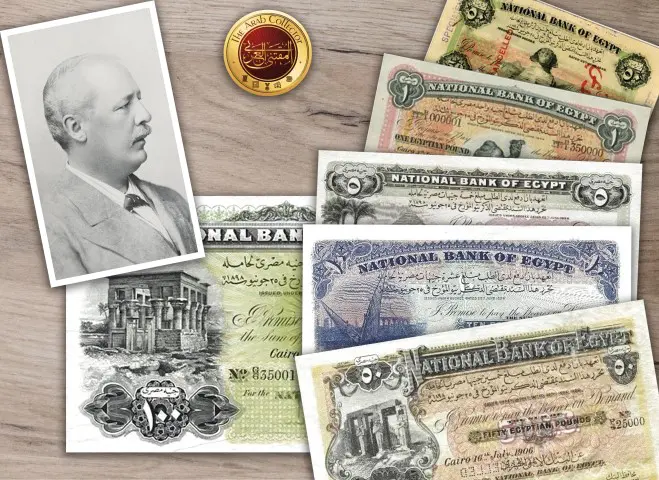
The first issue of Egyptian paper currency
When was the first issue of Egyptian paper currency put into circulation? And was it actually put into circulation from the first moment of its issuance?
Introduction to the first issue of Egyptian paper currency
 While reading the new part of Engineer Magdi Hafi’s book, Encyclopedia and Catalog of Egyptian Currencies - Egyptian Banknotes, I was struck by the details in Chapter Five regarding the circulation of the first issue of Egyptian banknotes, which is a distinctive addition for Egyptian banknote enthusiasts as it chronicles a period whose features were not clear.
This topic was addressed in this part of the book in a distinctive way, and it was clarified that the first monetary issue was circulated from the first year of its issuance, as an article published in Al-Muqtataf magazine issued in August 1899 was presented, in which there was a description of a ten-pound note in circulation. A model of a five-pound note dated 1/10/1899 was also presented, as well as models of other pieces that were circulated and others that were counterfeited.
Also displayed was a bank document issued in 1906 showing sums of money of various denominations (5, 10, 50 and 100 pounds), as well as a document from Lord Cromer documenting the circulation of paper currency of all denominations (50 piasters up to 100 pounds).
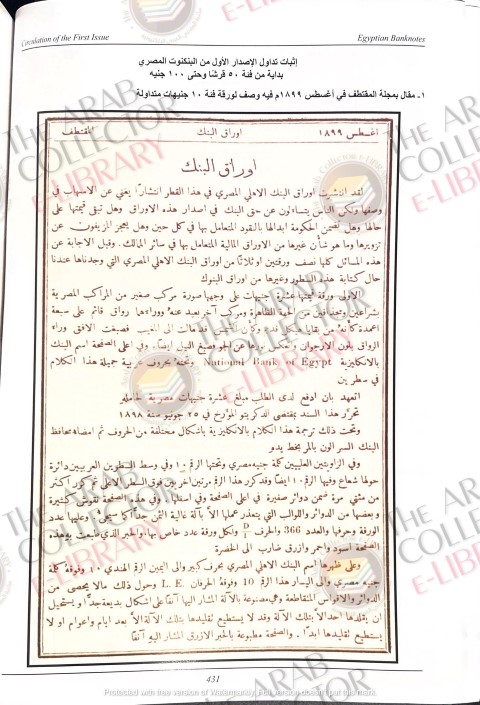
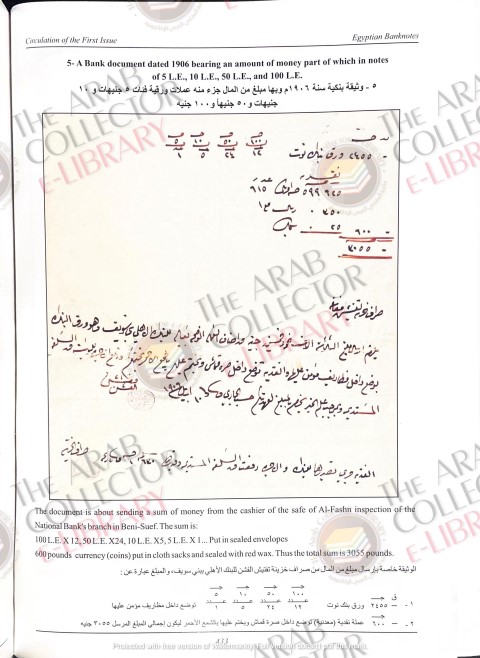
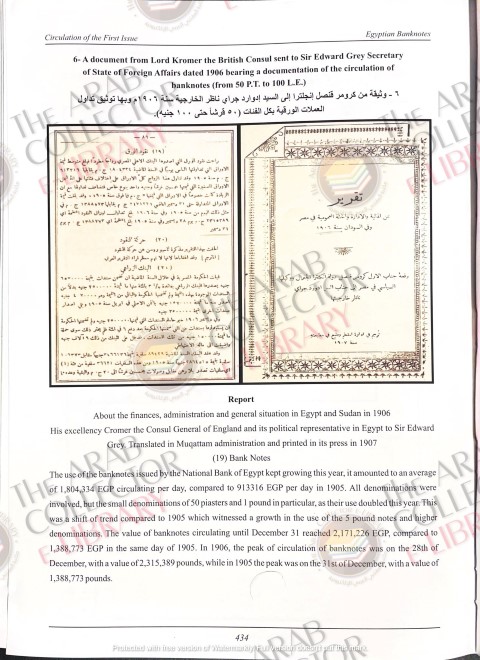
Therefore, I wanted to add to this wonderful work by Engineer Magdi Hanafi some other evidence and proofs that prove the circulation of the first issue of Egyptian paper currency since its first year, and on the other hand, to clarify the mechanism by which the currency was circulated in the markets, and we will try to mention it in a chronological sequence starting from the issuance of the papers.
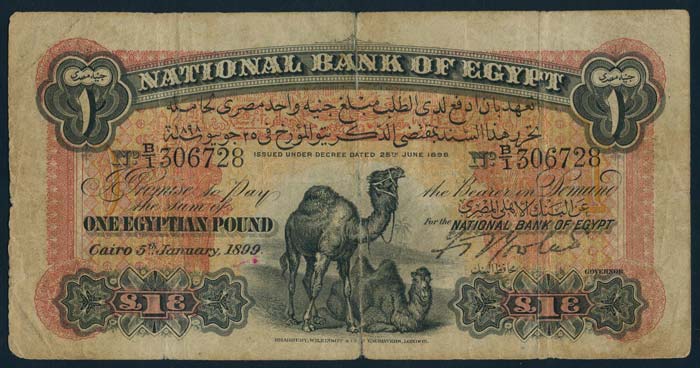
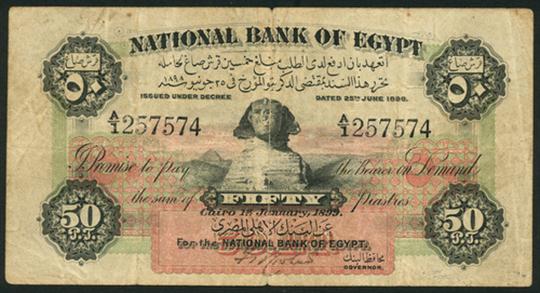
Al-Ahram Newspaper 1899
It published a news item in its issue dated April 11, in the interest of the Post Office, announcing to the public the circulation of Egyptian paper currency (banknotes) and that they should not send them by the Post Office except in registered and insured letters. It should be noted that the announcement was made when the circulation of banknotes began.

Financial Report 1899-1900
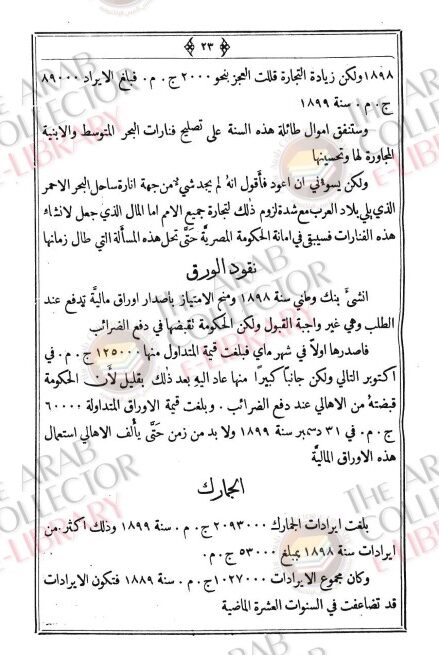
The report on Egypt’s finances, administration, and condition, issued in June 1900 in Arabic for the fiscal year (1899), clarified the point of using Egyptian paper money, stating that it was issued in May and that the amount in circulation up to October of the same year was equivalent to 125,000 Egyptian pounds. However, a large part of it was returned to it shortly afterward because the government collected it from the people when paying taxes, and the value of the papers in circulation reached 60,000 Egyptian pounds on December 31, 1899. However, it clarified that the people must get used to using these papers.
On the other hand, the report explained that Egypt had established a national bank in 1899 and granted the privilege of issuing securities payable on demand, which are not mandatory to accept, but the government collects them when taxes are paid. This explains another aspect of the mechanism of circulation, as the government was instilling confidence in paper money by finding a way to circulate it among the public, which was dependent on metal currency and rejected the idea of paper money, by making it a means of dispensing when collecting taxes. It is clear that the people returned most of it to the Egyptian government treasury at the first opportunity.
Financial Report 1900-1901
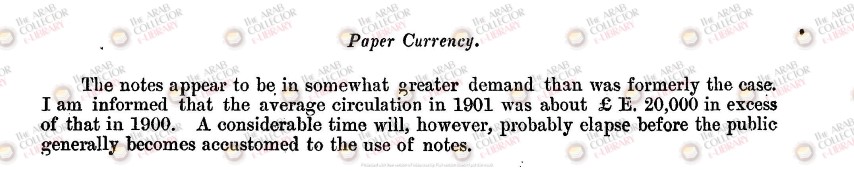
The financial report issued in 1901 in English indicated an increase in the need for Egyptian paper currency issued by an increase of 20,000 pounds over the previous year, but it was also reported that some time must be given to the public to become familiar with the banknotes.
Al-Ahram Newspaper 1900-1901
The National Bank began publishing advertisements directed to the public to facilitate the sending of Egyptian banknotes within Egypt to the bank’s customers in Cairo, Alexandria, and Mansoura, with a fee of 0.5 per thousand of the banknote’s value to be collected as postal fees, commission, and insurance. Along with presenting the facilities, it listed the advantages of using Egyptian banknotes, as they are used in government departments when paying money, fees, and returns, and government cashiers are ordered to help in disbursing their value in gold and silver, and vice versa. Through these advertisements, the bank’s management targeted the segment of landowners and capitalists.
It is worth mentioning that during that period, farmers still relied heavily on silver and nickel coins to sell their cotton crop, which were issued to them by the Ministry of Finance. The Ministry of Finance tasked the directorates’ treasuries with giving them the aforementioned coins in exchange for gold coins without taking commissions. Therefore, the bank expanded the scope of the loans it gives to farmers in the Lower Egypt centers starting from October 15, 1900, in order to attract other segments, and offered to appoint bank agents to facilitate loans to farmers with a commission of 1% on the value of the loans given by each of them in his district.

Various news
When we browse through the archives of Egyptian newspapers, we find many scattered incidents that prove the circulation of the first issue of Egyptian banknotes. We will review some of them as shown in chronological order.
Al-Ahram, August 24, 1901: 1000 Egyptian pounds stolen from the National Bank
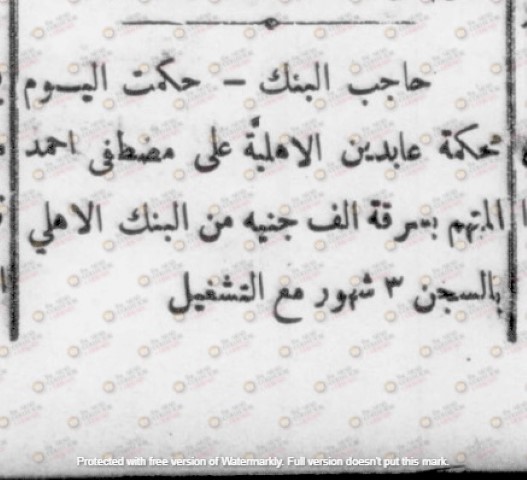
Al-Ahram, June 21, 1901: Letter of thanks for finding a lost 100-pound note

Al-Ahram, January 12, 1903: Postal Authority announces the need to secure correspondence containing banknotes.

Currency counterfeiting
The counterfeiting of Egyptian banknotes began after the Egyptian government issued a circular in December 1903 to all its departments to accept banknotes, which strengthened its position in exchange operations and made it a target for unscrupulous people.

As a result, the Ministry of Justice amended the National Penal Code and added to Chapter Sixteen a law that punishes the forgery of bank financial documents that were legally authorized to be issued.
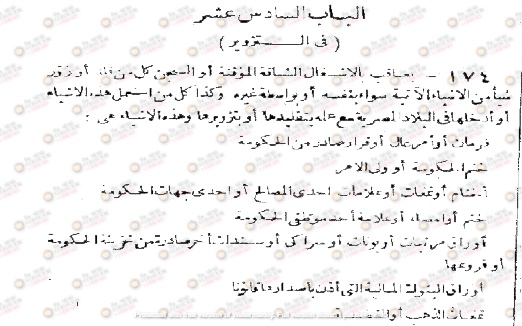
But this did not prevent the counterfeiting gangs, some of whom turned to counterfeiting National Bank papers, and the police began to arrest them, as in the news below (the news is from Al-Ahram newspaper, 19-8-1904).

Banknote theft was also active through letters, assaults, and robberies (News from Al-Ahram newspaper, 3-11-1906).

The evidence above, in addition to the chapter mentioned in Engineer Magdi Hanafi’s book, proves beyond any doubt that the first issue of Egyptian paper currency was circulated from the very first moment in the Egyptian markets in multiple stages and different time periods. It was explained that the circulation took place in multiple stages due to the public’s initial refusal to rely on paper money and their preference for the coins they were familiar with in their business.
Initially, transactions were limited to tax collection and within government departments, and then paper money found its way to multiple segments of the population after the adoption of bank lending (loans) and the support of the paper position for use within other government departments.
Dr. Mazen Ibrahim
Sources:
Encyclopedia and Catalog of Egyptian Currencies – Egyptian Banknotes (M. Magdi Hanafi)
Financial and General Conditions Reports for Egypt and Sudan 1899-1914
Library of Arabic Monetary Legislation – The Arab Collector
For more similar topics, you can browse the Arab Collector website through the Link the next:
Bank banknotes