Currencies lost by Egypt in the war
Did Egypt really lose a large amount of coins, especially silver, during World War I? And what type of coins were those?
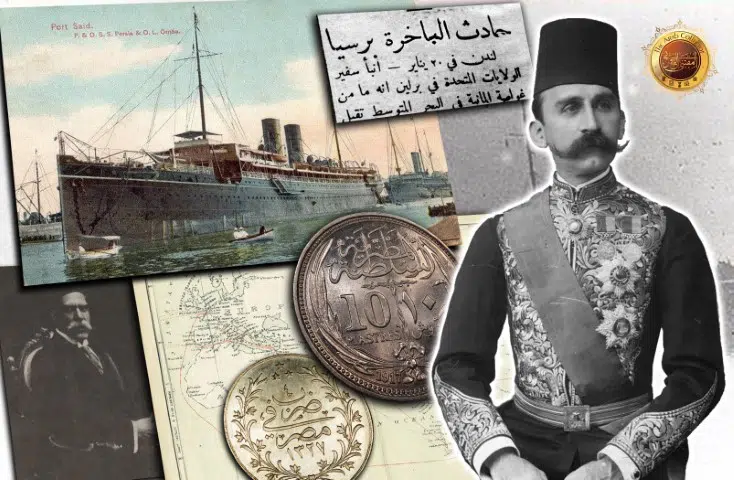
Many researchers mention that a large quantity of Sultan Hussein Kamel's coins were lost at sea during the First World War, and they explain the shortage of specific quantities of the coins issued in 1916 for Sultan Hussein Kamel with this. But is this true or is it just a rumor? In fact, half of the information is true, but the other half is not, and this is what we will explain in the following lines.
World War I and Egyptian politics
The events of our topic today take place between 1915 and 1916, which is the transitional period for Egypt during its transformation into a sultanate not subject to Ottoman rule under the leadership of Sultan Hussein Kamel. On the other hand, the events of the First World War were still present in the region, and Egypt was one of the regions of the Ottoman state that was placed under direct British protection. Similarly, Britain sent different groups of soldiers from its colonies of Australia, New Zealand, and India to settle in Egypt as a military base to train soldiers for the battles that were close.
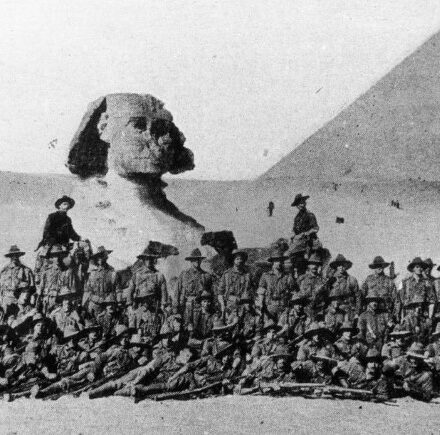
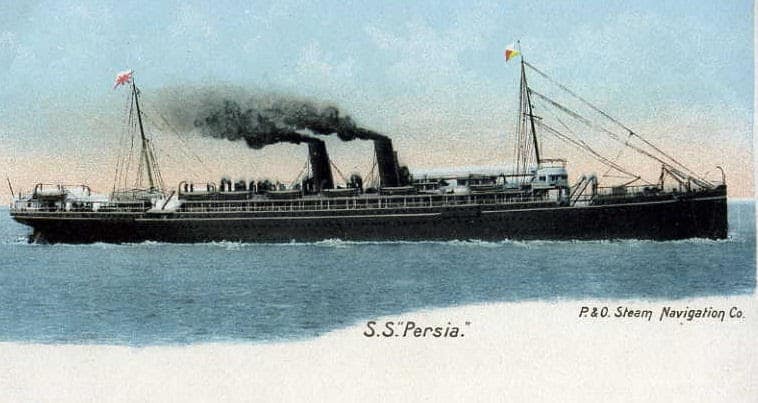
Despite the Minister of Finance's 1914 decision that the value of banknotes issued by the National Bank should be equal to the actual value of gold coins, the influx of foreign soldiers into Egypt necessitated, in mid-1915, the dispatch of silver coins for use by the soldiers in circulation and for paying their salaries. At that time, Egypt requested the British government to mint a quantity of silver coins to meet these needs. Several shipments were indeed sent to Egypt in stages until the arrival of a shipment in December, ordered by the British government, consisting of twenty, ten, and five piaster denominations. These coins were to be shipped aboard the merchant ship SS Persia. Now, let us continue the narrative in a chronological order:

December 18, 1915
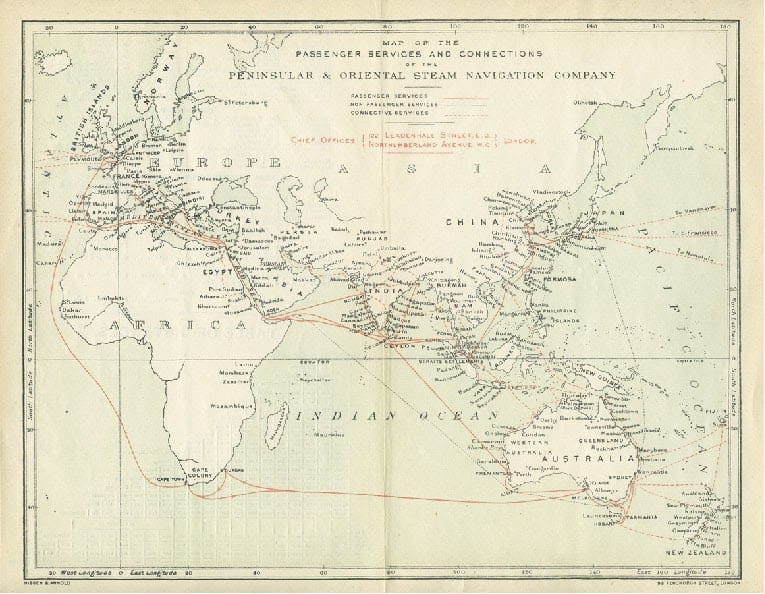
During the war in London, the ports were cold and gloomy a week before Christmas when the ship Percia sounded its horn and set sail from the dock to set out on the Thames for India. Her first stop was Gibraltar, followed by Marseille, where she spent Christmas. She left Marseille on December 26th and sailed to Malta, then headed across the vast expanse of the eastern Mediterranean towards the entrance of the Suez Canal at Port Said.
After the Suez Canal, it had to stop at Port Said, Aden, and Karachi. The ship carried 184 passengers and 3,166 tons of general cargo – 549 tons of cement, 100 tons of railway “chairs”, 39 tons of iron bars and paint, 750 tons of provisions, curtains and luxury goods, books and medicines, 160 tons of luggage, 1,577 tons of mail, and most importantly, a shipment of money sent to the Egyptian government, which was in the ship's safe next to the jewels of an Indian maharaja.
December 30, 1915
115 kilometers (71 miles) southeast of Cape Martello, Crete, and without any warning, a torpedo was launched from the German submarine U38 stationed in the Mediterranean Sea at the ship Brescia, which was traveling at a speed of 18 knots per hour. The water boiler exploded five minutes after the attack and it sank quickly, taking with it 334 of the 501 people on board, in addition to its cargo of 7,974 tons.
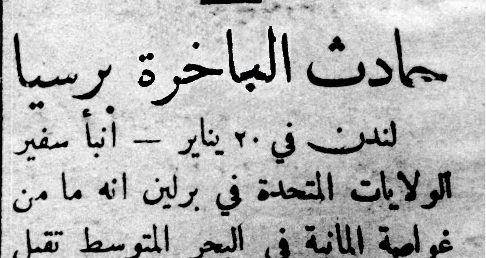
The Egyptian newspapers reported the sinking of the ship Persia, but the Egyptian government did not disclose the cargo of silver coins sent with the shipment at that time. However, it rushed to correspond with the British government by sending a telegram to work on minting other coins equivalent to 15,000 pounds as quickly as possible to resolve the crisis, while also seeking the opinion of the British government in general on the issue of minting coins.
February 16, 1916
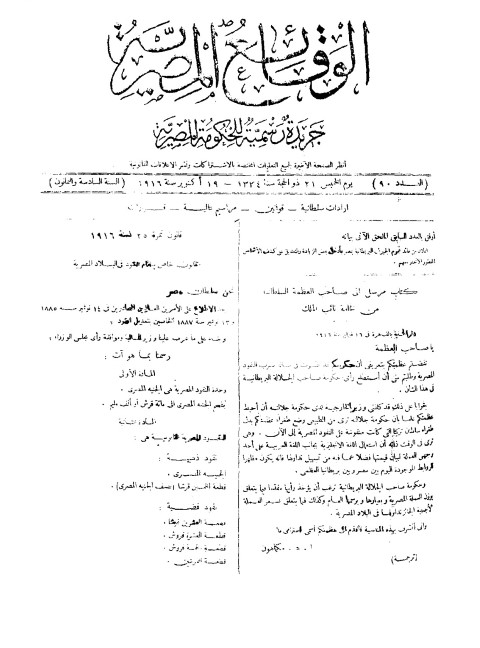
A letter from the Viceroy of King George V at the time, Mr. McMahon, to Sultan Hussein Kamel, urged him to mint coins for Egypt, but to place his own tughra (imperial monogram) instead of the Ottoman sultan's tughra, which had remained inscribed on Egyptian currency until then. The British government also suggested that using English alongside Arabic to indicate the currency's value, in addition to facilitating its circulation, would demonstrate the existing ties between Egypt and Britain.
February 21, 1916
The Ministry of Finance received 84 boxes of silver coins weighing 900 kilograms, which were delivered to the Suez Customs, and the nature of the money and the reason for its arrival in Egypt were not disclosed.
March 6, 1916
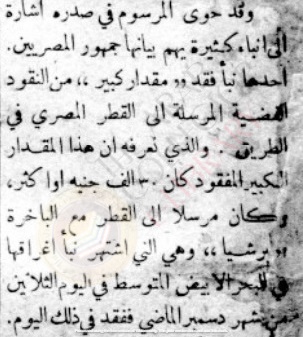
Sultan Hussein Kamel issued a decree granting the Indian rupee a temporary legal tender status, given the ample supply of these coins held in the Ministry of Finance's treasury. Sending another shipment of coins to Egypt would take considerable time, and the exchange rate was set at 65 milliemes to the Egyptian pound. Subsequently, on March 7th, Al-Ahram newspaper reported that a shipment of silver coins, equivalent to 30,000 Egyptian pounds or slightly more, had been sent with the ship "Bercia." The newspaper explained that the Egyptian government had insured these coins at their value before shipment and therefore incurred no loss. Al-Ahram also confirmed that the coins received were indeed rupees sent from India.
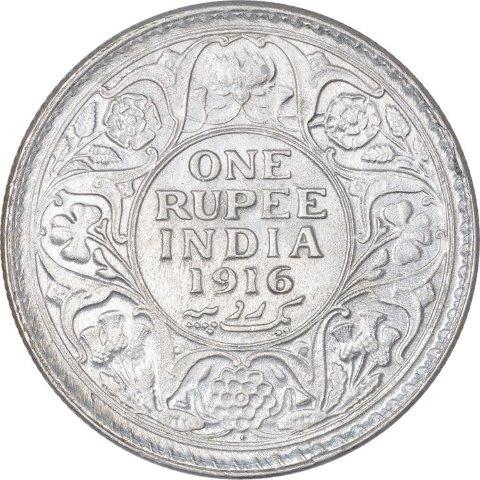
We conclude from this that the lost coins were Egyptian Ottoman coins for which Britain still had the minting dies and it was planned that they would be re-minted and used in Egypt temporarily, but things did not go as planned. Indeed, Britain minted a considerable number of those coins, and a small part of them was received, while a significant portion was lost with the steamer Persia. These coins did not belong to the Egyptian Sultanate currency, as they were issued later, more than 10 months after the ship sank.
Dr. Mazen Ibrahim
Sources:
| Currency regulations and legislation (Arab collector's library) | Al-Ahram newspaper from December 1915 to March 1916 |
| thesinkingofthesspersia | British National Archives |
For more similar topics, you can browse the Arab collector's website through the Link the next:
The small change crisis in Egypt in 1941