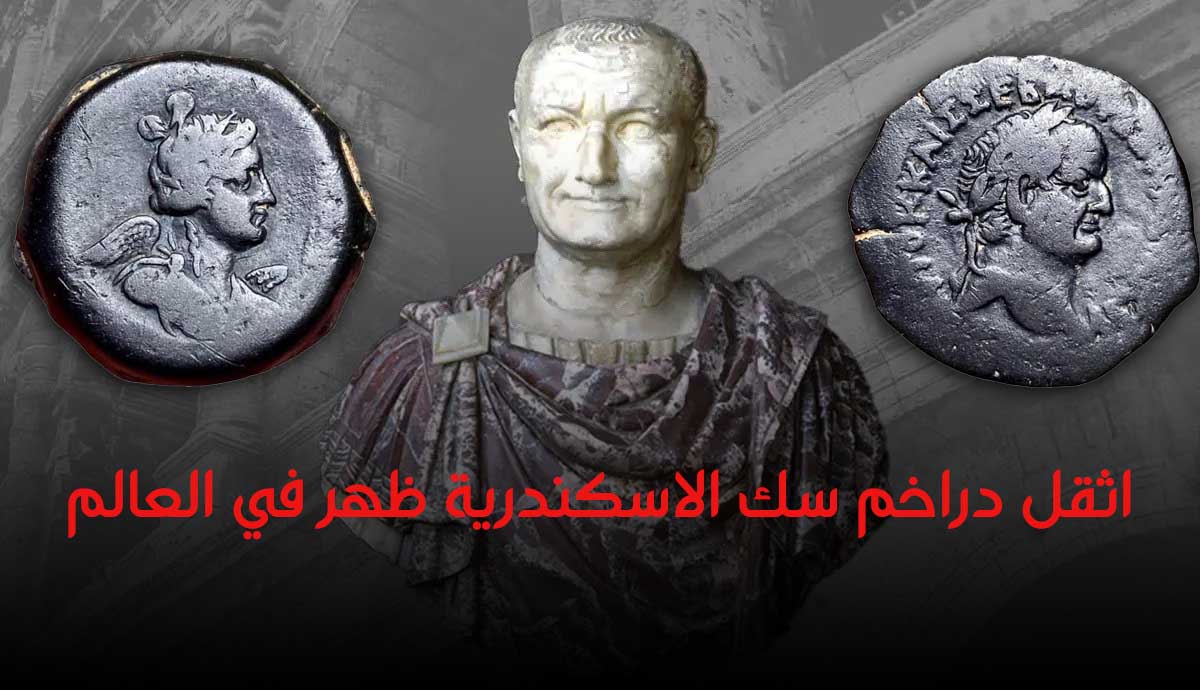
The heaviest drachma minted in Alexandria has ever appeared in the world.
What is the heaviest drachma in the world that was minted in Alexandria?
Introduction
Egypt fell under Roman rule in 30 BC after the Battle of Actium, a naval engagement between Mark Antony and Cleopatra VII on one side, and Octavian and the Roman legions on the other. The battle's conclusion marked the beginning of Roman rule over Egypt and the exploitation of its resources. In the emperor's eyes, Egypt was his personal domain, his private garden, part of his possessions, to be inherited like the throne itself! The emperor consistently appointed powerful governors to the provinces of Egypt due to its unparalleled strategic importance as the heart of the world and the gateway to Africa—that northeastern part of Africa, control of which meant control of everything! Regarding the monetary system… research has been ongoing, and scholars of ancient numismatics have been quick to point out, directly or indirectly, the stark differences between the Ptolemaic and Roman monetary systems in Egypt. The Ptolemies relied on a monetary system based on three metals (bronze, silver, and gold), while the Romans added lead as an auxiliary coin, starting to mint it from the beginning of the second century AD. The Romans mixed silver with other metals in different proportions until the batik alloy appeared (which is an alloy of 80-90% bronze and the rest is silver, and sometimes the coin was minted entirely from bronze with a thick layer of silver, and it began to appear during the reign of Emperor Nero). The Egyptians accepted Roman currency with some hesitation at the beginning of Augustus’s rule. So much so that the Egyptians accepted the idea of Roman occupation and continued to use the same Ptolemaic currency that had been used before. We see in the first issue of Augustus that he minted the same two denominations that were in circulation during the reign of his predecessor Cleopatra VII: the Opol of 40 drachmas and the Diapol of 80 drachmas, with the same design except for the removal of Cleopatra VII’s image and the placement of his own image with the addition of the phrase ΘΕΟΥ ΥΙΟΥ (which means Son of God), which was intended to give him the inherited legitimacy in Egypt, considering that the king in ancient Egypt was the son of God and his representative on earth, his word and his hand with which he strikes and with which he shows mercy. .
Setting up the monetary system
Research has been frequent and scholars of ancient numismatics have been quick to point out, directly or indirectly, the extreme differences between the Ptolemaic and Roman monetary systems in Egypt. .
The Ptolemies relied on a monetary system based on three metals (bronze, silver, and gold), while the Romans added lead as an auxiliary coin, starting to mint it from the beginning of the second century AD. The Romans mixed silver with other metals in different proportions until the batik alloy appeared (which is an alloy of 80-90% bronze and the rest is silver, and sometimes the coin was minted entirely from bronze with a thick layer of silver, and it began to appear during the reign of Emperor Nero).
The Egyptians accepted Roman currency with some hesitation at the beginning of Augustus’s rule. So much so that the Egyptians accepted the idea of Roman occupation and continued to use the same Ptolemaic currency that had been used before. We see in the first issue of Augustus that he minted the same two denominations that were in circulation during the reign of his predecessor Cleopatra VII: the Opol of 40 drachmas and the Diapol of 80 drachmas, with the same design except for the removal of Cleopatra VII’s image and the placement of his own image with the addition of the phrase ΘΕΟΥ ΥΙΟΥ (which means Son of God), which was intended to give him the inherited legitimacy in Egypt, considering that the king in ancient Egypt was the son of God and his representative on earth, his word and his hand with which he strikes and with which he shows mercy. .
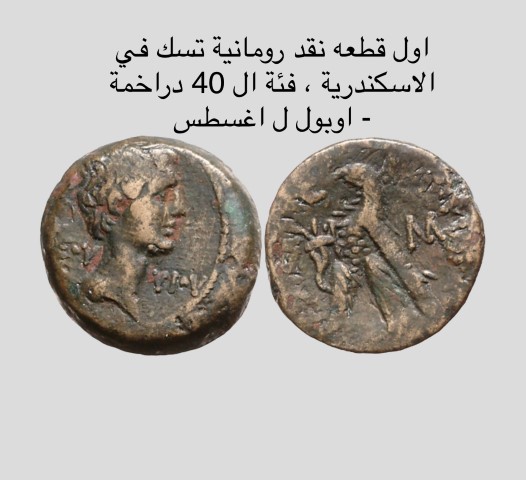

behind The Ptolemies Tons and tons of bronze and silver coins forced the brilliant Emperor Augustus to reuse them in accordance with the goals of the rising empire. He reduced the weight of the currency denominations and introduced and maintained small currency denominations minted at different periods of the Ptolemaic rule. These were sufficient for daily use but did not meet the needs of global trade, of which Egypt was the center. They were not destined to last and were destined to disappear like others that preceded them. .
The emperors who took control of affairs followed the same path as the deified emperor Augustus, until Tiberius took power in 14 AD and re-minted the Alexandrian tetradrachm from pure silver with Roman specifications and designs. It remained the highest monetary category in the Roman-Egyptian monetary system, which relied on bronze and silver only, until the arrival of Nero in 54 AD, who re-minted the drachma category after it had stopped since the rule of Augustus until the arrival of Nero. .

Nero’s project to restructure the monetary system in Egypt was not successful, due to his internal and external policies that turned the East and West against him. The models that were minted from the newly created monetary category in the Roman monetary system (drachm) in Egypt were kept by the state officials as a kind of imperial memento, and they were pierced and used for decoration as a brooch - fabiola - to be placed on the toga (the monthly Roman civil cloak). .
Since the re-minting of the Alexandrian drachma, its weight and diameter have remained constant, ranging from 15-30 grams, with a constant diameter of 33-35 mm. The increase and decrease in weight is attributed to the strength and stability of the economic system and the increase in the severity of inflation, and the wars and unrest to which the Roman Empire was exposed, which drained the resources of the provinces and directed them towards the war effort, and Egypt had the lion's share! As it was the breadbasket of Rome!
The heaviest drachma minted in Alexandria
This situation continued until the arrival of the cunning military leader and ruthless commander Vespasian, who ruled from 69 to 79 AD. He continued in the same manner as the previous emperors regarding dealing with Alexandrian currency, until the drachma under study appeared, which outweighed any Roman bronze coin that appeared in Egypt. Its details are as follows:
– Kingdom: The ancient Roman Empire.
– Emperor: Vespasian
– Date of rule: from 69 AD to 79 AD.
– City of the railway: Alexandria.
– Date of minting: LΓ The third year of Vespasian’s reign, corresponding to 70/71 AD.
– Metal: Bronze.
– Currency denomination: Æ Drachm. .
Weight: 42.30 grams.
– Diameter: Ø 38.30 mm.
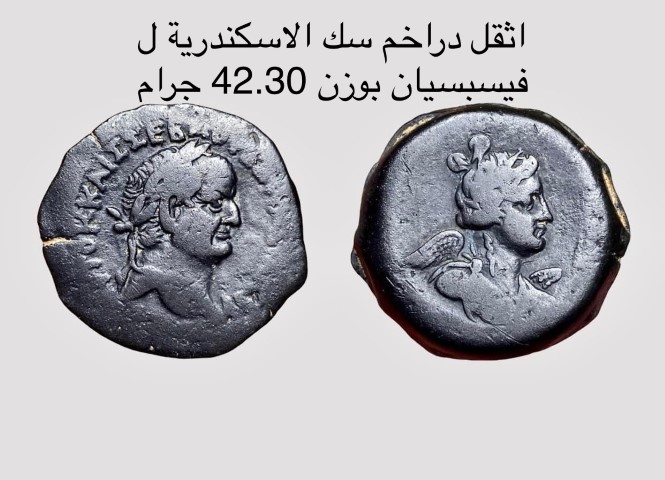
– Face: A head-on portrait of Emperor Vespasian crowned with a laurel wreath and looking to the right.
– Face writing: ΑΥΤΟΚ ΚΑΙΣ ΣΕΒΑ ΟΥΕΣΠΑΣΙΑΝΟΥ
– Back: A depiction of the goddess Nike, winged and facing right (NIKE, pronounced Nike in Latin) – (a famous Greek goddess whose worship spread in Italy, Asia Minor, and several parts of the Near East. She represented victory in the Olympic Games. The first time this goddess was depicted on coins was on Olympia coins, around 510 BC. She was also depicted on some local coins offering a wreath to the god Heracles, who is seated on the throne. The presence of Nike on coins symbolizes victory and triumph after death, and is also a symbol of athletic activity and military victory).
– Back writing: LΓ. .
Availability: Very Rare. .
Conclusion
Based on its weight and diameter, we can conclude that the specimen under study may be an attempt by Vespasian to create a new monetary denomination (2 drachmas – double drachmas), similar to the rare denomination prevalent in the Roman Bronze Age monetary system approved by the Senate (double certus). This is a new denomination not mentioned in any numismatic research, as an increase of 12 grams in a monetary denomination is highly unusual!
For more similar topics, you can browse the Arab collector's website. the Link the next:
A forged document for the sale of the coin of Julius Caesar's assassin