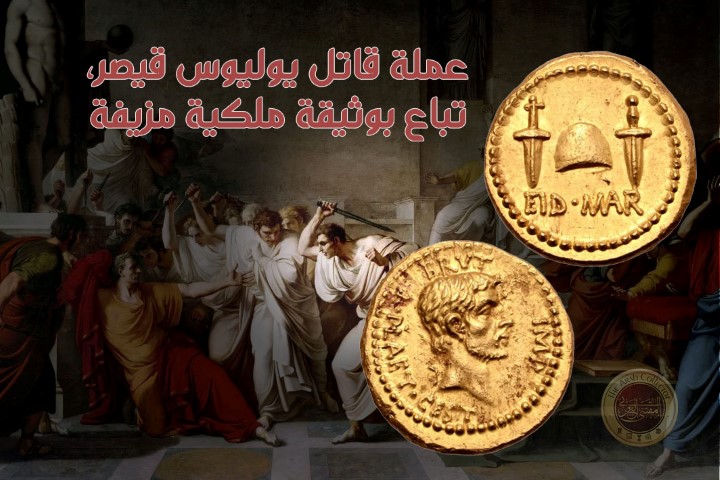
A forged document for the sale of the coin of Julius Caesar's assassin
One of the rarest coins in the world, the coin of Julius Caesar's assassin, was sold with a fake title deed, and the seller was arrested! What happened?
Aurelius Brutus (assassinator of Julius Caesar)
Richard Beale, owner and managing director of Roma Numismatics, a London-based auction house specializing in buying and selling ancient coins, was arrested in New York last January on multiple charges related to the sale of millions of dollars' worth of coins without proper documentation of ownership, including a model of a coin belonging to Julius Caesar's assassin, according to arrest warrants and a report from the US Department of Homeland Security obtained by the platform. ARTnews The media!
The currency in question (which served as the starting point for the investigation by the United States authorities) is one of the most valuable currencies in existence! .
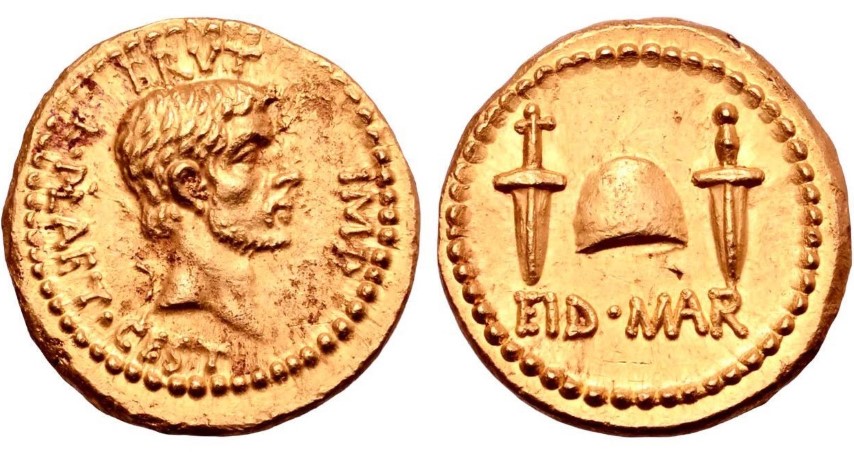
After Julius Caesar was killed by his friend Brutus, Brutus minted coins to commemorate the historic event of Julius Caesar’s murder. Only three examples of these “Mid-March” (Eid Mar) coins are known to exist worldwide in reference to Emperor Julius Caesar.
In 2020, Beale and Roma Numismatics set a world record for an ancient coin that may have been sold! The commemorative coin of Julius Caesar's assassination, shown below, was sold at auction. For approximately $4.2 million It now appears that the currency was sold using the wrong source! That is, the ownership documents on which the piece was traded from one group to another were forged. .
In a report by HSI Special Agent Brenton Easter, known for his work investigating smuggled antiquities, Bell (owner of the Roma Numismatics auction house) admitted to the scheme in what appears to be a plea bargain made to reduce his sentence. Because the investigation is ongoing, the HSI Special Agent was unable to comment further due to the confidentiality of the investigation, the results of which have not yet been made public. .
It seems the plan took years to prepare!
The 40-year-old Bill was a former member of the British Army, having suddenly entered the small-time coin trading business in London in 2009.
Christopher Martin, president of the British Numismatic Society, said about him in an interview with ART News:” It was like a lightning strike! ”L” , “LHe emerged and made his mark in a market where he didn't grow up! ”F”Within a year, he was selling millions of pounds worth of coins! This had never happened before, but that's what happened to him. Where did it come from? Nobody really knows. “.
At that time, Bell apparently built a modern coin auction house with the release of glossy catalogs and modern photographs that attracted the market to his auction house. .
Martin explained, unlike his colleagues, that he did not come to this field through family (that is, it was not inherited from his father), and he did not enter this business when he was young. Yes, he started in it slowly but steadily, and gained a reputation as an expert.
Other traders watched in awe when he began trading coins in the millions. Apparently to everyone he was inexperienced in the area where he worked, somehow he had ways of accessing valuable and rare coins. .
In 2014, Bill got his hands on what would become the most valuable antique coin ever sold on the market at that time. The piece in question was presumably acquired for him by Italo Vecchi, an Italian coin dealer who grew up in the UK. Over the decades, Vecchi's name became well-known in the coin world, first as an independent trader, then as an expert and partner with several large coin trading firms.
In the early 1990s, he worked for the American company CNG, but then, in 1992, Vecchi was caught in possession of a huge number of unauthorized Greek coins (which he had obtained illegally) while trying to enter the United States, causing some brief trouble for himself and the venerable CNG.
He even worked with the British Museum, where the museum has ten coins that appear to have been acquired from Vecchi, according to the museum's online records!
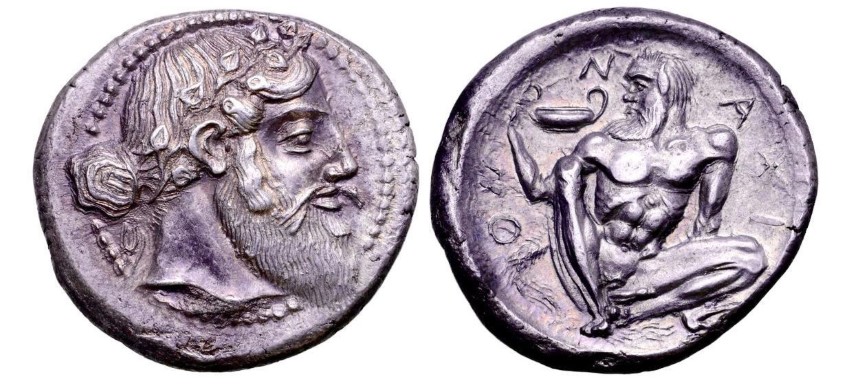
In his seventies, Vecchi began working as a consultant specializing in Rome Numismatics, where he not only brought the Brutus coin to Bell in 2013, but Vecchi also allegedly gave Bell what is known as the Sicilian Naxos coin, which was minted around 430 BC in the Greek colony of Naxos, depicting Dionysus on one side and Seleneus, his drinking partner, on the other. It is a very rare piece, which was offered at the same 2020 auction where the gold Brutus coin was sold, where the Sicilian Naxos coin fetched $291,682!!! .
However, before attempting to sell the coins through his auction house, Peel had originally tried to sell them directly to an unnamed party during the 2015 New York International Money Conference, held at the Waldorf Astoria Hotel in New York, where this person (of considerable stature and renown), known only as “Informant Number 1,” told Peel that the coin came from “Old Swiss collection”which he claimed was a well-known group in the antique coin trade. However, unable to convince any buyers at the conference, Bill and Vicky spent the following years preparing to forge ownership documents for the coin so that it could be sold at his auction house.”.
Around the world, there are restrictions on the sale or acquisition of antiquities and coins that have been in effect for a long time. Countries such as Italy and Greece have imposed restrictions on the import of ancient coins, and in some cases, they even demand the return of coins found in those countries. Navigating these rules can be very difficult for any dealer of these coins, especially since the culture around returning pieces obtained through illegal excavation methods to their homeland has changed.
Numerous examples of Brutus's danarius (silver coin) have been found throughout Europe, and their appearance has been confirmed throughout North Africa, even as far as India! So many examples have been confirmed in so many countries that it is extremely difficult to assess where they may have originally come from. .
It remains unclear how Vecchi obtained these coins and what problems they were trying to obscure by forging ownership documents. .
In the end, it was alleged that the couple (Bell and Vicky) paid for documents that claimed the coins were obtained from the collection of Baron Dominique de Chambéry. .
Another informant working with Esther (an expert at an auction house) told ART News that Vicky and Bill had contacted him to make a deal, in which they would give the expert who would be shown the coins $107,000 if he signed the forged papers regarding ownership of the pieces.
The informant told ART News that the expert refused to do so.
Prior to the sale of the coins in question at the last auction, it was alleged that Bell had shipped the coins to New York so that they could be authenticated by the Numismatic Guaranty Corporation, and when they passed the antiquity and authenticity examination, the authentication stage was the real deal for them!.
An official spokesperson for NGC wrote to the ART News news platform: “In 2020, NGC received the Oreos of Brutus coin ”EID MAR“ for appraisal from a London-based auction house and, after thorough examination, determined it to be authentic. The authenticity and grade of a coin are separate and distinct matters from its provenance. It is not common practice for NGC to comment on the provenance of a coin, and it did not do so here.“.
The downfall of the duo of evil and forgery
Finally, U.S. authorities seized the Sicily Naxos Coin and the Brutus Gold Coin (Julius Caesar). The Sicily Naxos Coin was seized at John F. Airport Terminal 1, according to a spokesman for the Manhattan District Attorney's Office, and the coins will be returned to their countries of origin.
Pell was charged with first and second-degree grand burglary, first and second-degree criminal possession of stolen property, fourth-degree conspiracy, and first-degree fraud scheme. The investigation into Vecchi is ongoing, and he has not yet been charged. Pell's scheme appears to have been uncovered after he sold five coins in 2022 that were later identified as stolen. Gaza.
For more similar topics, you can browse the Arab collector's website. the Link the next:
Gaza's forgotten treasure
Palestinian Currency Museum