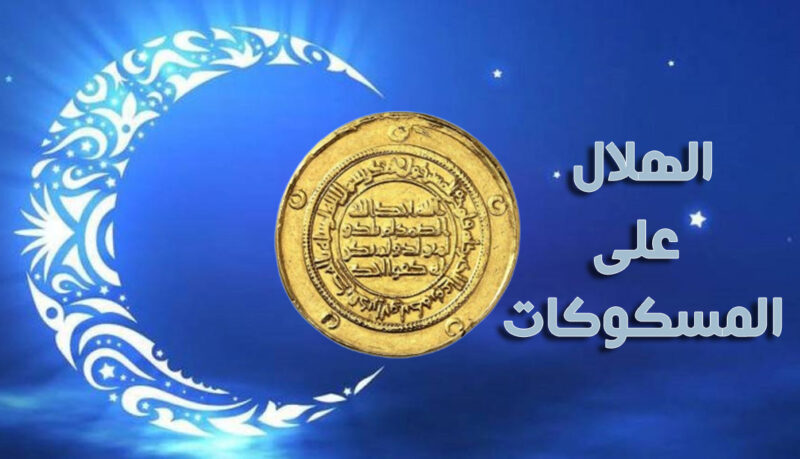
The crescent moon on coins
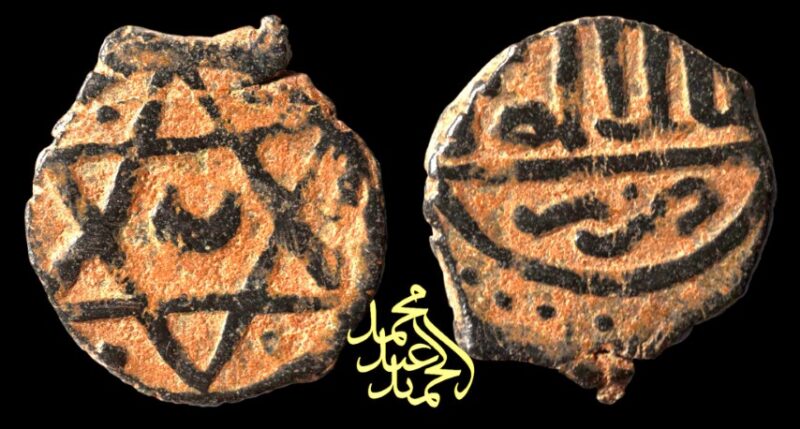
In celebration of the holy month of Ramadan and the sighting of its blessed crescent moon, let us examine the crescent on coins issued in Egypt throughout Islamic history and before. First, it is important to understand that the crescent is a symbol used on various types of coins, some Islamic and many others non-Islamic. We have chosen a striking example: a Mamluk fals (coin) of Sultan al-Mansur Ala' al-Din Ali ibn Sha'ban, which depicts the crescent within a six-pointed star.
Naturally, some may be surprised by the combination of the crescent and the six-pointed star in one piece. The truth is that the reason for this confusion is the lack of awareness that this star is merely a decorative unit that was commonly used during the Islamic eras, and it was never a religious or sectarian symbol at that time.
The crescent moon in the Umayyad era: weights and inscriptions
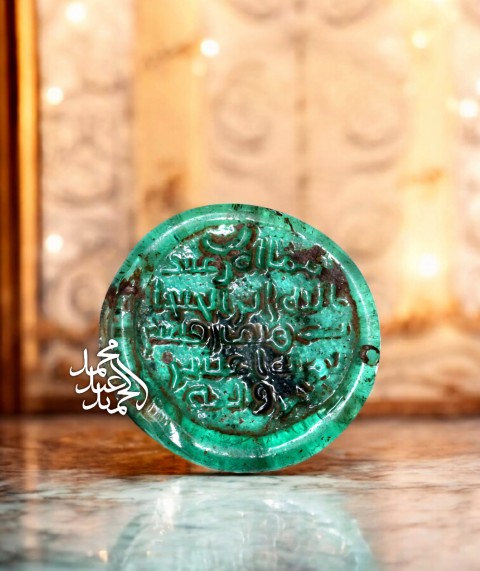
Moving on to the Umayyad era, we find Umayyad glass weight At the top, we see a miniature depiction of a crescent moon. In reality, the crescent plays a secondary role here; the most important element is the inscription in simple Kufic script: (From the order of Ubayd Allah ibn al-Habhab, a fils equivalent to eighteen carob pods). From this inscription, we understand that this weight was a "weight" for the fils, which was equivalent to the weight of 18 carob pods. It is worth noting that Prince Ubayd Allah ibn al-Habhab al-Saluli al-Qaysi was the governor of Ifriqiya under Caliph Hisham ibn Abd al-Malik, and he is famous for completing the construction of the Zitouna Mosque in Tunis.
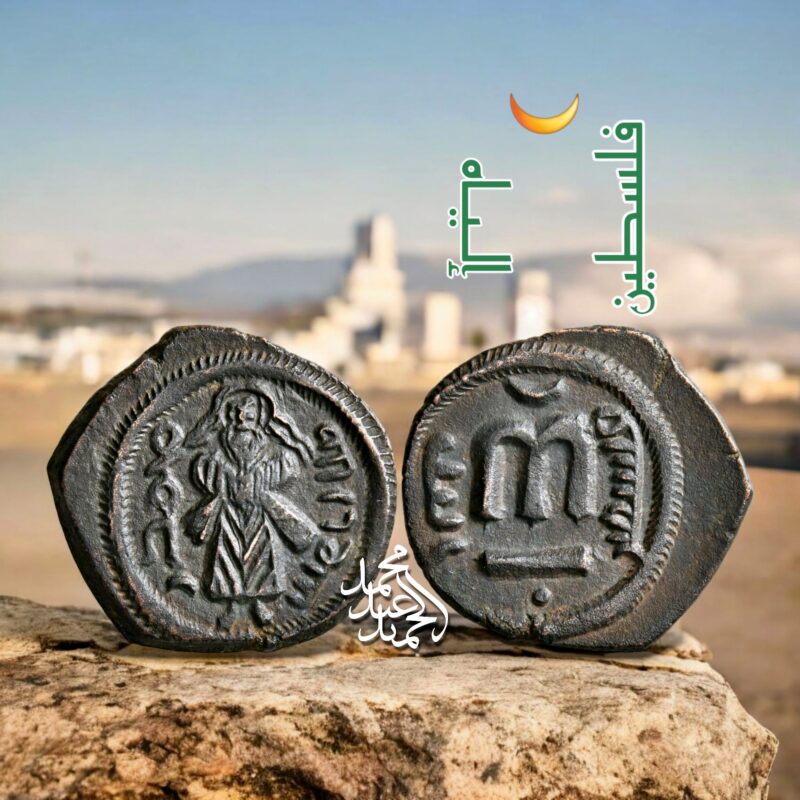
From the same era, we find an Umayyad coin, an Arabized version, featuring the caliph standing in Jerusalem. The obverse depicts Abd al-Malik ibn Marwan standing and holding his sword. The reverse bears the inscriptions "Palestine" on the right and "Iliya" on the left, meaning Aelia or Jerusalem as we know it today. At the top center is an image of the crescent moon; may God grant us and you the opportunity to pray in the first of the two qiblas and the second of the two holy mosques.
Unique styles: The crowned lady of Mosul
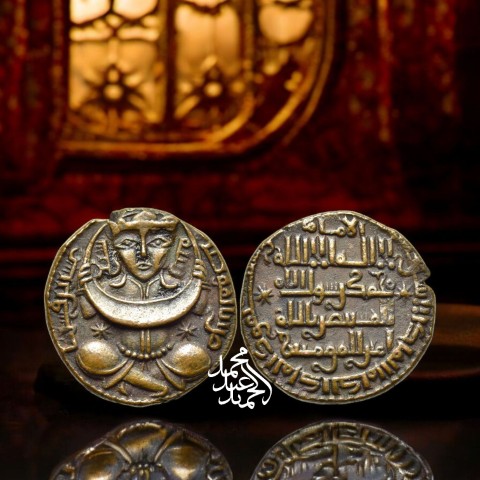
Regarding the most distinctive coins, we turn to Mosul during the reign of Atabeg Zengi Nasir al-Din Mahmud in 627 AH. As you know, the coins of the Zengid dynasty in Mosul and the Artuqids in Mardin were distinguished by unique styles among all Islamic coinage. On the obverse, we see a frontal depiction of a crowned lady seated cross-legged, holding a large crescent moon in her hands, while her clothing and appearance have a distinctly Turkish character. The inscription on the margin, from right to left, reads: "Struck in Mosul — in the year six hundred and twenty-seven.".
On the reverse, the inscription in the center reads: “The Imam, there is no god but God, Muhammad is the Messenger of God, Al-Mustansir Billah, Commander of the Faithful,” and on the circular margin: “The Perfect King, the Noble King, the Defender of the World and Religion, Atabeg Mahmud.” Of course, we could elaborate further on the depiction of the seated woman and explain the sequence of loyalties and alliances shown on the coin, but here we focus on the presence of the crescent as a key element.
The crescent moon in the Roman era: between astronomy and astrology
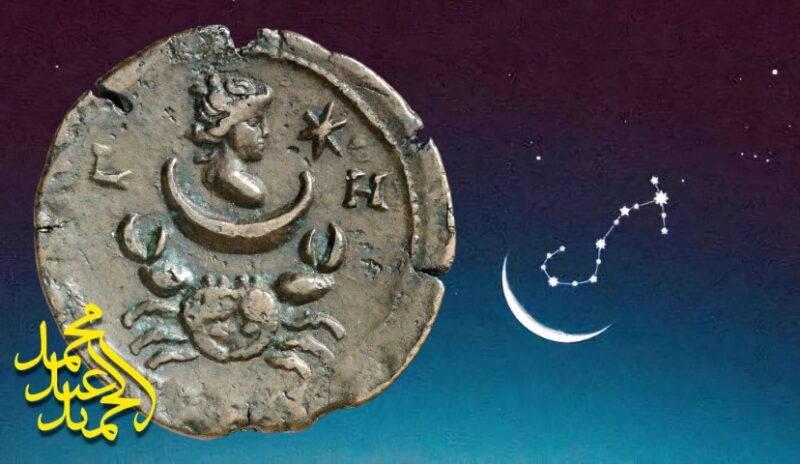
Looking at coins older than Islamic coinage, we find a very distinctive Alexandrian coin dating back to the Roman period in Egypt. Here, the crescent moon transcends its role as a mere symbol or artistic element; it plays a mathematical part within an "astronomical equation." This coin belongs to a famous series of issues known as the "Zodiac" collection, or the collection of constellations and celestial bodies.
On the reverse, we see an image of a crab surmounted by a crescent moon embracing a profile of the head of Selene, the moon goddess, with a small star to her right. Simply put, this design represents the moon's entry into the constellation Cancer (from June 21st to July 21st), when the crescent moon grows and obscures this celestial constellation. Here, we emphasize the vast difference between astronomy as a science and astrology as superstition. While astrologers claim this is an unfavorable time for marriage, we confidently say: "Marry whenever you wish.".
Lead coins and historical controversy
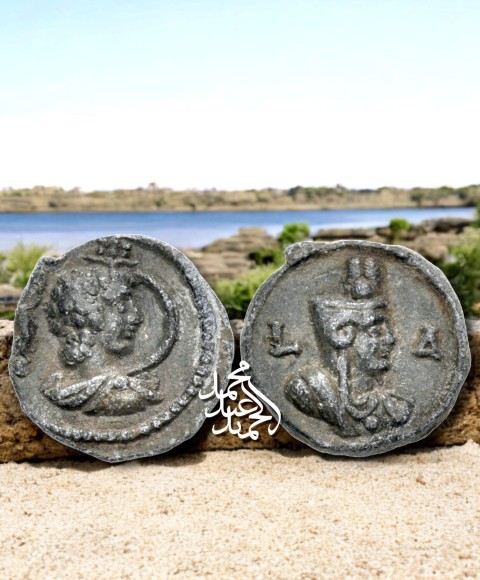
Among the Roman-Egyptian coins is one made of lead called the "Tessera." The obverse depicts the boy Antinoë (a favorite of Emperor Hadrian) in a deified form, and to the right, in front of the head, is a crescent moon adjacent to the face. The reverse shows a figure described as Horus, along with the inscription (LΔ), meaning "fourth year.".
These lead coins have sparked much debate regarding their purpose, uses, and value, and there is also controversy surrounding their minting location: was it Alexandria or Antinoopolis, the city built by Hadrian on the site where his servant drowned on the banks of the Nile? While Alexandria is currently the more likely location, future evidence may alter these hypotheses.
Dinars of Connection: A Golden Seal
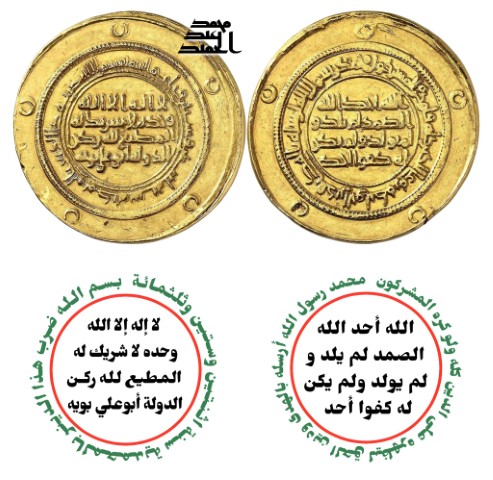
In conclusion, we return to Islamic coinage with a gold coin. Buhiyya A beautiful example of a "commemorative dinar" coin. This piece weighs ten dinars at once (42.85 grams) and was minted in the city of Al-Muhammadiyya in the year 362 AH. It bears the name of the Abbasid Caliph Al-Muti' followed by the name Rukn al-Dawla Abu Ali Buwayh. Of particular interest here is the five miniature crescents adorning the edge of each side of this unique coin.
Happy New Year, and Ramadan Mubarak.
For more similar topics, you can browse the Arab collector's website through the Link the next: