HistoryNumismatics
The Black Stone of Homs: A God's Journey from Homs to Rome
black Homs stone
The Syrian city of Homs is known in popular memory as the City of Black Stones, or the Mother of Black Stones, due to the abundance of dark basalt volcanic rocks that surround the city and have been part of its architecture for centuries. However, historically, Homs was known for one particular black stone, a stone that was not merely an element of nature, but a center of worship, a source of legitimacy, and a religious symbol whose influence reached the very heart of the Roman Empire.
This black stone represented a symbol of the Himyarite sun god «Elagabal».
The name "Ila Gabal" consists of two distinctly Semitic elements:
El: God
Gabal / Mountain: The mountain
The most likely meaning is: «God of the Mountain,» a title that is consistent with the nature of solar worship associated with elevation, light, and cosmic order.
This god was not embodied in human form as in classical gods, but was embodied in a black, cone-shaped stone, believed to be a celestial meteorite, representing the sun itself, not its image.
Historical evidence suggests that the worship of this deity predates Roman rule in Syria by centuries. Despite the absence of early texts, the nature of this worship places it within the traditions of the Semitic solar deities prevalent in the Levant and Mesopotamia.
With the Hellenistic period, Homs became an organized religious center, and the service of the god was entrusted to a hereditary priesthood belonging to the ruling elite of the city. The priest was not merely a religious figure, but also a bearer of political and social legitimacy.
The heart of this worship was the temple of Elagabal in Homs, where the sacred stone was kept and the rituals were performed. Roman sources confirm the antiquity of this temple and that it formed the center of religious life in the city.
However, unlike other Roman temples, no confirmed remains of this temple have yet been found. Researchers believe it stood within the ancient city center or on a symbolically significant high site, befitting the title "God of the Mountain." The area of Tell Homs (later the Citadel) is often cited as a possible location. The lack of archaeological evidence can be explained by several factors, including:
- Continuous settlement in Homs throughout the ages
- Stone reuse in Byzantine and Islamic times
- Religious transformations that led to the obliteration of pagan landmarks
Thus the temple remained present in the texts… absent from the land.
The first explicit references to the sun god of Emesa appear in the first century CE, when Emesa became a kingdom allied with Rome. The Sempsigramos family (Shamsi Gram), rulers of Emesa at that time, combined political power with priesthood, making the god a source of their legitimacy. Coins and inscriptions from this period confirm that the worship of Elagabalus was a distinctive element of the city's identity, even under Roman rule.
The god reached the zenith of his glory with the Severan dynasty. Julia Domna, daughter of a priestly family from Emesa and wife of Emperor Septimius Severus, was born in Emesa into the temple elite. Her sister's grandson, the young priest Elagabalus, ascended the throne of Rome in 218 AD, bringing with him the god of his city (his imperial name became Marcus Aurelius Antoninus, but he is referred to in historical texts by his ancient name, Elagabalus).
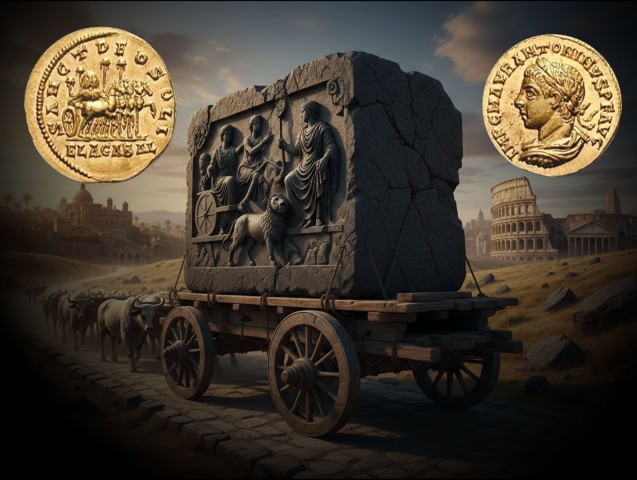
In an unprecedented move, the young emperor declared the sun god of Emesa a supreme deity, placing him above all others. Jupiter The same. So the Black Stone was brought to Rome, and a special temple was built for it on the Palatine Hill, and the Roman elders were forced to participate in oriental rituals that were alien to their traditions.
That moment was the culmination of the god's transition: from an unmarked temple in Homs, to the heart of the greatest empire of the ancient world.
However, this situation did not last long. In 222 AD, Elagabalus was killed, and official patronage was withdrawn from the god. Thus, the sacred stone was returned to Homs, and the emperor's name and policies were deliberately erased from official memory.
This was the last major mention of the Emesan sun god as an active force in political history.
Then, after the third century AD, references to his worship faded. With the rise of Christianity and then Islam, the rituals disappeared, and the memory remained scattered in the books of historians, on some coins, and in the name of a city that was once the center of the sun.
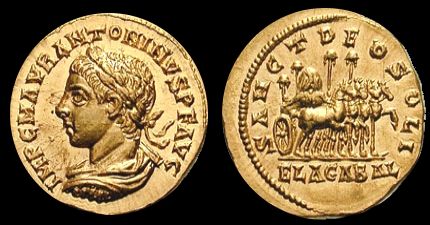
Image of the article:
A golden oreos from the reign of Emperor Elagabalus, on the reverse side of which appears the stone of the sun god Emesa being carried on a chariot drawn by four horses, and we see the name of the god Elagabal written under the horses’ feet.
For more similar topics, you can browse the Arab collector's website through the Link the next:
The crescent moon on coins