Numismatics
The secret of the two letters on Roman coins
What is the secret of the two letters on Roman coins?
In our next article, we will answer today's riddle. First, it's worth noting that one of our perceptive followers discovered something unusual in the image of the Orios we shared: the presence of the Latin letters SC. Roman coin collectors are accustomed to seeing these letters on bronze and copper coins, so why is it so strange to see them on gold coins? Let's explore together the meaning of these letters and the significance of their appearance on gold.
The letters SC on Roman coins: between symbolic legitimacy and golden exceptions
What does S•C mean?
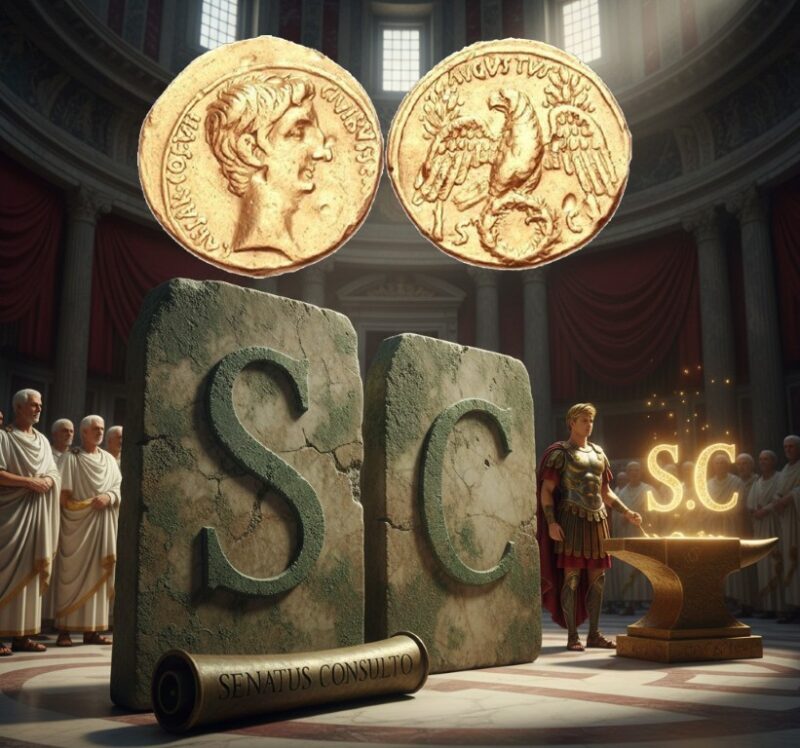
The letters S•C are an abbreviation for a Latin phrase: Senatus ConsultoIt means "by decree of the Senate." This phrase appeared on many Roman coins and indicated that the issuance of the currency had been approved by the Roman Senate, the legislative authority of the state.
The symbol S•C often appeared on coins made of bronze, copper, or brass. Some of the most famous of these were the cistertius, dupondius, and es. This was because these coins had a low intrinsic value; their value as metals was not equal to their market value, and therefore they needed legal tender to ensure their circulation.
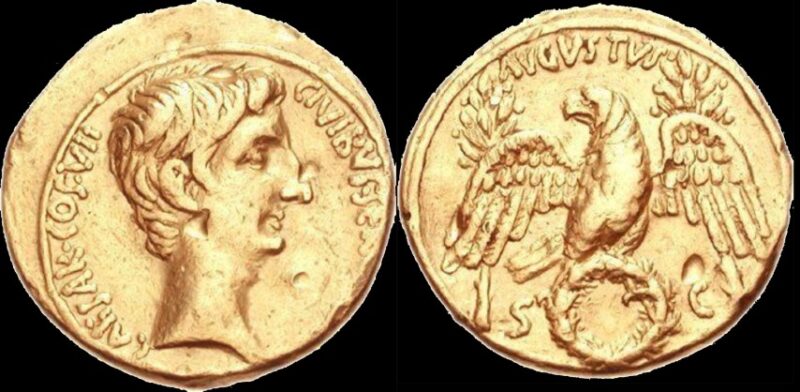
Gold coins (such as the aureus) and silver coins (such as the denarius) were issued directly by the emperor. Because these coins contained large quantities of precious metal, they did not require additional legitimacy; everyone accepted them due to their inherent metallic value, and therefore there was no real need to add the letters SC.
Despite the general rule, there are rare and interesting exceptions when these two letters appeared on gold coins:
Augustus' reign: A very few gold coins from Augustus' reign bore the letters S•C, probably as part of an attempt to show harmony between the emperor and the Senate, especially in the early imperial period.
Caligula's reign: The most notable exception comes from a rare gold coin issued during Caligula's reign, clearly bearing the initials S•C. This coin is believed to have been issued early in his rule, perhaps as an honorary gift or a token issue in collaboration with the Senate.
These small details reveal much about the nature of power in ancient Rome, and how the emperors in the early imperial era attempted to maintain a republican appearance. They also demonstrate the importance of legal legitimacy in issuing currency, especially currency of intrinsic value, and how monetary policy gradually shifted from a formal partnership with the Senate to absolute imperial control.
In conclusion, the letters “S•C” are not merely two letters on the face of a coin; they bear witness to a transitional phase in the history of Roman power. When they appear on a gold coin, they open a door to a deeper understanding of the dynamics of politics and legitimacy in the early and later stages of the empire.
For more similar topics, you can browse the Arab collector's website through the Link the next:
The Black Stone of Homs: A God's Journey from Homs to Rome