AuctionsNumismatics
Rare Zenobia coins up for Heritage Auction
The auction house ended on the morning of August 20th, Syrian time. Heritage The coins included two rare Syrian pieces, although they were minted in Alexandria, Egypt, but they formed a rare political document showing how a queen from Syria imposed herself at the heart of the Roman monetary system. Let's learn about these two coins and with them the story of Zenobia.,
In the mid-third century AD, the Roman Empire was experiencing a severe crisis known in history books as the Crisis of the Third Century. Multiple emperors vied for the throne, foreign invasions multiplied, and the economy collapsed due to hyperinflation and a loss of confidence in the currency. In this turbulent atmosphere, a queen from the East emerged, harboring imperial ambitions: Zenobia, Queen of Palmyra.
After the assassination of her husband Odaenathus, who had been granted the title of "Governor of the East" by Rome, Zenobia assumed power in 267 AD as regent for her young son, Vaballathus. This powerful woman did not settle for a secondary role; she proclaimed herself Augusta (Empress) and demonstrated exceptional political and military acumen. Within a few years, she expanded the Palmyrene kingdom to include:
The Levant, Asia Minor (modern-day Turkey), Mesopotamia, and Egypt, which was the most important source of wheat in the Roman world, thus Zenobia became the undisputed mistress of the East, ruling strategic lands linking trade routes from India to the Mediterranean.
Initially, Emperor Aurelian was in no hurry to confront Zenobia, preoccupied as he was with restoring order to the west after a series of disturbances and schisms. He allowed her to consolidate her control over the east for several years, until it seemed as though her rule was now a fait accompli. But once he had established his foothold in the west, he moved eastward with a powerful army, confronting her at Antioch and then decisively defeating her at Emesa in 272 CE, before besieging and capturing Palmyra. Although Palmyra revolted again in 273 CE, the city was finally destroyed, and the chapter of Zenobia's empire closed forever.
Her fate after her capture remains a subject of debate: some sources assert that she was executed, while others indicate that she lived in Tivoli near Rome and married a Roman senator. Her son, Vaballathus, was taken with her to Rome, where he disappeared from the records.
Among the few surviving evidence of Zenobia's reign are her coins, minted in Antioch and Alexandria. The most notable of these are the tetradrachms (four drachmas) made of pellion, an alloy of silver and copper. These coins depict Zenobia wearing the crowns and titles of Roman emperors, a clear declaration of her independent authority.
It is worth noting that the years during which ISIS controlled large areas of Syria and Iraq (2014–2017) saw a significant increase in the appearance of Zenobia coins and other artifacts on the global market. The organization systematically looted archaeological sites and permitted illegal excavations in exchange for taxes. Because the coins are small and easy to smuggle, they became prime targets for black market traders, and a number of them leaked into international markets.
For this reason, experts stress the importance of checking the provenance when purchasing such rare items, and relying only on trusted auction houses, in order to protect heritage from illegal trafficking.
Zenobia was not merely a local queen, but a potential global empress. She defied Rome at its weakest point and ruled an empire that stretched from the Nile to the Euphrates, not just in its ancient form. Yet, the few coins that survive today remind us that history is not only written with swords, but also imprinted on the faces of money.
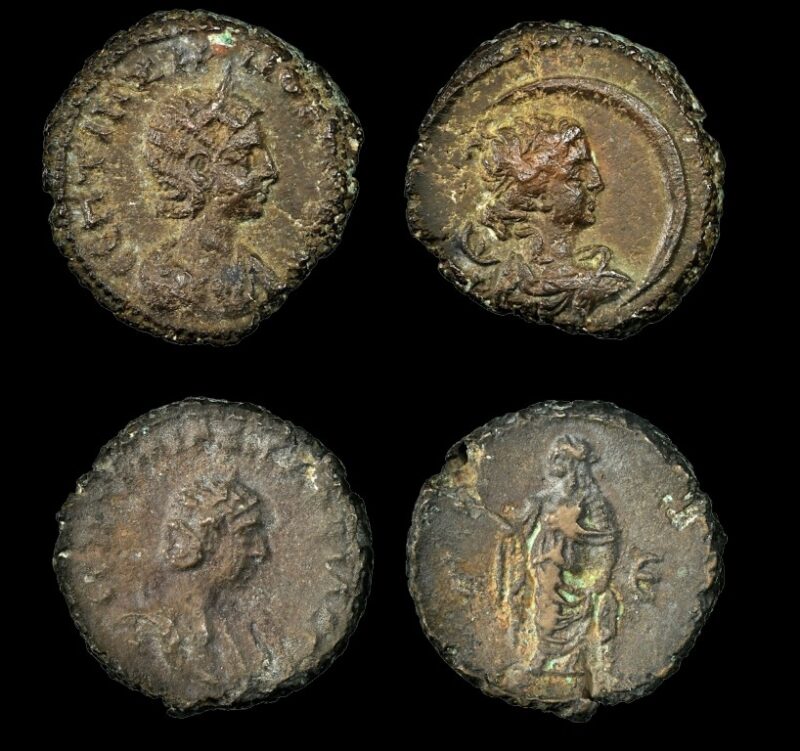
The image accompanying this article shows two coins from Zenobia's era that were sold at auction today. The first, from the top, fetched $2,000 USD, and the second, $1,300 USD. Both are Tetradrachms (pilons) minted in Alexandria in 272 AD.
For more information, you can browse the Arab Collector website through the Link the next: