Numismatics
Siege money: When palace ingots become soldiers' currency
Siege money, also known as "necessity money," is an interesting aspect of monetary history. These coins were issued during periods of war or invasion, particularly when a city or town was under siege.
The need for this currency arose due to the disruption of monetary circulation during wars, which led to a shortage of coins in circulation. Because trade needed to continue and salaries, especially soldiers' salaries, this currency was minted to fill the gap.
Siege money has been known since ancient times, but its use became more widespread from the late 15th century onwards. This was perhaps due to the increase in battles and sieges, particularly in Europe. These coins were made from readily available materials, including precious and non-precious metals, and even cardboard.
The Eighty Years' War (1568-1648): During theSpanish siege of Leiden In the Netherlands (1573-1574), the authorities issued silver coins of a certain shape, and when the silver ran out, they used the same mold to print money on cardboard, which represented one of the first uses of paper money in Europe.
The English Civil War (1642–1651): Several military garrisons issued their own siege coins, including Carlisle, Scarborough, and Newark-on-Trent. The Newark siege coins are particularly notable for their abundance; a significantly larger number have survived compared to other similar coins.
The Siege of Khartoum (1884-1885): During this siege, the British Governor-General of Sudan, Charles George Gordon, issued paper money.Read Money for the siege of Khartoum)
| Siege / City | Year | Material used | Historical value |
| Leiden (Netherlands) | 1574 | Cardboard (church books) | First paper money in Europe |
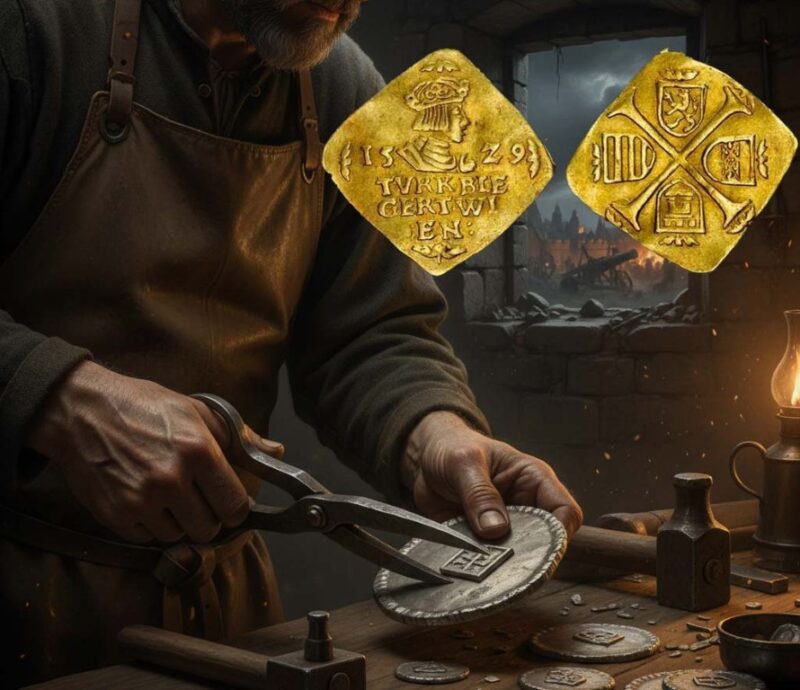
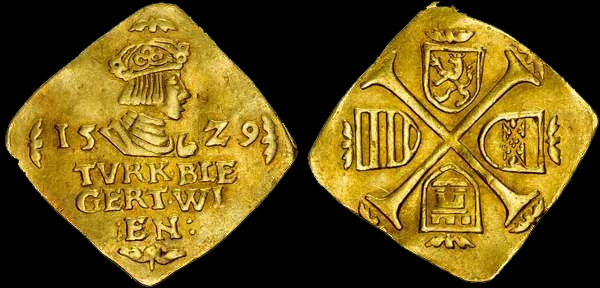
| Vienna (Austria) | 1529 | Gold and silver (treasures of the altars) | rare gold ducats |
| Newark (England) | 1646 | Silver (cut-out tableware) | distinctive diamond shapes |
| Scarborough (England) | 1645 | silver | It sold for £42,000 |
Why were coins minted in non-circular shapes?
Siege coins were often made in unique, non-circular shapes, for several practical reasons, the most important of which were:
Optimal use of materials and reduction of waste: During the siege and scarcity of resources, it is important to reduce waste where non-circular shapes such as squares or rectangles allowed, improving the efficiency of using available metals.
Ease of production: Non-circular coins can be produced more quickly and easily using the limited tools and facilities available during the blockade, as there is no need for the precision machinery required to create circular coins.
Ease of differentiation: The unique shapes helped to distinguish the siege coins from regular coins. This may help in collecting them in the future when they are no longer needed, so that they can be recycled as regular currency issues.
Due to their historical significance and the unique circumstances surrounding their issuance, Siege coins have become highly sought after by collectors who are willing to pay exorbitant prices to acquire them. For example, a rare Scarborough Siege sixpence coin (from the English Civil War) sold for £42,000 in 2011.
Siege money offers a unique window into the past, reflecting the resilience and ingenuity of people during times of conflict. It is not merely pieces of metal or paper, but stories of survival and adaptation in the face of adversity and hardship.
The churches went to Suleiman the Magnificent
A gold ducat that was minted in Vienna during the siege of the city by the Ottoman forces led by Suleiman the Magnificent in 1529. The siege lasted about two and a half weeks and the Austrian authorities were forced to melt down the gold treasures in their palaces and churches to convert them into coins like the one in the picture to pay the soldiers defending the city.
For more similar topics, you can browse the Arab collector's website through the Link the next:
Sale of the Danish West Indies