In a previous post, we asked a question about a currency from the Danish West Indies and inquired about its relationship with Greenland and the United States of America. In today's post, we will tell you an interesting chapter from history, a chapter that will help us better understand the present and the Trumpian claims (referring to Trump) to annex the island of Greenland, which is under Danish control. Let's start with the West Indies...
The Danish West Indies (comprising the Caribbean islands of Saint Thomas, Saint John, and Saint Croix) had been a Danish colony since the 17th century. These islands played a significant role in the transatlantic slave trade and the rum and sugar industries, which formed the mainstays of the colony's economy.
In the second half of the 19th century, the cost of maintaining these islands far outweighed the economic benefits, and the Danish government began attempting to sell or exchange them. It unsuccessfully tried to swap the islands with Prussia (later Germany) in order to regain some of the territory it had lost in its last war with Prussia.
From the beginning of the 20th century, Denmark faced increasing economic pressures and challenges, forcing it to relinquish its colonies in the Danish West Indies. Simultaneously, the United States was interested in expanding its strategic presence in the Caribbean to protect the Panama Canal (then under US control) and enhance its naval capabilities.
The $25 million golden deal
As a result of this convergence of interests between Denmark and the United States, negotiations began between the two parties to agree on the sale of the islands. These negotiations culminated in the signing of a treaty. West Indies Danish on August 4, 1916.
The treaty stipulated that Denmark would sell the islands to the United States for $25 million in gold. The sale was finalized on March 31, 1917, and the islands were renamed the U.S. Virgin Islands.
This treaty also included, at the request of the Danish side, a clause stating that “the United States of America does not object to the Danish government extending its political and economic influence over the entire island of Greenland.” Denmark insisted on including this clause in the treaty in order to close the door in the future to any American claims to the island, especially the northern parts of it, which many American missions contributed to discovering.
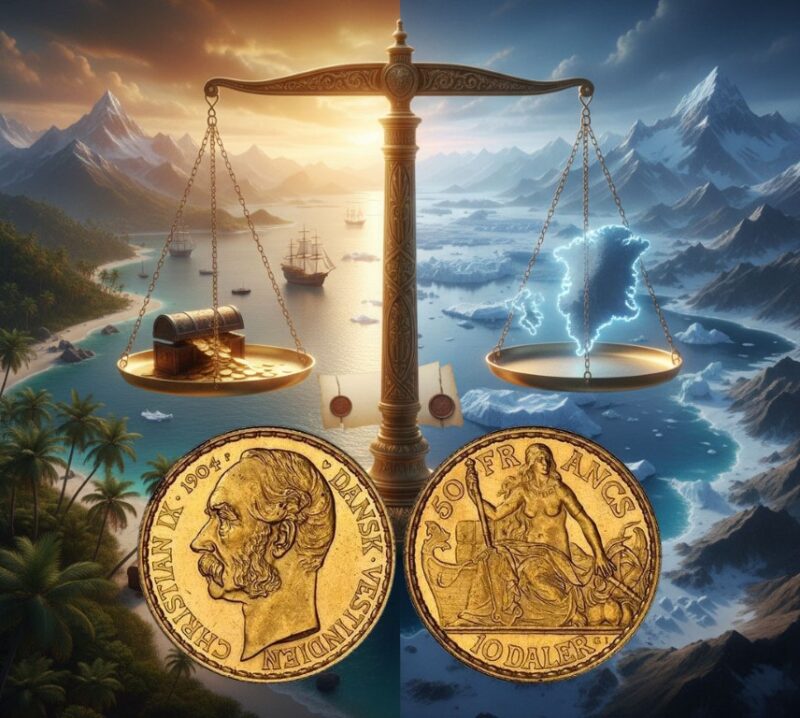
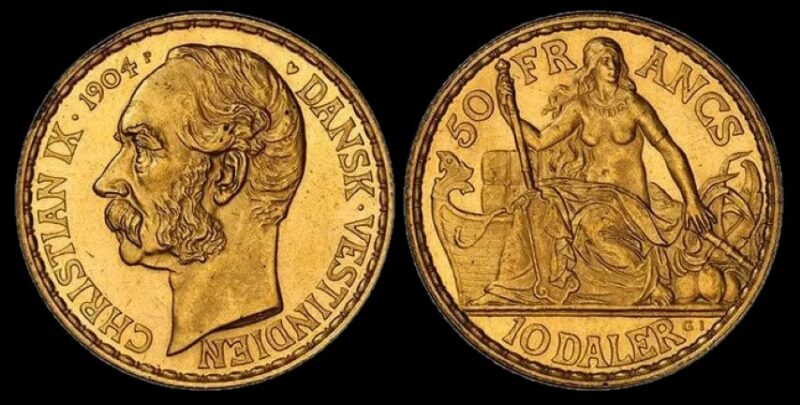
The image is of one of the most beautiful and last gold coins of the Danish West Indies. What makes this coin unique, besides its beautiful design, is that it has a face value of two currencies: fifty francs and ten dollars simultaneously.
Greenland: The clause that changed the map of the North
At that time, the strategic importance of the Danish West Indies was far greater than that of Greenland, especially if Germany decided to pursue the islands. Therefore, the United States had no qualms about relinquishing its claims to Greenland in exchange for these islands. This recognition was extremely important for Denmark, as Greenland held significant strategic and economic value.
From 1917 to today: Why is Trump claiming Greenland?
Have you ever wondered why former US President Trump offered to buy Greenland? The answer lies in a historical precedent. In 1917, America purchased what is now known as Greenland. Virgin Islands From Denmark with a successful business deal.
Historically, the United States has considered Greenland to fall within its sphere of national security (the Monroe Doctrine), and the 1916 treaty was the only time Washington formally recognized Denmark's full sovereignty over it in exchange for the cession of the Caribbean islands. Therefore, these recent claims are an attempt to reopen old wounds that were sealed with gold more than a century ago!
For more similar topics, you can browse the Arab collector's website through the Link the next: