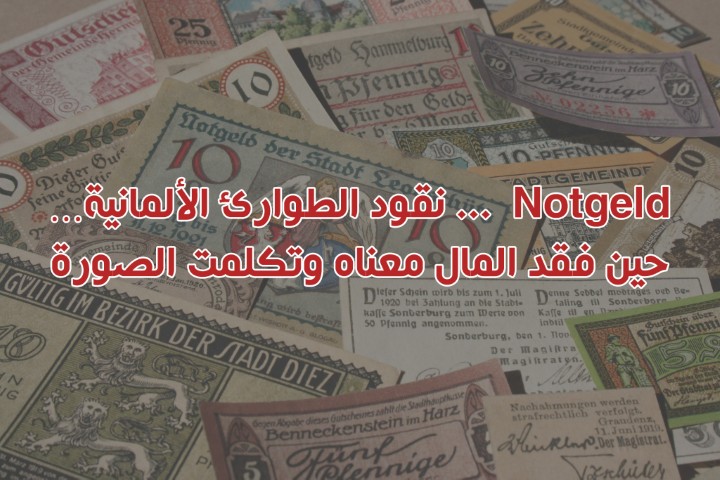
Notgeld… German emergency money
When money lost its meaning and the image spoke
The seasoned collector of banknotes is not drawn to nominal value or mere rarity alone, but to that kind of currency that seems to defy convention and carries an exceptional story. What truly fascinates them is the "unusual"—the note that is not merely a forgotten medium of exchange, but becomes a small narrative artifact, opening a window onto a turbulent world and an extraordinary historical circumstance.
This collector is always looking for currency that poses questions before it gives answers: Why was it issued? At what critical moment? And to whom was it addressed? Every unfamiliar detail — a satirical drawing, an informal text, poor printing material, or a design outside of classical taste — becomes a thread that leads him to a wider story, where politics, society, and the human psyche intersect on a limited paper space.
Here, the Notgeld, or German emergency money, stands out as a vivid and rich example of this type of currency. It did not emerge from a normal monetary context, but rather from the heart of an economic and social collapse during the 1920s. It was not issued by a stable state, but by cities, municipalities, and businesses struggling to survive. Therefore, it was not a silent document, but a speaking one, filled with local drawings, symbols, satire, and texts that attempted to explain a world that had lost its balance.
For the discerning collector, Notgeld represents the pinnacle of collecting pleasure: a coin that tells a story, reflects an identity, and reveals how money, in a moment of crisis, transforms from a tool of account into a space for cultural expression. It is a living example that the most exciting coins are not necessarily the most expensive, but rather those that hold within them a whole world waiting to be discovered.
The birth of emergency money
Germany did not enter the 1920s suffering from an ordinary economic crisis, but rather as a country emerging from a heavy military defeat, burdened by reparations. Treaty of VersaillesExhausted by weak production and a loss of confidence, the national currency was further weakened by the government's resort to printing money without backing. Inflation accelerated until the currency became a daily burden. The mark was no longer a stable means of saving or exchange, but rather a number that fluctuated from morning to evening, in a scenario that paved the way for a complete collapse in the meaning of money.
At the heart of this turmoil, the notgeld emerged as a local, makeshift solution. Issued not by the central government, but by municipalities, small banks, and businesses, its purpose was to keep markets functioning. These notes were valid only within a limited geographical area, and their acceptance depended on local trust rather than monetary backing. Thus, a fragmented monetary system emerged, reflecting the disintegration of the centralized economic order.
When the city becomes currency
Notgeld was more than just paper money; it was a declaration of identity. Each city imprinted its history and landmarks on its currency: churches, castles, bridges, ancient squares. In a time when the state had lost its ability to control, the city itself became a unit of trust, and the currency an extension of local belonging, telling people that stability, however temporary, began there.
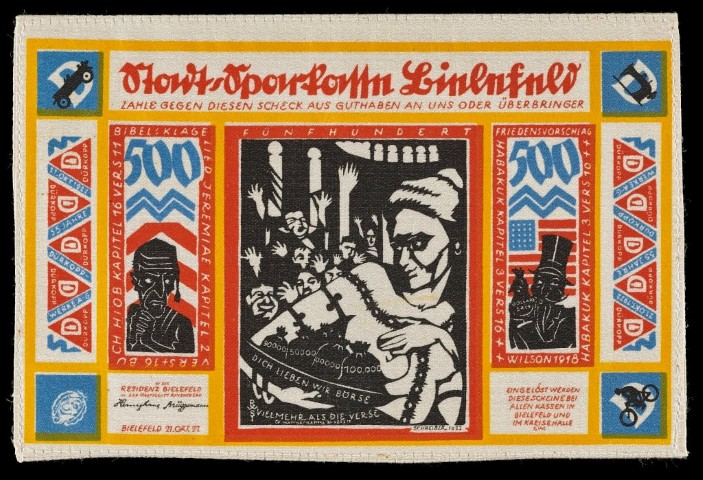
Drawings as a social document
Notgeld presented a rich visual world: drawings of peasants in the fields, workers in factories, and craftsmen in workshops. These images were not neutral; rather, they expressed society's view of true value: labor and production. In contrast to worthless paper, these drawings restored the value of human effort as the foundation of the economy.
Irony as a form of resistance
In many editions, the designers resorted to satire and caricature. Huge bags of money are carried aimlessly, children play with banknotes, a scale tilts under the weight of empty numbers. These satirical drawings were not artistic indulgence, but a form of cultural resistance, an attempt to understand the catastrophe through visual critique.
Text and image: dual language
Notgeld didn't stop at just the image; it combined drawing and text. Warning phrases, explanations of the reason for issuance, verses of poetry and proverbs, and sometimes patriotic messages—the banknote became a small cultural publication, explaining its own crisis and addressing its user directly.
Numbers that swallowed the meaning
As inflation accelerated, nominal values ballooned into millions and billions of marks. Along with them, the quality of printing and paper began to decline. Fine details vanished, but the message remained: numbers, when divorced from reality, lose their power to express meaning. These banknotes were a visual testament to the moment when value and numbers blurred.
Limits of a local solution
Economically, Notgeld was not a radical solution. It did not stop inflation, nor was it backed by strong assets. But it played an important social role, maintaining a minimum level of trust within local communities and giving people a temporary sense of control in a time of chaos.
From trading to memory
With the introduction of the Rentenmark in 1923, the need for the Notgeld diminished, and its monetary function ended. But it didn't disappear; instead, it moved from pockets to archives and museums. Today, these notes are read not as currency, but as historical and visual documents that tell the story of the collapse of a society and a system.
Value beyond paper
The current value of the Notgeld lies not in its printed numbers, but in its rarity, its designs, and its historical context. It has become sought-after by collectors and a rich resource for scholars of economics, history, and the arts, because it demonstrates how money, in a moment of collapse, transformed into a space for cultural expression.
When the economy fell silent, the image spoke.
In ordinary times, money performs a silent function: a printed number, an agreed-upon value, and a medium of exchange that requires no explanation. But when it loses its economic meaning, it doesn't necessarily disappear; rather, it may transform into something else. This is what happened in Germany during the hyperinflation of the early 1920s, when money ceased to be a financial instrument and became a visual cultural expression, conveying what economics could not.
With the collapse of the mark's value, the number written on the paper could no longer represent reality. Millions and billions no longer made a significant difference in people's lives. Here, a dangerous disconnect occurred between the symbol (the number) and the meaning (the value). In this void, the image, the drawing, and the written word stepped in to fill what economics had failed to explain.
Notgeld banknotes were born primarily as a practical solution, but their design was anything but neutral. The municipalities and companies that issued them understood, consciously or unconsciously, that public acceptance would depend not only on their face value but also on how people felt about them. Thus, the banknote became a medium of communication. The images were not mere decorations but messages: an image of an old church signified continuity, a depiction of a farmer in a field meant that work was still going, and a scene of a local market suggested that life hadn't stopped despite the currency's collapse.
In many cases, images played a psychological role before they played an economic one. They reconnected people to what was familiar and constant, at a time when numbers had lost their ability to provide reassurance. When a citizen sees a landmark of their city on a banknote, they don't see a "monetary value," but rather a sense of self and belonging. Thus, money became a medium of identity, not merely a medium of exchange.
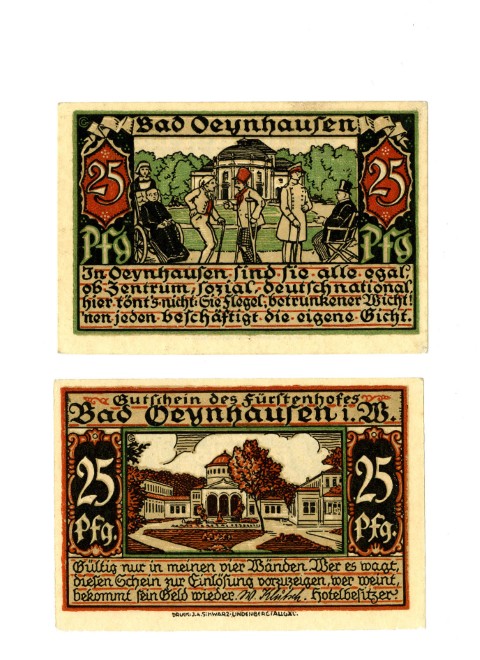
Most telling is the use of satire and caricature in some Notgeld publications. Historically, satire has been a tool societies use to cope with helplessness. When reality becomes too harsh to bear, it becomes fodder for ridicule. The drawings depicting people carrying enormous bags of money, or children playing with marks, were not merely documentation of absurdity, but a collective acknowledgment that the monetary system had lost its legitimacy. These drawings said what official statements could not: that money no longer reflected work or value, but had become a symbolic burden.
The accompanying texts also transformed into a form of narrative. Some banknotes explained their issuance, others contained warnings or moralizing statements, and still others incorporated poetry or proverbs. Here, the banknote was no longer a financial document, but a small cultural publication, explaining its own crisis. In a moment of institutional collapse, societies turned to language and art to interpret their circumstances.
It is striking that this shift was not planned within a conscious cultural policy, but rather arose spontaneously, as a collective reaction to a loss of control. When the state lost its monopoly on critical discourse, this discourse moved to the local level. Cities spoke their own language, their own art, their own colors. Thus, Notgeld became a visual archive of the multiplicity of voices within a society in crisis.
This explains why these notes remain, even today, more interesting than the official currency of that period. While official currency says what the state wanted to say, the Notgeld says what people actually felt. It expresses fear, nostalgia, anger, sarcasm, and hope, all within a small space no larger than a banknote.
In the world of banknote collecting, Notgeld's satirical editions hold a special place, for they reveal the informal face of the crisis, when money could no longer fulfill its function and was forced to "speak" in the language of irony. These banknotes don't present inflation as a number or economic statistic, but rather as the daily absurdity people experience and laugh at bitterly.
Some of these papers contain shocking caricatures: citizens pulling carts laden with piles of cash to buy bread or coal, children playing with mark notes as if they were worthless, or figures carrying bags of money with a burden that far outweighs their usefulness. In these images, the crisis is not condemned directly, but rather exposed through satire, as if the artist is saying that reality has become too harsh to be recounted seriously.
Other models have resorted to animal or imaginary symbolism: donkeys or cartoon characters associated with money production, in a biting reference to an economy now run on an absurd logic. Sometimes the scales appear unbalanced under the weight of huge, meaningless figures, or a machine that prints money endlessly while the people around it grow poorer. Here, the currency becomes a concentrated political and social caricature, understood by the user without explanation.
What's striking is that this satire wasn't marginal or subtle, but rather printed on the currency itself. Some editions accompanied the drawings with satirical texts or sarcastic phrases, warning of inflation or mocking the rapid devaluation, making the banknote resemble a small protest leaflet passed from hand to hand. It's a rare moment when money itself becomes a tool for criticizing money.
In these banknotes, Notgeld reaches its zenith as a cultural document. It preserves not only the history of the economic collapse but also the bitter humor that society resorted to in order to endure the unbearable. For this reason, these banknotes remain among the most compelling issues, as they demonstrate that irony was not an escape from the crisis, but rather a way of understanding and resisting it.
The Last Money Lesson
Ultimately, Notgeld's experience reveals that culture isn't confined to museums or books; it can emerge from the heart of crisis, even in the most everyday and mundane objects. When the economy collapses, meaning doesn't disappear; it seeks a new vessel. In 1920s Germany, it found it in money itself, which, having lost its primary function, acquired a deeper one: to tell a story, to explain, and to leave a lasting impact.
This is why the seasoned collector is particularly drawn to these models. They not only represent the era of hyperinflation, but also how people understood and psychologically experienced their crisis. Official currencies say what the state wanted to say, while the satirical Notgeld expresses what people actually felt: astonishment, anger, and dark laughter in the face of a reality that had lost all meaning.
Written by Ahmed Al-Gharib
For more similar topics, you can browse the Arab collector's website through the Link the next: