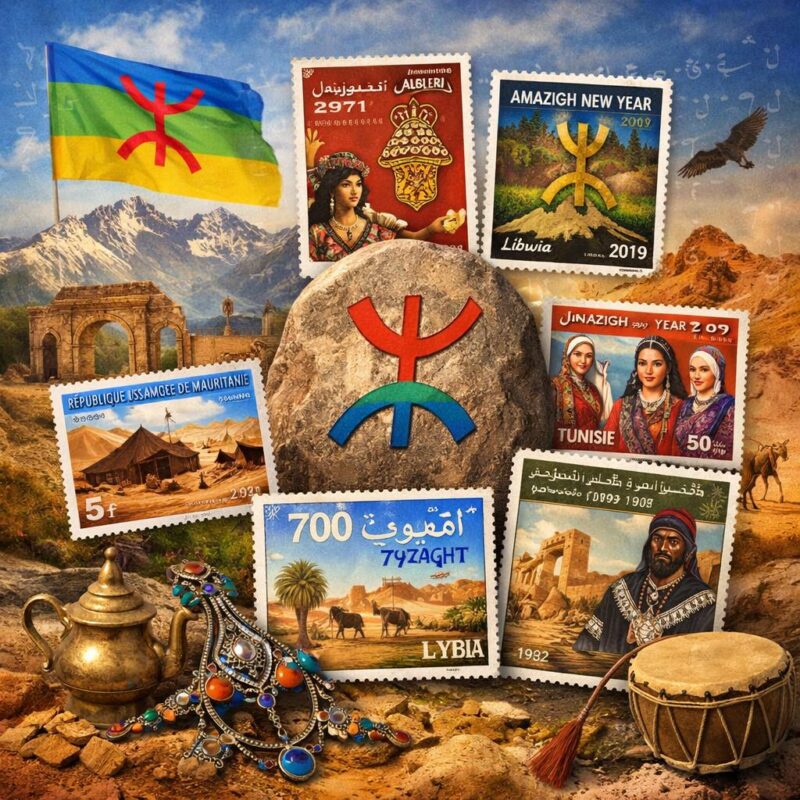
Maghreb postage stamps related to Amazigh culture
Postage stamps constitute an official visual record reflecting a country's choices in representing its cultural and historical identity. They are not limited to performing a postal function, but rather become a miniature cultural document that expresses national memory and the civilizational elements that a country chooses to enshrine within its symbolic discourse, both domestically and internationally.
In the Maghreb region, Amazigh culture is an authentic and deeply rooted component of the region's history, and its presence—to varying degrees and in different ways—is reflected in the official postal issues of the Maghreb countries. This article aims to provide a comprehensive and integrated documentary overview of all official postal issues related to Amazigh culture in the Maghreb countries, from the beginning of each country's stamp issuance to the present day, including recent issues not yet listed in philatelic catalogs.
The methodology adopted in documenting and analyzing Postage stamps
This article adopts a documentary-analytical approach, combining a chronological inventory of official postal issues with a contextual reading of their cultural content. The research scope is geographically limited to the Maghreb region and chronologically spans from the beginning of official postal issuance in each country to the most recent published issues.
On the documentation side, the work was based on two complementary sources:
The approved stamp catalogues are used to document historical and classic issues, announcements, postal platforms and official statements of national postal administrations, in order to include modern issues that have not yet been included in the catalogues due to time delays in updating.
Documentation is not limited to publications that explicitly mention Amazigh culture, but also includes publications that address it in content and cultural context through language, occasion, or heritage elements with Amazigh roots, as long as they are included within the framework of official state postal publications. From an analytical perspective, the postage stamp is read as an official cultural document, without assuming unsubstantiated meanings or projecting interpretations beyond the visual and official text of the publication.
 Algeria Amazigh as a direct institutional recognition
Algeria began issuing its postage stamps after independence in 1962. The first direct representation of Amazigh culture appeared relatively early on, in 1966, with the issuance of the "Traditional Crafts of Greater Kabylia" stamp. This stamp was the first Algerian stamp to address Amazigh culture in terms of content, geographical designation, and cultural significance. This issue marked a foundational point in integrating the Amazigh dimension into Algerian postal discourse, highlighting traditional crafts associated with the Greater Kabylia region as an authentic expression of the national heritage.
This early issue, during the late 1960s and 1970s, was followed by other stamps on traditional Algerian clothing, and then stamps on folk arts and traditional crafts, where the inclusion of Berber elements continued within the framework of the general national heritage, without a direct linguistic designation at that stage.
With the dawn of the new millennium, particularly in 2001, stamps were issued commemorating cultural and intangible heritage. A significant shift occurred in 2018 with the issuance of a stamp for the Amazigh New Year (Yennayer), explicitly naming the occasion. This trend deepened in 2020 with the issuance of a stamp for the President of the Republic's Prize for Amazigh Literature and Language, representing direct institutional recognition. This approach has continued in subsequent years with new stamp issues related to Yennayer and intangible heritage, announced through official postal channels.
In this context, a highly significant development in the history of Algerian stamps was recorded: on February 11, 2025, the name “Algeria” was first included in official postage stamps written in Tifinagh script. This measure marks a pivotal moment in the representation of Amazigh culture, as it moves the stamp from a level of heritage or ceremonial representation to a level of direct linguistic representation of national identity, and enshrines Amazigh as a language present on the stamp alongside the other officially recognized languages.
This development represents the culmination of a cumulative process that began in the 1960s with heritage representation, then with institutional recognition of the occasion and language, reaching in 2025 a permanent official linguistic presence in Algerian postal design.
 Morocco Berber culture in terms of character and language
Groupe Barid Al-Maghrib – Moroccan Post Group
Morocco is one of the oldest Maghreb countries in the history of postal issuance. After independence in 1956, Amazigh culture appeared within heritage publications without direct naming, particularly in series on traditional clothing, folk arts and traditional crafts.
Starting in the second decade of the 21st century, the integration of the Amazigh language (Tifinagh) into the front of the stamp within special multilingual issues emerged, especially after the 2011 constitution. This trend continued in subsequent institutional and cultural issues, including stamps of Moroccan cultural heritage and intangible heritage, where Amazigh is integrated as a natural component of national identity.
 LibyaAmazigh culture as a national cultural event
Libya began issuing its postage stamps after independence in 1952. During the early decades, Amazigh cultural elements appeared on stamps depicting traditional costumes and folklore within the broader framework of national culture. However, 2019 marked a turning point with the issuance of a stamp for the Amazigh New Year, directly naming the occasion—the first explicit contemporary inclusion of Amazigh culture on Libyan stamps. This was followed by subsequent issues featuring cultural heritage and events, incorporating elements with Amazigh roots.
 TunisiaHistorical and cultural presence in visual memory
Postal issuance in Tunisia dates back to July 1, 1888, the date that marked the release of the country's first official postage stamp. From that early stage, local culture was reflected in Tunisian stamps through general representations of daily life and social patterns, before later developing issues with a heritage theme.
The Amazigh presence appears in Tunisian stamps mainly within historical and heritage representations documented in stamp catalogs, especially in stamps of the 1950s that dealt with scenes of traditional life, and then in later issues on traditional arts and folk dress during the 1960s and 1970s, where the Amazigh style is dominant in some of the costumes and jewelry associated with Tunisian regions with a historical Amazigh extension.
As part of its intangible heritage, Tunisia has issued stamps featuring traditional cuisine, including couscous, a shared cultural element with clear Berber roots in the Maghreb region. More recent heritage issues have also included stamps depicting traditional clothing and jewelry from certain Tunisian regions, where the Berber influence is evident in the shapes, motifs, and materials used, even without direct linguistic references.
This approach reflects a Tunisian pattern in postal representation, based on including Amazigh culture within the national and intangible heritage through food, clothing, and adornment, without adopting an explicit name, while preserving its visual and cultural presence within the postal memory of the state.
 MauritaniaAmazigh culture within the Maghreb-Saharan context
Mauritania began issuing its postage stamps at the beginning of the 20th century. Its early postal history includes stamps depicting the desert landscape and life in the Sahara during the 1920s and 1930s, imbued with cultural content rooted in Berber traditions within the broader Maghreb-Saharan context. Following independence, this theme continued with stamps showcasing Mauritanian heritage and traditional arts, and later with more recent issues focusing on intangible cultural heritage and national heritage.
The Amazigh extension beyond the Maghreb region: a cultural and methodological explanation
Historically, the Amazigh cultural sphere extends beyond the current political borders of the Maghreb countries, encompassing regions within the Sahara and the Sahel. However, the presence of this extension on postage stamps issued by these countries is often limited to a general visual ethnographic representation, without explicitly naming Amazigh culture, including its language, or linking the stamps to specific cultural events. Based on this methodological distinction, the comprehensive inventory in this article is limited to the Maghreb countries only, and the reference to its extension beyond these borders is mentioned as a cultural illustration, not as part of the study's corpus.
conclusion
Maghreb postage stamps demonstrate the presence of Amazigh culture as a unifying cultural component within national identity, albeit with varying degrees of clarity from one country to another. From symbolic heritage representation to linguistic integration, and finally to explicit naming and institutional recognition, postage stamps reflect the evolution of the state's official cultural discourse over time. This text offers a comprehensive resource for philatelists wishing to trace this presence and understand its significance.
Systematic Notice
This article is an analytical documentary work that falls within the approaches of reviewing postal issues with a cultural dimension. It relies on available official information and postal issues actually in circulation up to the date of its preparation. It should be noted that any potential omissions in some precise dates or details of some recent issues are not due to a lack of documentation, but rather to the absence of a comprehensive official announcement, delays in the publication of annual postal plans by the issuing authorities, or the time gap between the issuance of the stamp and the updating of the stamp catalogs.
Any accompanying images – if any – are for illustrative purposes only and are not real, and are used only to visually simulate the idea of the article, without being considered original documents of the aforementioned editions.
For more similar topics, you can browse the Arab collector's website through the Link the next: