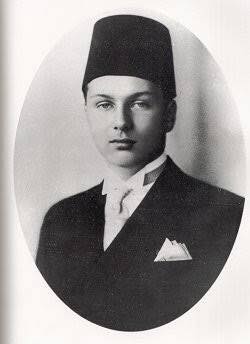
Notes on the Farouk Royal Commemorative Stamps
Did you know that there are some simple observations – which may be unknown to some enthusiasts – about some of the Farouk royal commemorative stamps?
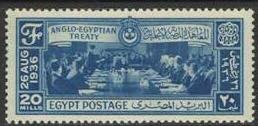
1936 Treaty
It is one of the most important commemorative stamps. The photograph was taken in the Locarno Hall of the British Foreign Office buildings and not in the Zaafaran Palace as is commonly believed. It is also worth mentioning that the stamp is the only one in the history of Egypt that bears the monogram of two kings (Farouk I in Arabic on the right and the letter F in English for Fuad I).
Abolition of foreign privileges
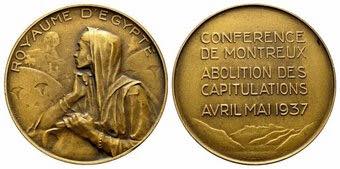
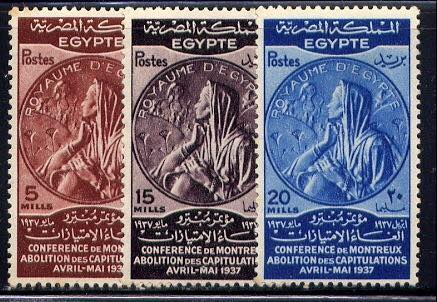
A conference was held in Switzerland. It's worth noting that Switzerland issued commemorative stamps to mark the Egyptian conference, but unfortunately, very few Egyptian collectors are interested in this collection! (A photo of the medal itself is attached.)
Commemorative stamps forOphthalmology Conference
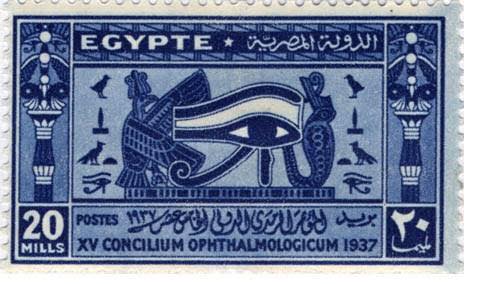
The image adorning the commemorative stamps for the Ophthalmology Conference is of the Oudjar, or "eye of health and well-being," in ancient Egyptian history, resting on the Uraeus bird (sometimes depicted as a cobra above the pharaoh's head). The entire piece is from the tomb discoveries. Tutankhamun.
royal marriage
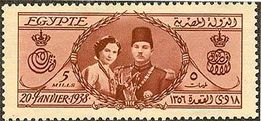
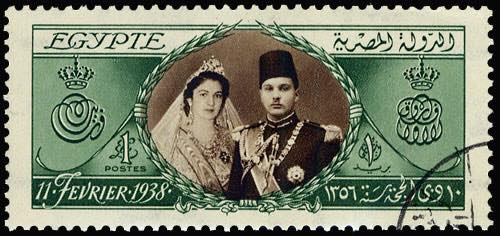
While the king usually gave his approval to postage stamps when they were presented to him, King Farouk gave this stamp extraordinary attention due to the importance of the occasion. He ordered the design to be issued on January 6, 1938, and three days later he personally received the Director General of the Postal Authority, the Director General of the Survey Authority, and Ghalloush Bey from the Survey Authority at Qubba Palace and discussed the details of the design meticulously with all three of them for an hour. One of the king's most important observations that day was to create a better balance between the image of the king and the queen and to use the same design when issuing the stamp to celebrate his birthday on February 11.
Cotton Conference 1938
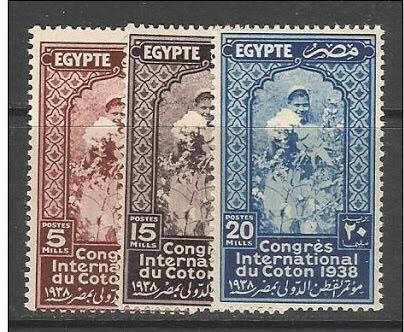
The commemorative stamps for the Cotton Conference are considered the first Egyptian stamp to bear the abbreviated name "Egypt" in its design, as all previous stamps referred to the Egyptian State, the Egyptian Post Office, or the Kingdom of Egypt, etc.
Telecommunications Conference
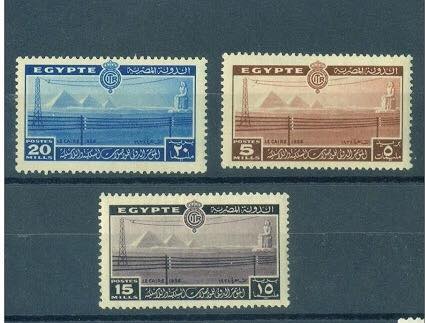
Between July and November, work was proceeding at full speed to refine a design submitted by the Director General of the Egyptian Telegraph and Telephone Authority, which was considered at the time to be the final design. However, the Survey Authority ultimately declined to accept the design for those commemorative stamps based on technical considerations, so the design was changed to the one currently known.
Royal Christmas stamp
It is worth noting that the image used in the design of the commemorative birthday stamps Farouk It is for the king and his bride, and it was taken on the happy wedding day by photographers from the “Abkar” studio in Alexandria, which is unusual since the photos that were uploaded by the royal photographer Riad Shehata to the royal thresholds were not used.
Leprosy Conference
The plant pictured on the stamp is Hydrocarpus Wightiana, a plant that is abundant on the coasts of India and was widely used in the past to treat leprosy. It is worth noting that the word Hydrocarpaceae on the stamp refers to the general plant family to which the pictured plant belongs, but it was decided not to mention the full name due to its length.
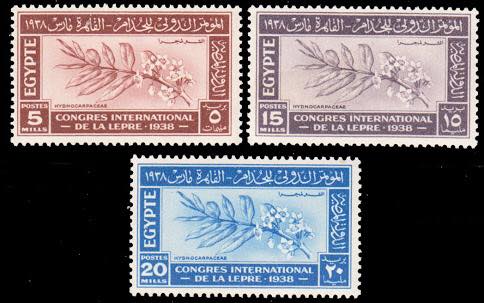
Note regarding scientific names: It is customary to write the scientific name in two parts (or rather, two words) in Latin (in most cases), with the first part beginning with a capital letter representing the species of the plant or animal. The second part begins with a lowercase letter representing the genus of that species of plant or animal (the word "genus" here is unrelated to "sex"). Both parts should be italicized to distinguish them from the rest of the original text. The scientific name is followed by a comma, and then the name of the cultivar belonging to the same species and genus (variety).
childhood
It contains a picture of Princess Ferial at the age of 18 months. The picture and the subject were chosen directly from the palace and submitted to the postal service in the form of a royal decree (meaning that several pictures were not submitted to the palace to choose one of them as was the practice with most previous designs).
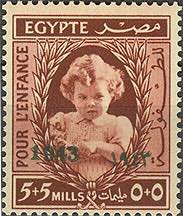
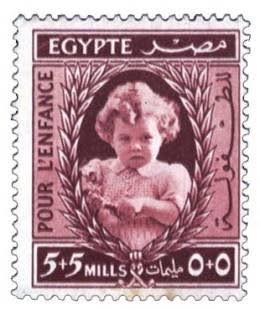
King Fuad's death anniversary
The image used is taken from an oil painting by the world-renowned painter Philippe de Leglo, a British man of Hungarian origin who came to Egypt specifically in 1929 to paint this picture of King Fuad.
King's Birthday 1945
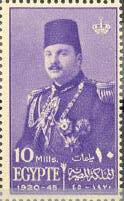
Photographed by Riad Shehata, it is worth noting that this photograph became the official photograph displayed in offices, government departments, and companies until July 1952.
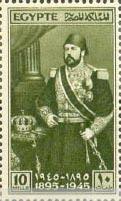
The anniversary of Khedive Ismail
It is the same image that was used on the stamps of the 1934 Postal Congress.
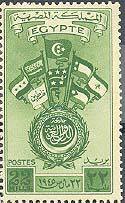
League of Arab States
The initial decision was to reuse the design of the 1936 treaty stamps with a new image of the signing ceremony. However, the postal service submitted a simpler design, which was favored by the government and His Majesty the King. It should also be noted that Palestine did not have an independent flag at that time, so it was decided to write the word "Palestine" on a flag with a white background.
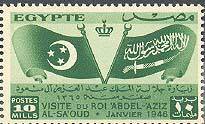
King Al Saud's visit
It was initially decided to design a stamp with an Egyptian sword and a Hejazi sword crossed, but the image appeared somewhat aggressive, especially since the world was celebrating peace at the time after the end of World War II. Therefore, an image of the two national flags was chosen, and following the rules of protocol, the flag of the honored guest was placed on the right side and the flag of the host country (Egypt) on the left side. It is worth noting that the Saudi flag in this form was not realistically positioned, as it is noticeable that the two testimonies were facing towards the flagpole, while in reality they are far away (see the image of the Saudi flag and its flagpole on the Arab League publication for further clarification).
For more similar articles on Al-Muqtani Al-Arabi, you can follow the Link the next
King Farouk's World Coin Collection