The Legend of Coin Collecting
The Legend of Coin Collecting
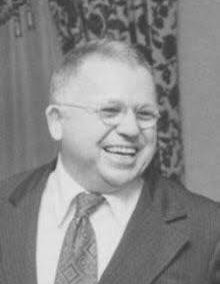
John Jay Pittman is a name that perhaps many Arab collectors do not know, but he is truly a legend among coin collectors in the United States. Pittman did not become famous because of his strong presence at King Farouk's auction, as many collectors came from the farthest corners of the earth to that international auction. Nor did he become famous because of his legendary collection, as there were collections that were more valuable than it. He was not only famous for his vast knowledge, but he became famous because he was able to simply combine all the previous points in addition to his remarkable ability to form a great coin collection without paying a huge fortune for it, only relying on his personality!
John was born in 1913 in North Carolina to a poor family. His father was a railroad worker and his mother was a housewife. It is said that his circumstances were so simple that he owned his first pair of shoes at the age of ten. He started working at the age of seven picking cotton for 7 cents a day, then he worked distributing newspapers. He left his city and traveled to New York and worked at the port there. He wished to become a doctor like his uncle, but the costs of medical school were impossible for him, so he enrolled in chemistry instead and worked as a waiter during his studies.
His trip to Cairo
After graduating, he worked at the Kodak Eastman laboratories, a job he held for the rest of his life. He married Miss Gering, who worked as a primary school teacher in the public schools for a small salary. It is worth noting that John and Gering's marriage remained happy and stable for 60 years. When John was young, his grandmother gave him a handful of small denomination coins, and the child stood mesmerized by their captivating shine, the images they held, the stories they told, and the places they might have visited.
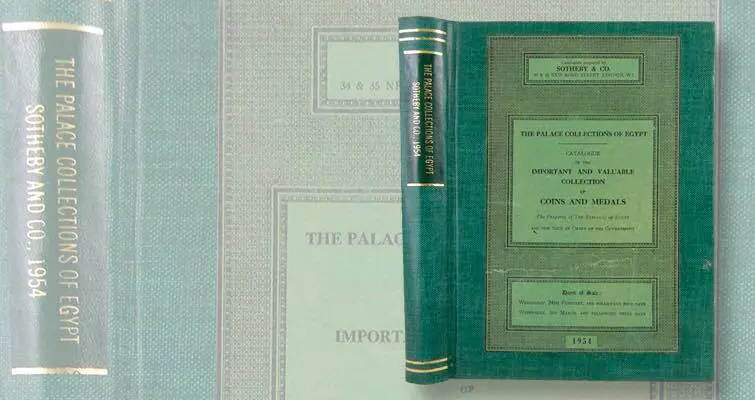
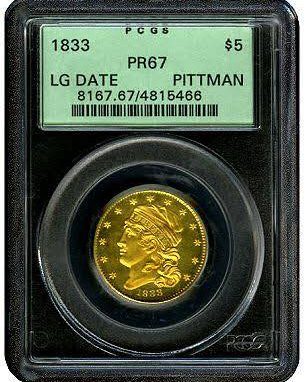
Later in his life, his wife greatly encouraged him to continue his coin collecting and even helped him build his collection. Their correspondence still bears witness to their deep love for each other and their constant encouragement regarding coin collecting and life in general. In 1954, when the Qubba Palace auction was announced, the couple didn't hesitate at all: they decided to mortgage their small house and, with youthful enthusiasm, set off for the city of a thousand minarets—Cairo—to buy coins belonging to the former king! One of John's best deals at the royal auction was his purchase of the 1833 US five-dollar coin for 6051 TP4T, which was later sold for 467,500 TP4T!
His arrival in the world of fame
As time passed, Pittman gradually became known for his passion for coin collecting. He read, or rather studied, thousands of books on the hobby, famous collections, the currencies of the world's nations, their history, and their differences. He examined tens of thousands of coins and was an active member of American coin collecting clubs until, in his later years, he became president. American Currency Association.
The secret to Pittman’s success in building his great collection was due first and foremost to his personality. The man was distinguished by a photographic memory and great patience. He armed himself with a wealth of information about each coin and its history, and trained his eye to be accurate in assessing cases. Moreover, the support of his family always strengthened his resolve.
Besides all of the above, Pittman was distinguished by qualities that he used intelligently to enrich his collection. Firstly, the man was realistic and aware of his financial capabilities, and therefore he never tried to acquire what was considered the rarest American coins, but rather directed all his attention to what he called “sleeping treasures,” that is, cheap things that he expected to have a great future. Secondly, the man did not joke about his hobby. It is said about him that in one of the auctions, 5 rare coins were offered in 5 consecutive lots, and John had decided that he would win them all at a cheap price.
When the auctioneer reached the first lot, John suddenly stood up from his chair and walked conspicuously down the middle of the hall until he reached the auctioneer's platform. He stopped there, then turned towards the audience, raising his hand to bid, and kept it raised for the entire time allotted for the five lots! What's worse, he glared at any other bidder who dared to raise his hand to bid against him, so much so that no one else in the hall could even breathe. John actually succeeded in acquiring all the coins at a bargain price. That day – because of the way he stood with his hand raised – the enthusiasts nicknamed him “The Statue of Liberty”!!
His death
When Pittman died one day before his 83rd birthday in 1996, he was found to have possessed nearly complete collections of coins from Cuba, Canada, the United Kingdom, Russia, Japan, Sweden, Mexico, South Africa, Egypt, and Australia. The Canadian collection alone was so vast that it had to be offered in two separate auctions! His collection was estimated at 12,000 coins, and preparing the auction catalogs for the entire collection took many months. It was so enormous that the auction house had to hold several auctions over two years to allow collectors to catch their breath from the sheer rarity of the items. Ultimately, based on Pittman's ledgers, which recorded what he paid for each coin, his entire collection cost him less than $75,000 and was sold in a series of auctions between 1997 and 1999 for $30 million, with the proceeds going to his three children.
You can follow more articles from the Arab collector through the Link the next: