Israeli occupation funds for economic control over Sinai
Did you know that there were banknotes issued by the Israeli occupation forces that were prepared for circulation in Arab areas during the 1967 war?
Expanding Israeli influence
Shortly after the fall of the West Bank, Gaza Strip, Egyptian Sinai, and Syrian Golan Heights to the Zionist occupation in 1967, secret deliberations took place within the Israeli government regarding the possibility of introducing special currency denominations for circulation in the occupied territories, replacing the local currencies in use at the time. However, this was done without the knowledge of the Prime Minister at the time, Levi Eshkol. The Israeli position was based on the view that it would be easy to extend economic control over all the areas invaded by the occupation army through such currency.
There had been no prior decision to print currency denominations specific to the Zionist occupation of those areas until the meeting between the Governor of the Bank of Israel, David Horowitz, and the Acting Minister of Finance, Zeev Scharf. The agreement was to continue the circulation and use of Egyptian currency within the Gaza Strip. The Israeli government was unaware of the amount of Egyptian currency present within the Strip, and there were concerns about a decline in the volume of currency in circulation with the increase in demand and the inability to cover the deficit resulting from the shortage of Egyptian currency.
Emergency currencies
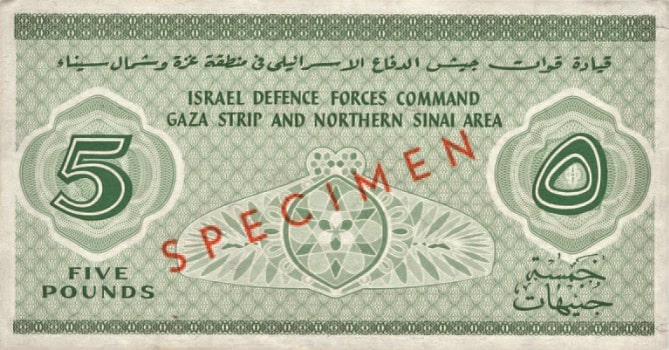
Based on this, the decision was made to print special banknotes as emergency currency to cover this deficit. It was agreed to print special Israeli currency for circulation as an alternative to Jordanian, Egyptian, and Syrian currency, especially since the amount of cash in Israel was not sufficient to meet this purpose. There were fears that the circulation of the occupation currency in the occupied territories would cause a crisis within Israel. The Israeli government considered that expediting the implementation of the emergency currency project would prevent the continued smuggling of currency from Egypt, Jordan, and Syria. Indeed, the Bank of Israel was tasked with designing different denominations of currency for circulation, written on them in Hebrew, Arabic, and English.
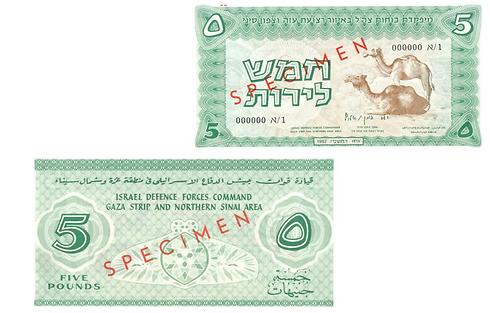
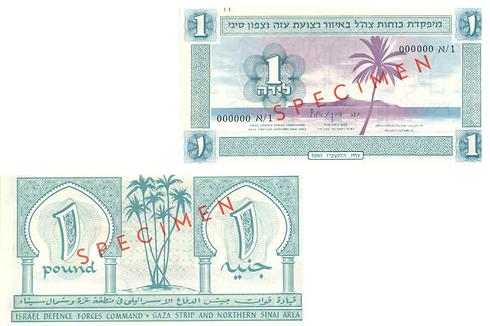
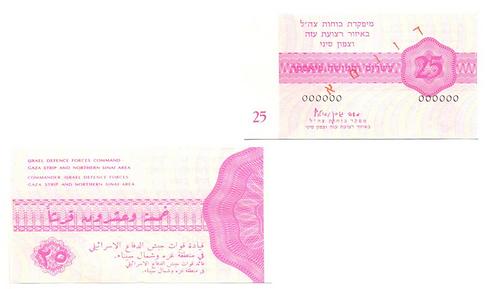
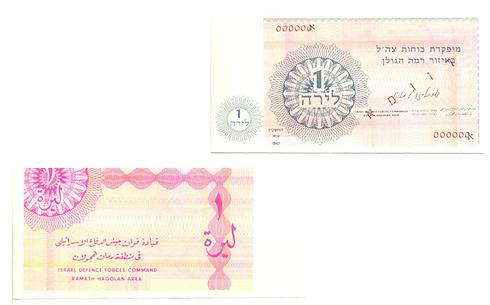
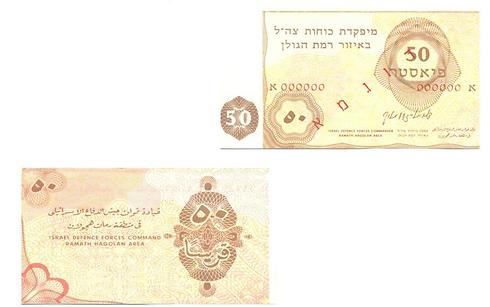
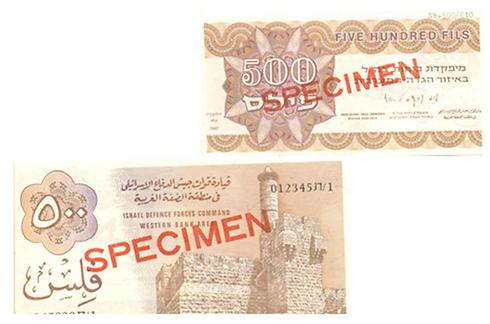
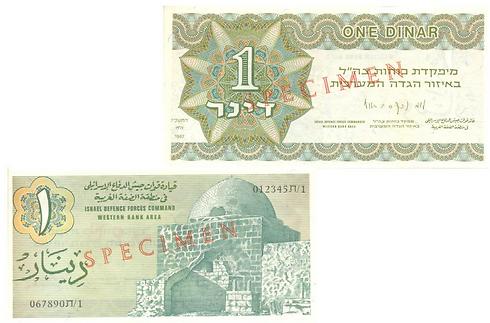
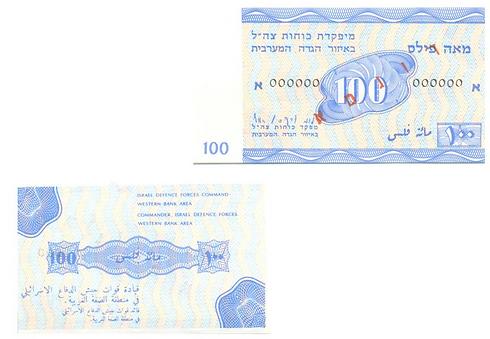
These banknotes bear the logo of the Israeli army and the name of the region in which the banknotes will be circulated, which are as follows: (Southern Gaza Strip and Sinai), (West Bank) - (Northern Golan). Different denominations were designed, as banknotes were designed for circulation in the Gaza Strip and Sinai in the five-pound and one-pound denominations, as well as a dinar and a half dinar for circulation in the West Bank and a pound denomination for circulation in the Golan. The decision was to design banknotes that closely resemble the banknotes previously circulated in those regions.
Designs with local symbols
The proposed currency denominations for circulation in the Gaza Strip and Sinai were designed using some local symbols such as camels and palm trees, while the currency denominations to be circulated in the West Bank were designed with images of Damascus Gate, Bilal Ibn Rabah Mosque and some distinctive inscriptions of the West Bank. Some distinctive marks were also placed as a precautionary measure to prevent counterfeiting.
The operation was carried out very slowly due to the inability to print large quantities of those banknotes. Accordingly, the Bank of Israel approached some parties in the Netherlands and Belgium to cooperate in order to carry out this purpose. This was done in complete secrecy, and large quantities were indeed printed, arrived in Israel by air, and were hidden in special secret warehouses belonging to the Bank of Israel.
Withdrawal from trading
But shortly after, and after secret deliberations and discussions between officials in the Ministry of Finance in Israel and the army leadership, the decision to circulate those denominations was reversed once again after reaching a decision that those currency denominations would increase the burdens on the Israeli economy and that they might cause successive crises for it, especially since the value of the Jordanian dinar and the Egyptian pound at that time was higher than the value of the Israeli lira. Accordingly, it was better to wait and introduce the Israeli currency that is already circulating in Israel in those areas to integrate their economy with the Israeli economy. This was done after a decision by the Zionist military government to stop the circulation of the Egyptian pound and the Jordanian dinar and to consider them invalid for circulation.
Strangely enough, when the Israeli Prime Minister received information about this project, he expressed his anger and complete rejection of its implementation. The idea was frozen, and a decision was issued in 1978 to destroy all the printed banknotes, amounting to approximately 25 million notes of various denominations. It was agreed that some notes would be kept as souvenirs by certain prominent figures in Israel, as well as by the Bank of Israel. Years passed without anyone knowing anything about this project.
Sources: theshekel
The detailed article was published in issue number four (August 2016) of Al-Muqtani Al-Arabi under the title “Israeli occupation funds...for economic control over Sinai and the West Bank and the GolanYou can download the issue from the Link the next: