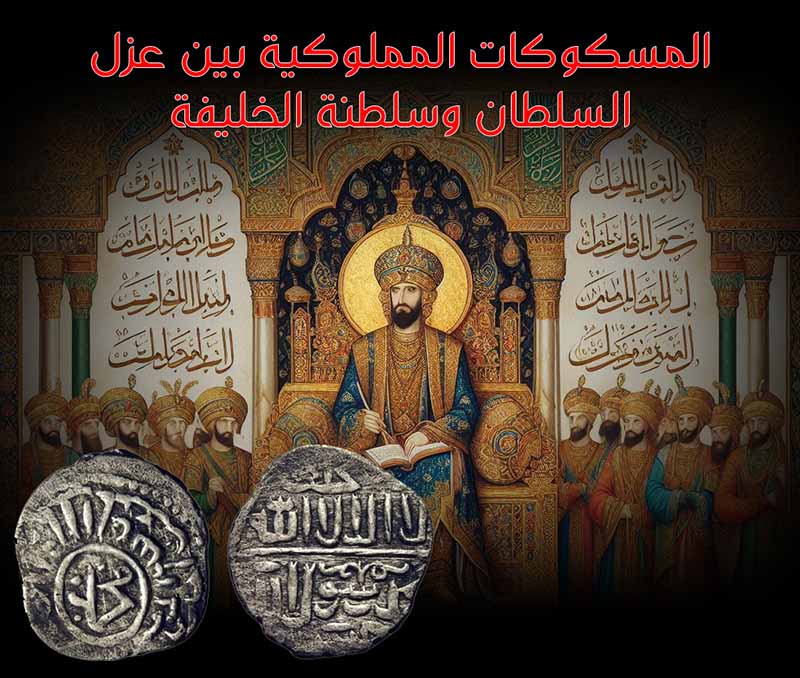
Mamluk coinage between the deposition of the sultan and the rule of the caliph
The Abbasid caliphs in Cairo had no real power to speak of. They were called the Commander of the Faithful; prayers were offered for them on the pulpits; and their names were inscribed on some coins. Everything else was up to the sultan, including the dismissal and appointment of the caliphs themselves. There was only one unique case that deserves our careful consideration, even if it lasted only seven months; even if it was born of chance and the product of the political circumstances; even if it was marred by some exaggerations and differences in assessment.
Mamluk State
Al-Abbas ibn Muhammad al-Mutawakkil was born in Cairo in 792 AH (1392 CE). He was proclaimed Caliph after his father's death in 808 AH (1408 CE), and was given the title al-Musta'in Billah II. This occurred at the beginning of the second reign of al-Nasir Faraj ibn Barquq, a period that proved disastrous for Egypt and the Mamluk state in general, as it was marked by regional threats, internal strife, famine, and plague. In late 814 AH (1410 CE), Sultan al-Nasir Faraj departed Cairo to subdue those who had rebelled against him in Syria, taking Caliph al-Musta'in Billah with him. This followed his confirmation of the repeated defiance of the two emirs, Shaykh al-Mahmudi and Nawruz al-Hafizi. This was the eighth and final campaign led by al-Nasir Faraj towards the Levant.
After skirmishes and skirmishes, the first incident broke out in which the Sultan was defeated and retreated to Damascus, fortifying himself in its citadel. The Caliph Al-Musta’in fell into the hands of the two princes, Sheikh and Nawruz. Events moved quickly until the Sultan was besieged in Damascus. The princes gathered to consult, and they were certain that the end of Al-Nasir Faraj was near. However, the princes who gathered to fight him had among themselves such rivalry and enmity that it foreshadowed their fighting as soon as they got rid of Al-Nasir Faraj, as each of them aspired to the Sultanate and had many Mamluks and followers under his command.
Here the princes agree on an unprecedented matter. They deposed the Sultan and installed the Caliph as Sultan. This was in fact a trick aimed at unifying the word and weakening the resolve of Faraj’s supporters and influencing the general public in Damascus and the rest of the Levant and Egypt as well. Al-Musta’in reluctantly agreed, and wrote to inform the people of Faraj’s deposition and that the matter had been transferred to the Caliph in full with the consensus of the princes and judges. Indeed, a group of Faraj’s supporters dispersed and left him to face his fate with only a few who could not defend him. The events ended with Faraj being arrested, imprisoned, and then killed with the support of the Caliph and the judges, as well as most of the princes.
Al-Musta'in returned to Cairo and entered it as a sultan after he had left it - several months earlier - as a caliph in the company of Sultan Al-Nasir Faraj. Cairo was decorated to receive the sultan-caliph and the princes with him. His procession passed through it and exited from Bab Zuwayla, ascending to the Citadel, as was the custom of sultans, not caliphs. The new coinage was minted in the name of Al-Musta'in Billah, and his name was preceded by the title (the Great Imam), a title that none of the previous or subsequent Abbasid caliphs of Cairo had received. Here, we should ask about Al-Musta'in's actual authority and whether the coins can help us answer this question.
By studying and analyzing the coins of Al-Musta'in Billah II minted in the year 815 AH, we arrive at some observations that will lead to a theory. Let us begin with the observations:
* Looking at the titles on Al-Musta’in’s coins, we note that he was titled “The Great Imam” on the coins of Cairo; and ”Commander of the Faithful” on the coins of Damascus and Aleppo. In all cases, he was not titled “Sultan,” except for a single issue of the dirham category minted in Aleppo, in which the name of Al-Musta’in is preceded by the title “Sultan King.”.
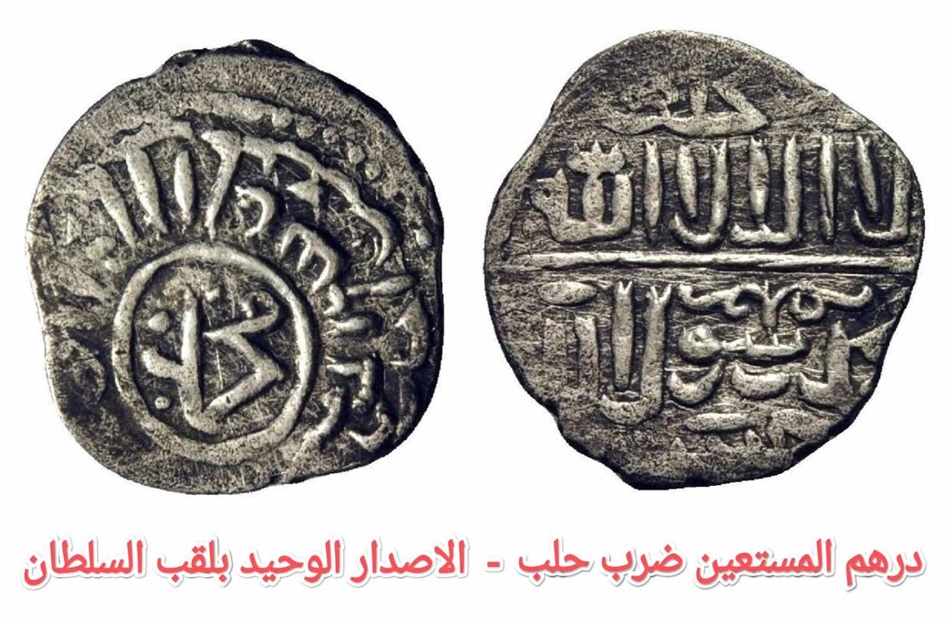
* All of Al-Musta'in's coins bear on the back only the two testimonies of faith, and there is no mention of any other name besides the name of the Caliph which is on the front.
Most of the coins that reached us from Al-Musta’in were poorly minted and struck with poorly engraved molds, and this is an indication of haste and neglect of the quality of workmanship, compared to what came before and after it.
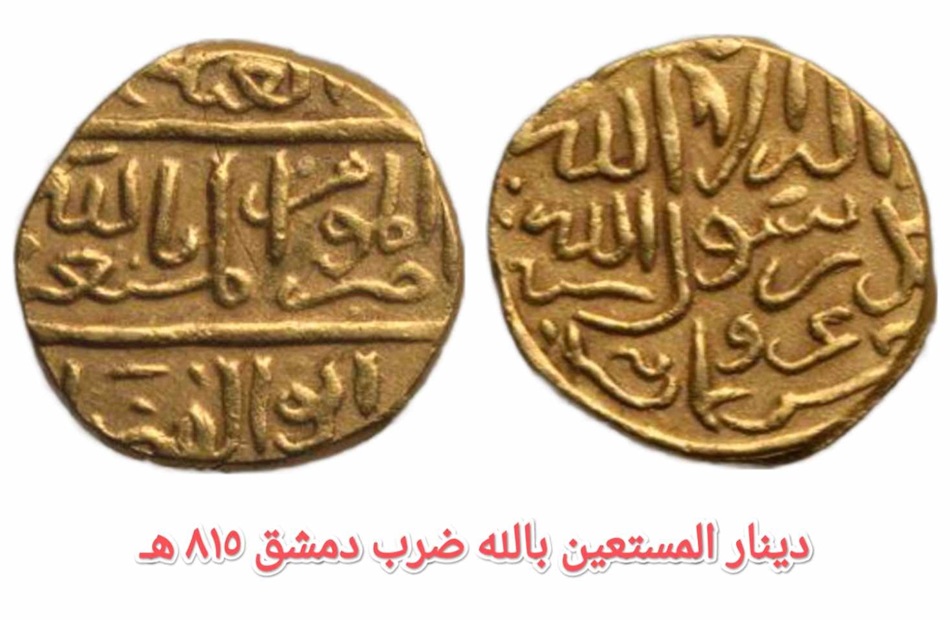
We can deduce the limited total amount of dinars and dirhams minted in the name of Al-Musta’in Billah, and classify the rarity – according to Stephen Albom – between “rare”, “very rare”, and “extremely rare”.
* The silver coinage was reduced in weight and purity, and this reduction would later become a general feature of the Circassian Mamluk dirhams.
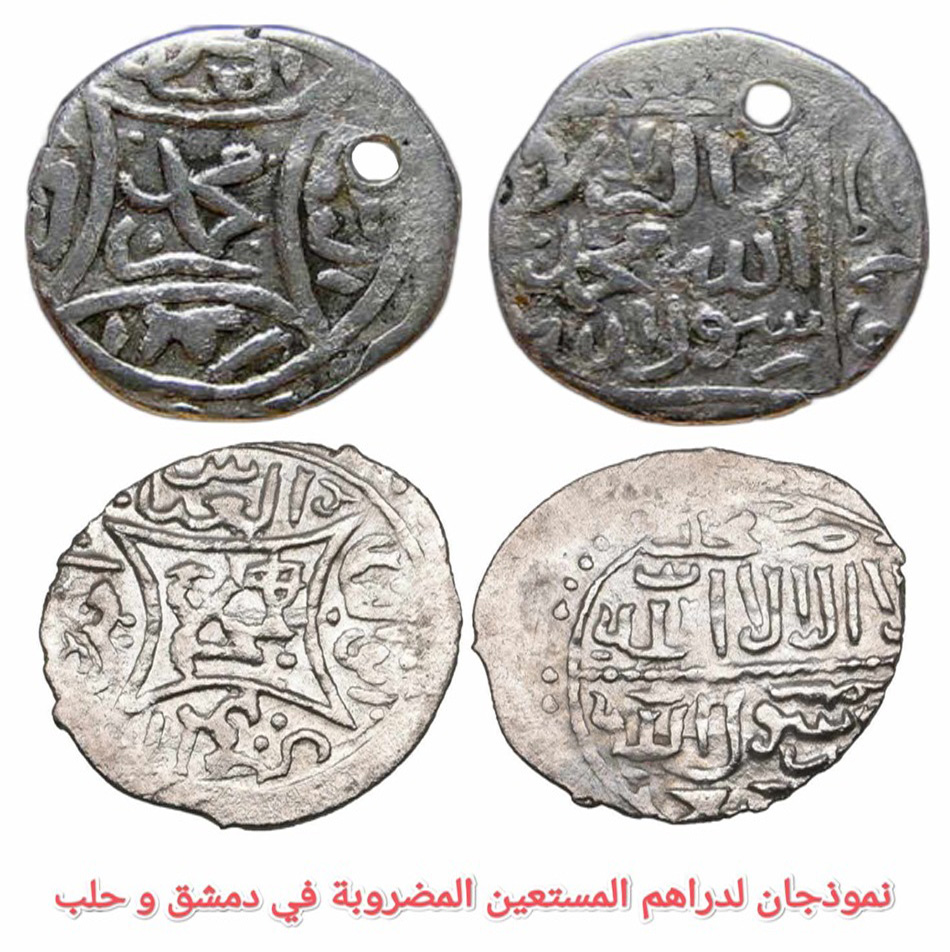
* In my research, I did not find any examples minted in Cairo of the silver dirham or copper fils category, only gold dinars exist, unlike Damascus and Aleppo, as we received dirhams from each of them with reduced weight and purity. It is worth mentioning that Paul Balouge made a mistake in attributing some dirhams to Cairo, while they were minted in Aleppo. .
* The dinars and dirhams of Al-Musta’in that reached us were minted in Cairo, Damascus and Aleppo only in the year 815 AH, and on the same date of that year the first dinars and dirhams of Al-Mu’ayyad Shaykh reached us. .
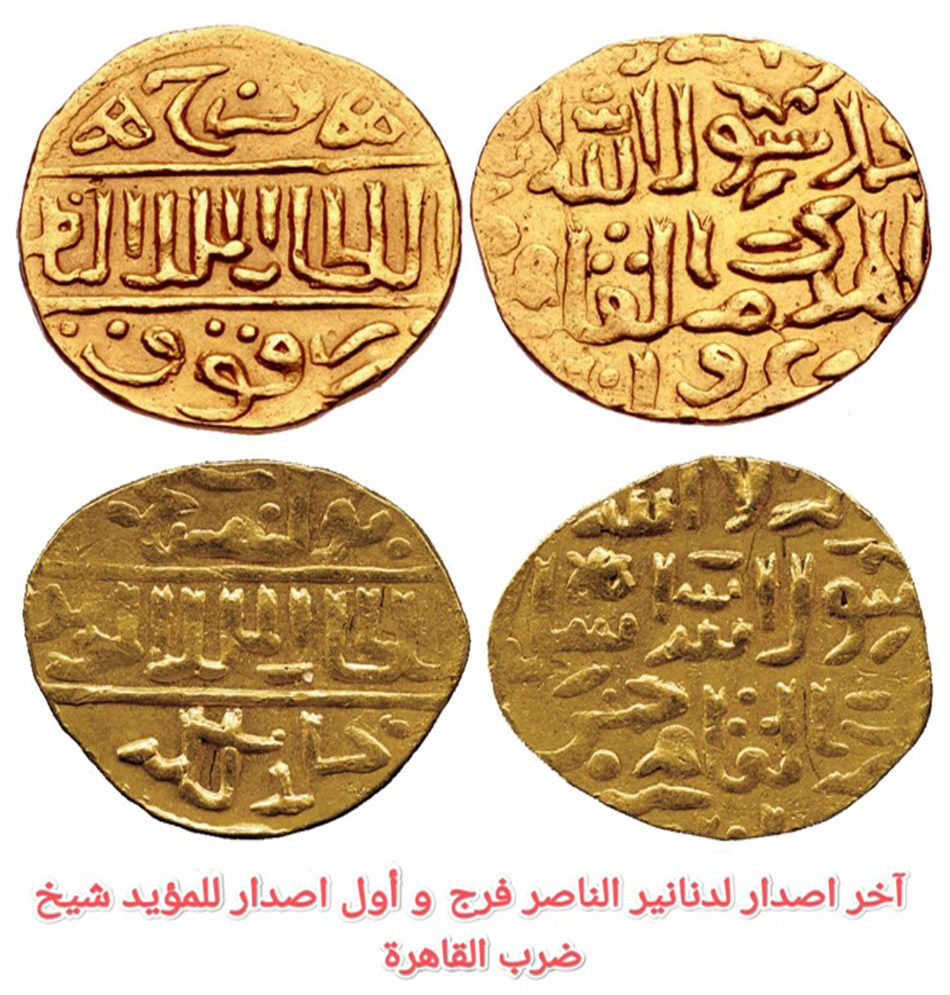
* The general style and pattern of the inscriptions on Al-Musta’in’s coins are similar to the last ones minted in the name of Al-Nasir Faraj and also the first ones minted in the name of Al-Mu’ayyad Shaykh. The same applies to the standard of dinars, which are similar in weight and gold purity to the Venetian ducats, and for this reason the dinar was called Venetian. .
Based on the preceding observations, we can construct a coherent hypothesis: we are dealing with a nominal ruler, summoned to serve as a legitimate figurehead during a transitional period. History teaches us that whenever powerful figures vie for power and fail to resolve the conflict, they bring in a weak figure from outside the circle until the strongest among them consolidates their position and assumes control. Analyzing the authoritarian messages embedded in the inscriptions on these coins reveals that while al-Musta'in was formally treated as a sultan, he was not titled "Sultan" on most of his coins. This reveals the true nature of the power structure behind the sultan-like figurehead, a power shared between a sheikh in Egypt and a Nawruz in the Levant, each with their own monetary policies and administrative style. Consequently, no one cared about the quality or sufficiency of the coins minted in al-Musta'in's name, especially in the capital. In Cairo, this was limited to dinars only, meaning they were not available to the general public. It is likely that the political messages behind this coinage were primarily directed at the military, the Mamluks, and the princes. Those vying for the throne of the Sultanate.
In Cairo, Sheikh wanted to demonstrate his commitment to what had been agreed upon when they were at the gates of Damascus. Similarly, Nawruz in Damascus and Aleppo wanted to demonstrate the same. In fact, neither Sheikh nor Nawruz wanted – at that stage – to put his name on the coinage before he had consolidated his actual authority in a way that would allow him to resolve the conflict. When Sheikh took the initiative to seize the Sultan’s throne, removing Al-Musta’in from the Sultanate and then the Caliphate was easier for him than suppressing his rival princes. At the same time, dinars of Sheikh – who was called Al-Mu’ayyad – were struck in Cairo with better quality molds. Perhaps some of them had been engraved before Sheikh became Sultan, so that the year 815 AH became the famous year whose coins reached us once in the name of Al-Nasir Faraj bin Barquq; and once in the name of the Great Imam Al-Musta’in Billah. Once in the name of Al-Mu'ayyad Shaykh Al-Mahmudi, and starting from the same year, the Mamluk coinage returned to its previous state with regard to the name of the Sultan and the name of the Caliph. Most of the coins minted in Egypt bear the name of the Sultan on the obverse and the two testimonies of faith on the reverse without any reference to the Abbasid Caliph residing in Cairo. As for the coins minted in the Levant, they bear the name of the Sultan on the obverse and the name of the Caliph on the reverse. This confirms our belief about the coins of Al-Musta'in, as if they could speak, they would tell us:
“There is a caliph without a sultan, as he does not actually rule, and the sultan’s chair is vacant, waiting for someone to resolve the conflict in his favor and revive the history of the sultans with the shadow caliphs of Cairo.”. 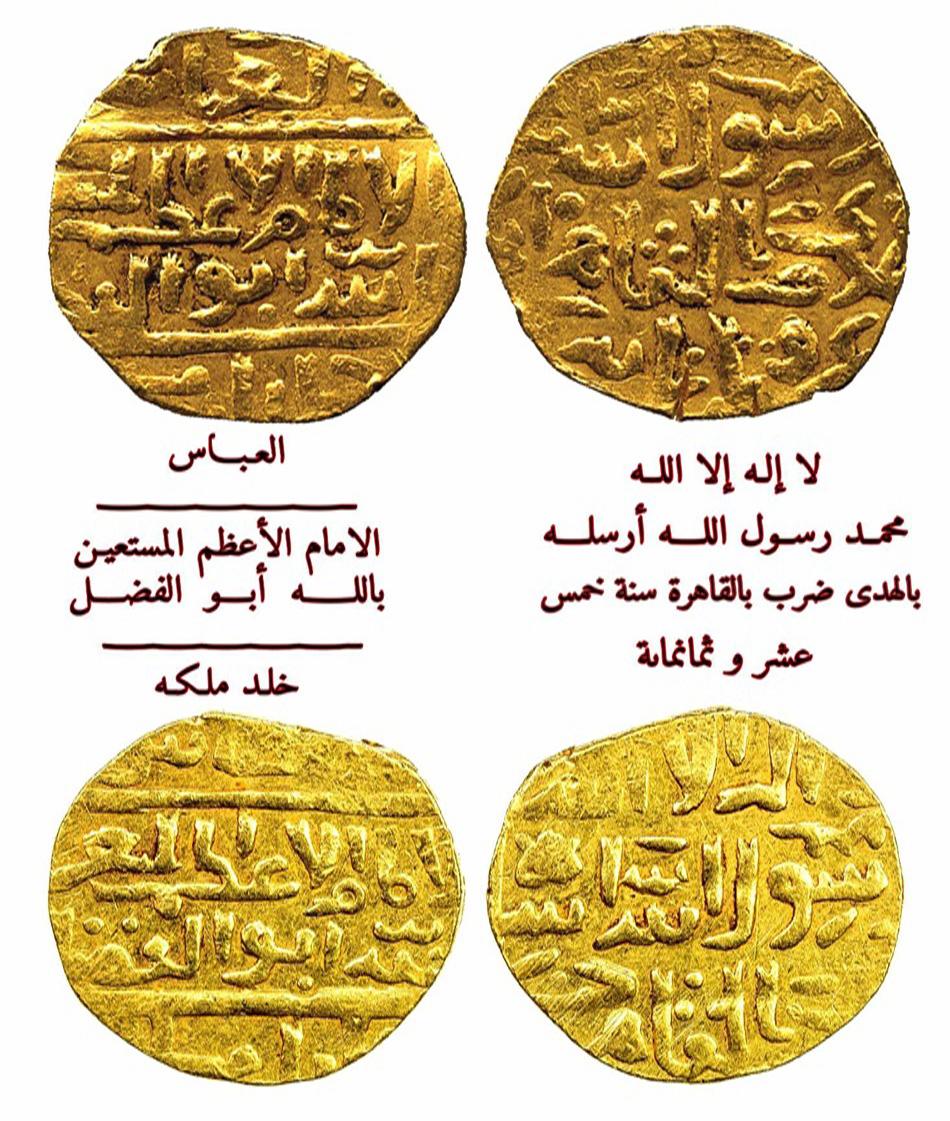
The writings of historians tell us that Al-Muayyad Shaykh, after dismissing Al-Musta’in from the Sultanate first and then from the Caliphate, imprisoned him in a tower in the Citadel of the Mountain until he sent him in the year 819 AH to prison in Alexandria, where he remained imprisoned until Sultan Al-Ashraf Barsbay released him later, to die in Alexandria in the year 833 AH as a result of contracting the plague, and glory be to Him who is eternal.
the reviewer :-
– Taqi al-Din al-Maqrizi, Al-Suluk li-Ma'rifat Duwal al-Muluk (The Path to Knowledge of the Dynasties of Kings)
– Taqi al-Din al-Maqrizi, Shudhur al-'Uqud fi Dhikr al-Nuqud
Jamal al-Din Yusuf ibn Taghribirdi, The Shining Stars in the History of the Kings of Egypt and Cairo
– Khair Al-Din Al-Zarkali, Al-A’lam
– Muhammad ibn Jarir al-Tabari, History of Nations and Kings
* Steve album. Checklist of Islamic Coins
* Omer Diler. Islamic Mints
*Paul Balog. The coinage of the Mamluk sultans of Egypt and Syria
For more similar topics, you can browse the Arab collector's website through the Link the next: