Ancient CoinsPtolemaic CoinsRoman CoinsHistoryNumismatics
Cleopatra, Queen of Kings
The coin features a profile portrait of Queen Cleopatra VII.
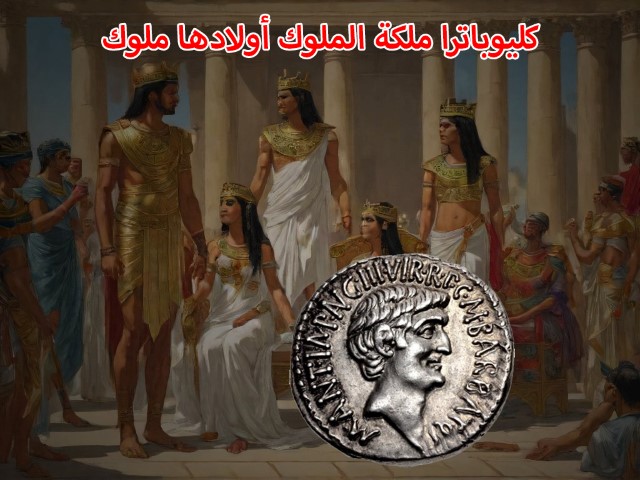
In the autumn of 34 BC, Alexandria was about to witness a grand celebration and an even bigger event; at that time... Mark Antony The Roman governor of the East came to Alexandria to meet his wife, Queen Cleopatra VII, and celebrate with her and their sons his victories in the Armenian campaign. The Egyptian queen had prepared that historic ceremony that would witness what came to be known as the “Alexandrian Gifts,” which was the announcement of the crowning of the queen’s sons as kings over the cities and regions of the East, and Cleopatra as queen of kings. It is that unique event that has reached us through the writings of Cassius, Plutarch, and other contemporary historians. It is the same event that Octavian, the rival of Antony and Cleopatra, exploited to spread the rumor in Rome that the enchanting Egyptian queen had enslaved the Roman commander. Despite the importance of that event, it is difficult to find archaeological or historical evidence of it, except for the writings of ancient historians and some coins. It is noteworthy that the coins, as usual, summarized the ceremony and the gifts in two sentences and two images, a summary that may contain much more detail if we consider it carefully.
Here we present an example of one of the most important archaeological pieces of evidence that commemorates the success of Antony's campaign against Armenia and his declaration of the distribution of the eastern provinces to Cleopatra's sons in what is known as the Alexandrian gifts.
Silver Denarius category
Cleopatra, Queen of Kings
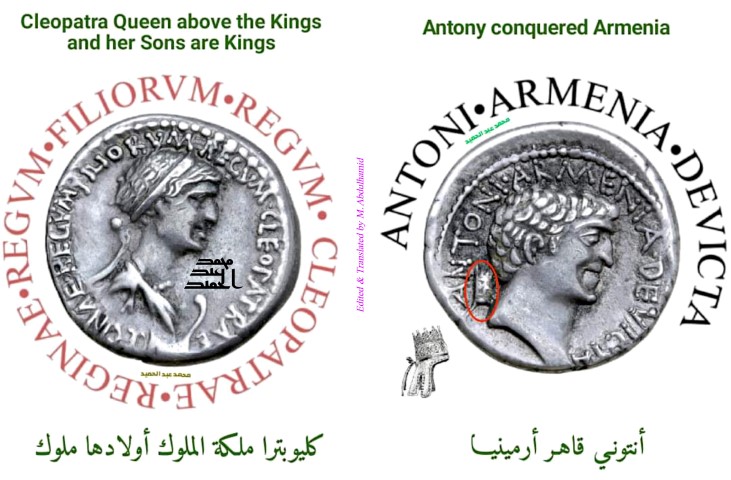
On the front we see a profile portrait of Queen Cleopatra VII, and the following sentence is inscribed in Latin on the margin.
CLEOPATRAE•REGINAE•REGVM•FILIORVM•REGVM
The translation of the sentence is
“"Cleopatra, Queen of Kings, her sons were kings."”
The intended meaning is
“Cleopatra, Queen of Kings and Queen over her sons, who are also kings.”
That sentence clearly indicates the installation of Cleopatra's sons as kings of the East, and confirms Cleopatra's sovereignty over them.
On the back we see a profile of the Roman commander Mark Antony, and to his left a miniature depiction of the Armenian crown. The shape of the crown here symbolizes supremacy and indicates its seizure. The following sentence is inscribed in Latin on the margin.
ANTONI•ARMENIA•DEVICTA
The translation of the sentence is
“Anthony, the conqueror of Armenia”
The intended meaning is
“Anthony subdued Armenia”
That sentence clearly refers to the success of Antony’s campaign against Armenia and commemorates that victory.
Naturally, we do not see any indication of the year or city of minting, but we can place a time range between 34 and 32 BC. As for the place of minting, I tell you truthfully that we have only hypotheses and guesses in this matter, and I think most likely that this denarius was struck with the same style and traditions in more than one city or region, perhaps Alexandria was one of them.
In conclusion, we see that these issues that combined Cleopatra and Antony were clearly characterized by a political purpose at a pivotal historical moment in the history of Rome, Egypt, and the entire East. We should not treat these coins as traditional monetary issues produced by a fixed mint according to the financial needs of the economy, but rather as records that document alliances and spread the map of power and sovereignty…
For more similar topics, you can browse the Arab collector's website. the Link the next: