Egyptian banknotes that never saw the light of day – Part 2
Egyptian banknotes that never saw the light of day
We continue with another part of our presentation of images of Egyptian banknotes that never saw the light of day, the Egyptian banknotes that were offered at auction. Spink In London in 2017, specifically between September 27th and 29th, you can review Part One To learn about the pieces that were displayed from the beginnings of Egyptian banknotes in 1898 and 1899
In this section, we continue to learn about the pieces that were designed between 1910 and 1913. It is worth mentioning that all the exhibits are archival images of designs that were proposed to be implemented on Egyptian banknotes. Indeed, those designs or parts of them were used in some banknotes, but most of them did not see the light of day.
Five pounds, November 2, 1910
The front of the banknote shows a bank building in the center, with street numbers, values on the left and bottom left and right, and the reverse side features a domed building and palm trees in the center. This design is interesting and perplexing for a number of reasons.
First and foremost, the design dates back to 1910, but a banknote with an almost identical design was issued in 1924. It is unclear whether this design was created as early as 1910 and then used only 14 years later, or whether the designer mistakenly placed the incorrect date on the template. Interestingly, in the final 1924 design, the Arab man on the front was changed to a policeman, presumably guarding the bank building. Other differences from the issued note include the straight text at the top (this was previously curved), the large number 5 at the bottom left and right (which were significantly reduced), and the later addition of two pharaonic heads at the top left and right.
It is worth noting that the piece was sold for £1000


Ten pounds, (probably around 1910)
Archival front and reverse images of Egyptian banknotes showing designs for the 10-pound note (probably circa 1910), black and white, depicting a goat herder with a goat in the center, the value at the lower center, left, and right. On the reverse, a Bedouin camp with a tent and a camel in the center, the value at the left, right, and lower center.
This undated design is arguably the most intriguing of the entire collection, as its place in the design process is unclear. It has been speculated to be from around 1910 because it shares some design elements with the others here. However, it could easily have been part of the 1924 issue, of which only 1 and 5 pounds were produced. It is a well-conceived and beautifully produced design, which would have made a striking banknote; this particular piece sold for 800 pounds sterling.

Fifty pounds (probably around 1910)
A picture of Egyptian banknotes showing on the front a picture of a man and a woman outside the house on the left, the value in the middle and upper left and right, while on the back, the statues of Memnon appear in the center, the value on the left, right and corners.
As in the previous example, there is no date, and it is highly likely that this design was part of the same series. A similar level of care and skill was used in the design, although unfortunately, none of it was ever used on any subsequent banknotes.

A complete series from 1913
Note: The Arab Collector's Magazine has not received complete images of this part of the pure series featuring unpublished Egyptian banknotes. Information regarding the auction has been added, but images will be displayed gradually as they become available.
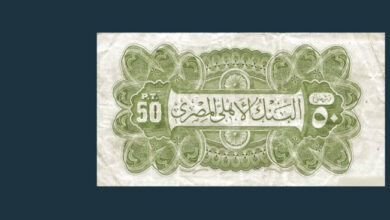
National Bank of Egypt, archival photos showing designs of a complete series from 1913, consisting of 10 piastres reversed, 50 piastres, 1 pound front and back and reverse (2), 5 pounds front and back, 10 pounds front and back, 50 pounds front and back and 100 pounds front, all in black and white.
The National Bank of Egypt never issued a 10-piaster note, but the reverse side is almost identical to the 25-piaster note from 1913. The Egyptian government took over the issuance of small paper notes in 1916, which may explain this. The note's design was later either canceled or adapted to suit the new design.

The 50-piaster designs are not actually identical, as they have very different underprints. The second design was used, and the first was not.
The designs of the 1 pound note were used almost entirely in the banknote issued the following year. The only difference was that the camels had been replaced by temple ruins.


This sentence was used in the earlier 1-pound edition but not again. This 5-pound design is similar to the one used in 1913, but it shows the central short article used in the earlier edition. This was later replaced by a new one showing the felucca and the pyramids.


This concludes the second part of Egyptian banknotes that never saw the light of day. We will meet you with the third and final part.
You can follow the first part of the article from the following link:
Egyptian banknotes that never saw the light of day – Part 1