It is the city of Gaza… that steadfast, ancient city that has always been a thorn in the side of invaders throughout history, even if the invaders have changed, it remains. It is also the most important city on the Palestinian coast that began issuing its own currency, or rather the first of them.
It's Gaza The city whose land still witnesses a present that is making history From its monuments we draw inspiration from its past and present.
I always pause to contemplate the designs of ancient Palestinian coins. Of all the releases, I dedicate this design's interpretation to the people of Gaza.
Time range during the 5th century BC The quarter shekel denomination according to the Phoenician standard ((whose name was stolen by the occupation just as it stole the land and fabricated history))
The face is a portrait of a lady with artistic, oriental features. It may symbolize the Canaanite mother goddess. My interpretation of it is that it refers to the Palestinian mother who is not worshipped, but is worthy of veneration.
As for the design of the back, I see it as an embodiment of the state of that proud city. Walls as impregnable as that land against occupation, and towers as tall as the stature of the Gazans. Behind the walls are palm trees, a symbol of Palestine's growth and fertility. And in front of the walls, a lion, Ghadanfar, stands guard among the hills, ready to strike down the invaders.
The walls, towers, palm trees, and lions all together weave that unique, present-day historical reality.
We will review some examples of coins Gaza City The ancient city of Gaza has existed throughout the ages, and the focus will be on showing the city's name as it appears on coins. The most important observation is that Gaza's name has not changed over thousands of years; only the alphabet has changed. I will be satisfied with examples written in three languages: Phoenician, ancient Greek, and Arabic. Note that there are others in other languages. We will begin this post with Phoenician and ancient Greek.
Dating back to the 5th century BC, denomination: silver quarter shekel according to the Phoenician standard
On the back, at the top of the horse's image, we notice two letters from the Phoenician alphabet, corresponding to the Arabic letters غ & ز, which are the first two letters of the city's name in Phoenician, pronounced (Ghaza).
The second model
It dates back to the Ptolemaic era during the third century BC, specifically to the reign of King Ptolemy II.
Category: Silver tetradrachm according to the Ptolemaic standard
On the back, to the left of the eagle, we notice a monogram consisting of two interlocking letters GA, which are the first two letters of the city's name in ancient Greek, GAZA, pronounced (Gaza).
The third model
It dates back to the Roman era, specifically to the second century AD, during the reign of Emperor Hadrian.
Bronze category, name unknown
On the back, on the left side, we note the full name of the city in ancient Greek, ΓΑΖΑ, which is pronounced (Gaza).
Islamic coins of Gaza City
The fourth model
It dates back to the time of the Abbasid Caliphate, specifically to the reign of Caliph Al-Ma'mun in the year 217 AH.
Category: Bronze coin
We notice on the back of the coin the Arabic proverbs engraved on the margin in a circular pattern
(This coin was minted in Gaza in the year 217 AH)
Fifth model
It dates back to the time of the Ayyubid state, specifically to the reign of King Al-Kamil Muhammad ibn Abi Bakr in the year 624 AH.
Category: Silver Dirham
We note on the back of the dirham the Arabic inscriptions engraved on the left of the margin (struck in Gaza).
In conclusion, we can deduce from what we have presented that Gaza is Gaza, whether it is written in Phoenician, Syriac, Greek, or Arabic.
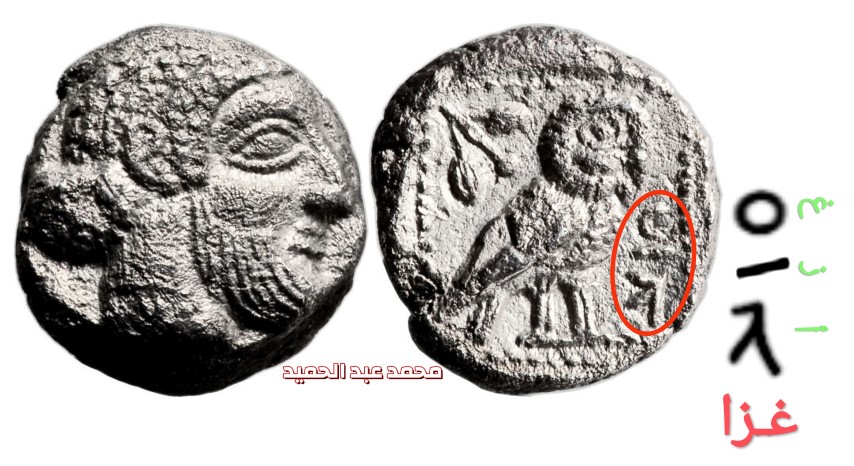
A model bearing the name of the city of Gaza in ancient Syriac script
The quarter shekel denomination according to the Phoenician standard It dates back to approximately the late fifth century BC. We notice on the back, to the right of the owl, three Syriac letters that are read from top to bottom and are pronounced ((Ghaza)).
For more similar topics, you can browse the Arab collector's website. the Link the next:
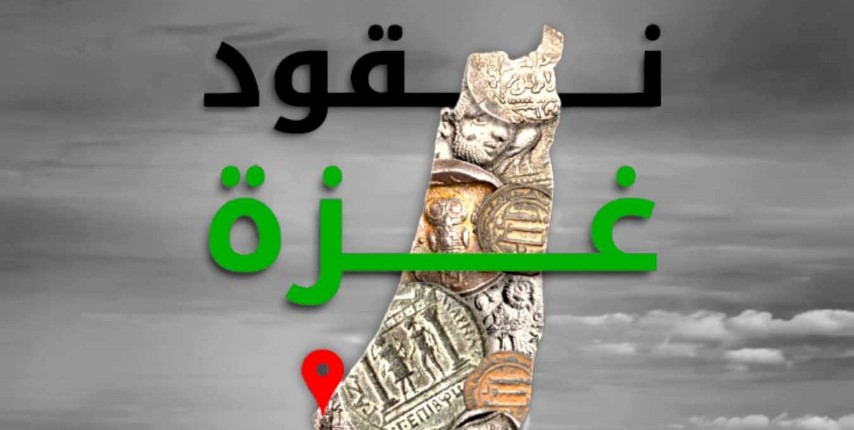

 Examples of coins from Gaza City
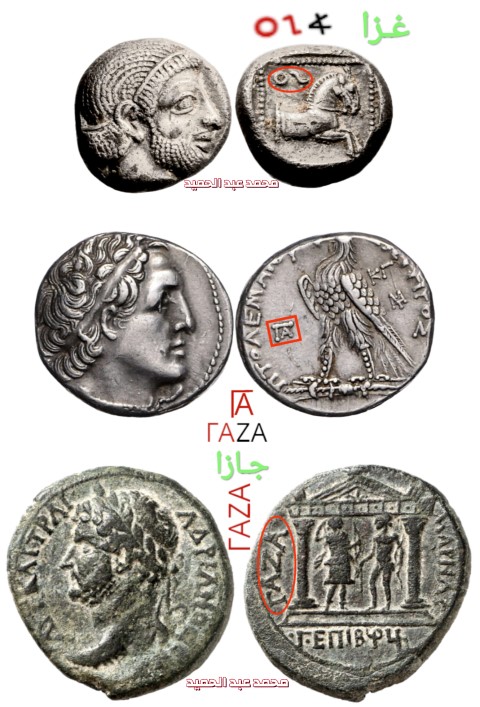 Examples of coins from Gaza City
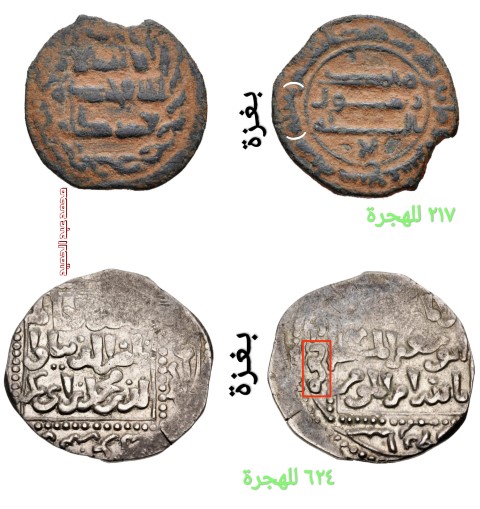 The fourth model