Ancient CoinsByzantine CoinsIslamic CoinsPtolemaic CoinsRoman CoinsNumismatics
Ashkelon coins through the ages
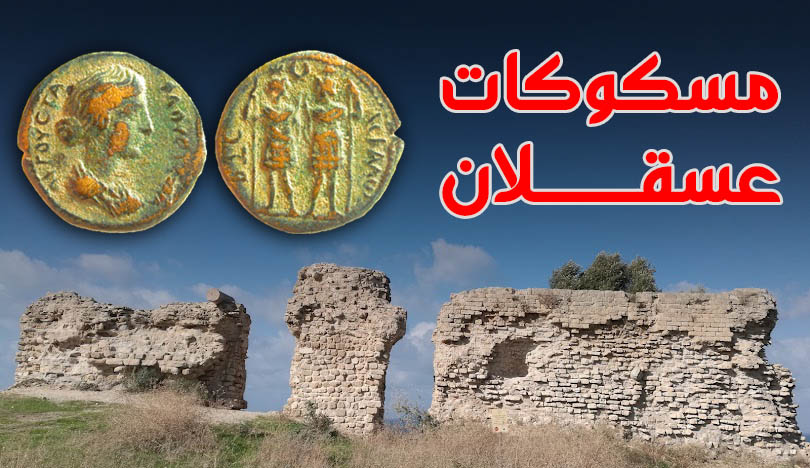
During this article we will review examples of Ashkelon coins throughout the ages: Philistine, Hellenistic, Roman and Islamic.
It is Ashkelon It is one of the largest and oldest cities in Palestine on the Mediterranean coast. It is located 65 km west of Jerusalem. The Canaanites founded the city in the third millennium BC.
1- The Philistine
Here we present a coin minted in Ashkelon during the second half of the fifth century BC. It is a beautiful coin and bears diverse influences.
The Tetradrachm class according to the Attic standard.
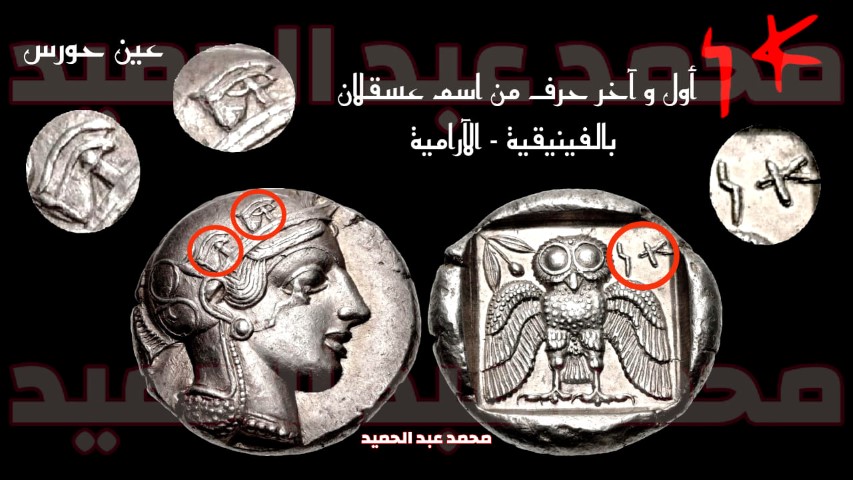
The overall design is similar to the design of the coins of Athens, but we notice the Egyptian Eye of Horus symbol on the side view of the head of Athena on the front, and we also notice on the back two letters (Phoenician-Aramaic) which are the first and last letters of the name of Ashkelon.
As we know, the beginnings of Philistine coins in Ashkelon were like those in Gaza, initially influenced by Athenian coins, then gradually the Canaanite influence replaced the Athenian one. The piece on display belongs to the early period, but it was interesting to see the Egyptian influence as well.
 2- The Hellenistic Period
 2- The Hellenistic Period
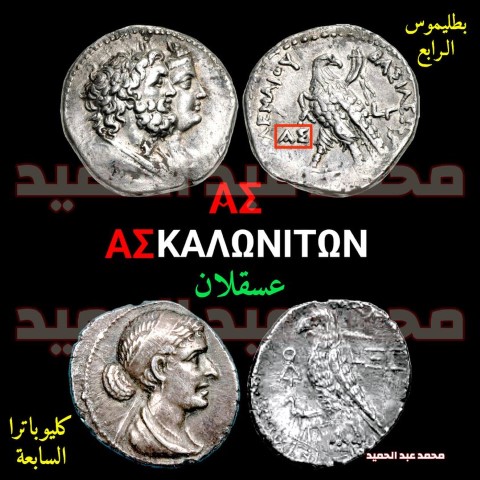
Now it is the turn of the coins of Ashkelon from the Hellenistic period after Alexander the Great, and we will review Two Ptolemaic models were struck in Ashkelon.
The first piece
It was struck during the third year of the reign of King Ptolemy IV, which corresponds to the year 217 BC.
The Tetradrachm class according to the Ptolemaic standard
On the obverse, we see a double profile depiction of both Serapis and Isis, while on the reverse, to the left of the eagle, we notice the coinage symbol of Ashkelon, consisting of the letters ΑΣ, which are the first two letters of the name Ashkelon in ancient Greek: ΑΣΚΑΛΩΝΙΤΩΝ
The second piece
It was struck in 39 BC during the reign of Queen Cleopatra VII.
The Tetradrachm class according to the Ptolemaic standard
On the front we see a profile portrait of Queen Cleopatra VII, while on the back, ancient Greek is written in a circular shape in the margin.
ΙΕΡΑΣ ΑΣΥΛΟΥ ΑΣΚΑΛΩΝΙΤΩΝ
It means (holiness and invincibility of Ashkelon)
3- The Roman period
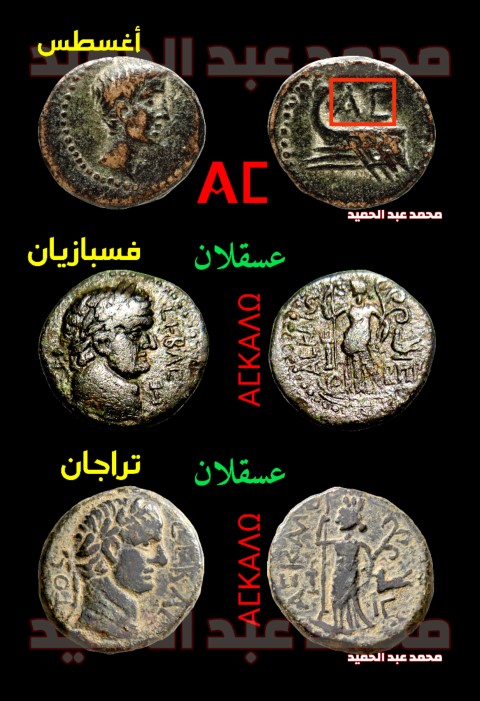
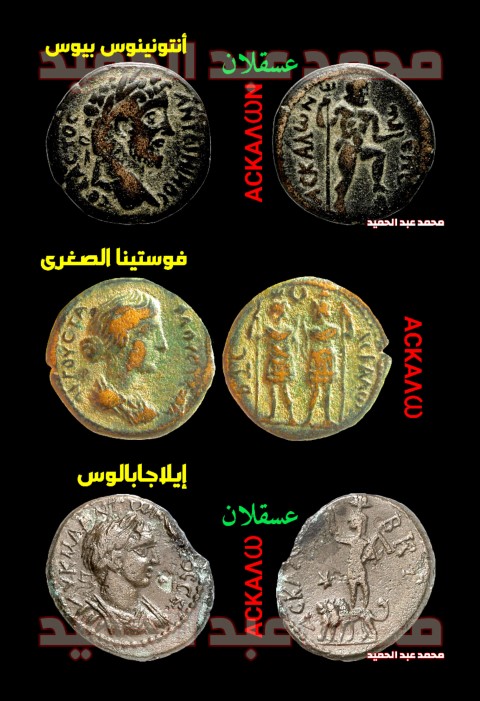
Before us are six examples of Ashkelon coins struck during the reigns of the emperors Augustus, Vespasian, Trajan, Antoninus Pius, and Elagabalus.
What interests us here is how the city's name was written, as we note that the pronunciation of the name did not change and the language used was ancient Greek, but the shape of some letters sometimes changed.
For example, the letter sigma Σ is sometimes drawn like this Ⳟ or like this C
The letter omega (Ω) is sometimes written like this: Ⲱ
The name itself was abbreviated as ΑΣ or ΑⳞ
And sometimes almost complete ΑⳞΚΑΛΩ or ΑCΚΑΛⲰ
And sometimes the full ΑΚΑΛⲰΝ which is pronounced in Arabic (Askalon)
Regarding the designs, we notice a great variety in the Roman Ashkelon editions, but we often see the emperor or empress depicted on the front and a deity or symbol on the back. The design of the back panel, as shown, is as follows:
The first piece (the prow of a Phoenician boat)
The second (the idol Tikki)
The third (the goddess Tikki)
Fourth (the deity Poseidon)
Fifth (The Dioscore Brothers)
Sixth (the deity Harpocrates)
As we can see, some of the deities were Eastern, some Greek, and some Egyptian. This has implications that would take too long to explain, but in short, we say that the city's culture was characterized by diversity and richness…
 4- Islamic eras
 4- Islamic eras
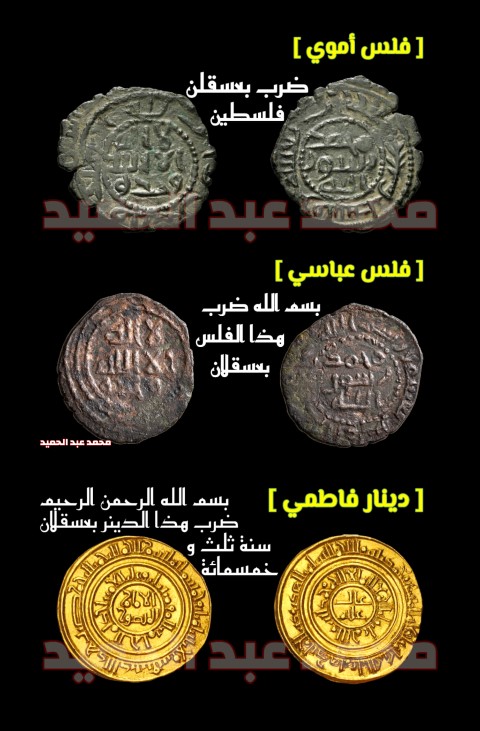
Here we present three examples of Ashkelon coins from Islamic currency issues minted in Medina.
First model
(Umayyad coin) of dubious origin, likely minted towards the end of the first century AH.
We read on the center of his face, “There is no god but God alone.”
On the center of the back we read “Muhammad is the Messenger of God”
The following saying was inscribed in a circular pattern on the margin:
“Strike in Ashkelon, Palestine” followed by a miniature depiction of an olive branch
We read on the center of his face, “There is no god but God alone.”
On the center of the back we read “Muhammad is the Messenger of God”
The following saying was inscribed in a circular pattern on the margin:
“Strike in Ashkelon, Palestine” followed by a miniature depiction of an olive branch
The second model
(Abbasi fils) of the year, likely minted during the beginning of the third century AH.
We read on the center of his face, “There is no god but God alone.”
On the center of the back we read “Muhammad is the Messenger of God”
The following saying was inscribed in a circular pattern on the margin:
“In the name of God, this coin was struck in Ashkelon.”
We read on the center of his face, “There is no god but God alone.”
On the center of the back we read “Muhammad is the Messenger of God”
The following saying was inscribed in a circular pattern on the margin:
“In the name of God, this coin was struck in Ashkelon.”
اFor the third model
(Fatimid Dinar) in the name of Imam Al-Amir bi-Ahkam Allah, minted in Ashkelon in the year 503 AH.
We read on the center of the face “Imam Al-Mansur”
And on the middle circle: “Abu Ali al-Amir bi-Ahkam Allah, Amir al-Mu'minin”
The following saying was inscribed on the outer margin circle:
“In the name of God, the Most Gracious, the Most Merciful. This dinar was struck in Ashkelon in the year five hundred and three.”
We read on the center of the face “Imam Al-Mansur”
And on the middle circle: “Abu Ali al-Amir bi-Ahkam Allah, Amir al-Mu'minin”
The following saying was inscribed on the outer margin circle:
“In the name of God, the Most Gracious, the Most Merciful. This dinar was struck in Ashkelon in the year five hundred and three.”
For more similar topics, you can follow the Arab collector's website. the Link the next:
Love Dirham
Gaza Money Lecture