Ancient CoinsIslamic CoinsNumismatics
Love Dirham
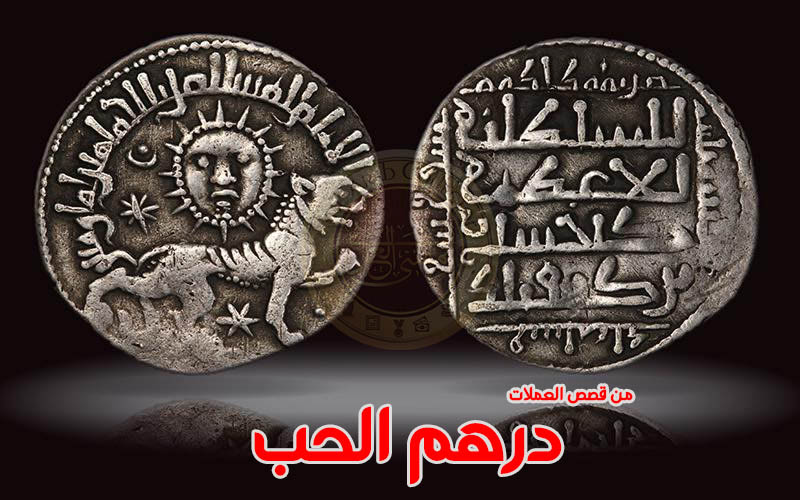
From the stories of currencies: The Dirham of Love!
It is perhaps one of the most beautiful Islamic pieces in terms of design, and nothing surpasses the beautiful design except the most beautiful love story!
The coin known as the "Lion and Sun" dirham or "Dirham of Love" is a piece that was minted and circulated in the kingdom Seljuks of RumIt differs from most Islamic coins that have reached us, as it does not bear a decorative or floral design as was common in that period of history, but rather it bears symbolic shapes that were considered at the time to be quite bold, especially if the collector understood their meaning and the love story between the Sultan and the Sultana that brought these shapes to the dirham.
The Seljuks descended from a dynasty of Turks who ruled the region stretching from Afghanistan in the east to Egypt in the south, and as far west as the borders of Greece. In 1071 AD, they defeated the Byzantine army and are also credited with halting the advance of the First Crusade. By 1078, their influence had reached as far as Nicaea, near Constantinople, where they ruled for nearly two centuries.

Ghiyath ad-Din Kaykhusraw II was the son of Sultan Kayqubad and his Greek wife. He ruled the Seljuk state from 1237 to 1245 AD. During his father's reign and at the beginning of his own, the Seljuks had reached the height of their military power and their territory had expanded considerably. In 1232, when Kaykhusraw was still a prince, a political alliance was formed with the Emirate of Aleppo when the young prince married (perhaps against his will) the daughter of the Ayyubid ruler of Aleppo.
But things were not stable on the borders, as the Mongol tribes, in cooperation with the Georgians, launched raid after raid. Kaykhusraw advanced to punish Georgia, and when the Queen of Georgia saw the size of the Seljuk armies, she asked for peace and - as was customary - offered that Kaykhusraw marry her beautiful daughter, Tamara.

Queen Tamar's role was significant, especially considering the era in which she lived, as women did not usually have influential roles. One day, the Sultan wanted to proclaim his love for his wife to the world, so he ordered new coins to be minted bearing her image alongside his – similar to the coins of Western monarchs. However, the kingdom's ministers and wise men advised him against implementing the idea for many reasons, and they even refused to allow her name to be inscribed alongside his on the coinage… But the stubborn king did not despair…
Instead of issuing coins bearing both faces, he requested that the face be altered to feature a lion (symbolizing the Sultan) with a radiant sun above it, representing Tamara, whom he often described in his private conversations as being like the sun in his life. It was a beautiful gesture to his beloved wife and a symbol of love rarely seen since (at least in the realm of coinage!). These "Lion and Sun" dirhams were minted in several mints across the kingdom over three years, from 1240 to 1243, with slight variations in design and inscriptions. Later, the lion and sun would become symbols of Persia throughout history, appearing in various modern forms—and with different meanings—on its national flag until the Islamic Revolution of 1979.

We had hoped to conclude our story with ”Then they lived happily ever after and had sons and daughters,” but unfortunately, history had other plans. After a short period, a violent internal revolution broke out, and after a bitter struggle that lasted two years, the Sultan won with difficulty. However, the conflict exhausted the Seljuks and Kaykhusraw, and the lurking Mongols attacked his weakened kingdom until they seized most of it. He was forced to flee to Greece, while his mother and daughter fled to the court of the King of Armenia, who initially treated them with great respect. However, the Mongols demanded their surrender, otherwise they would declare war on Armenia, so the King was forced to comply.

Kaykhusraw tried to rebuild his army and attack Armenia to take revenge, but after a few small victories, defeats followed and he was completely refuted. All these losses resulted in a state of confusion and resentment among the Seljuk leaders, who ultimately decided to kill the Sultan by strangulation. As for the beautiful Tamara, according to the customs and traditions of that era, she was forced to marry one of the nobles, where she lived the rest of her life.
And so the years and centuries pass, and the Mongols and the entire Seljuk kingdom disappear, leaving us with nothing but these small coins as witnesses to one of the most beautiful love stories the world has ever known.
For more similar topics, you can browse the Arab collector's website through the Link the next:
A gang that forged postage stamps was arrested.