The Arabization of Islamic coinage went through several gradual stages. Changing the currency in circulation is not an easy matter, and the state of internal conflict that the Caliphate witnessed greatly disrupted the course of Arabization. When Abd al-Malik ibn Marwan was sworn in as Caliph in Damascus, he did not actually control most of the provinces of the Caliphate, and years passed before he was able to impose his authority and get rid of Ibn al-Zubayr in the Hijaz and the Kharijites in Iraq, as well as some of the rebellious tribes of the Levant, so that he could then begin pushing towards the complete Arabization of the coinage and the Diwans.
Models of Arabization of Islamic currency
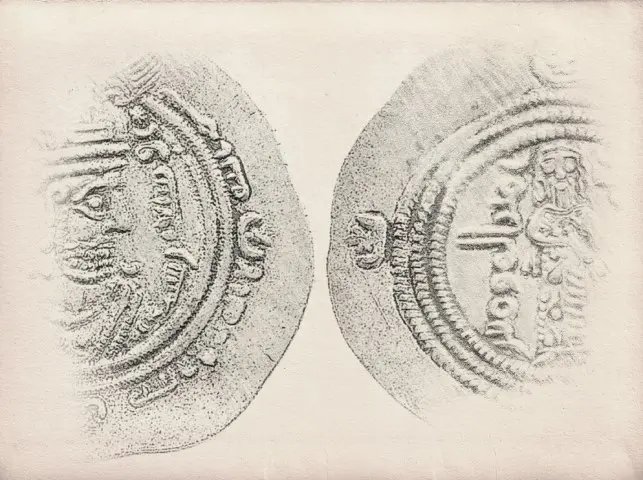
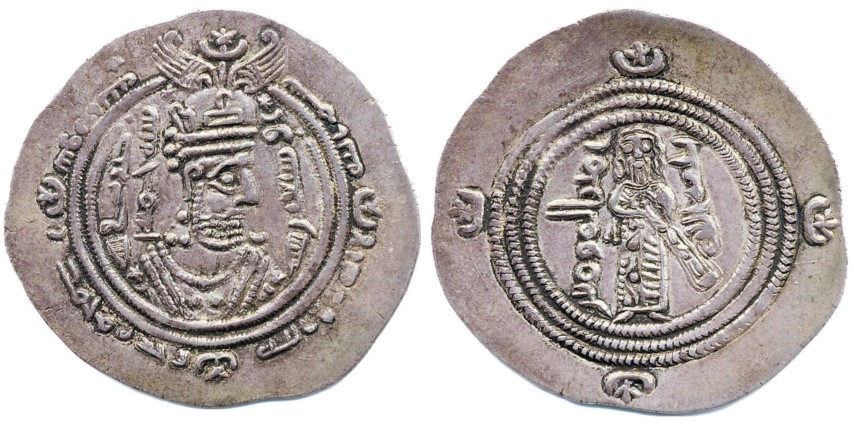
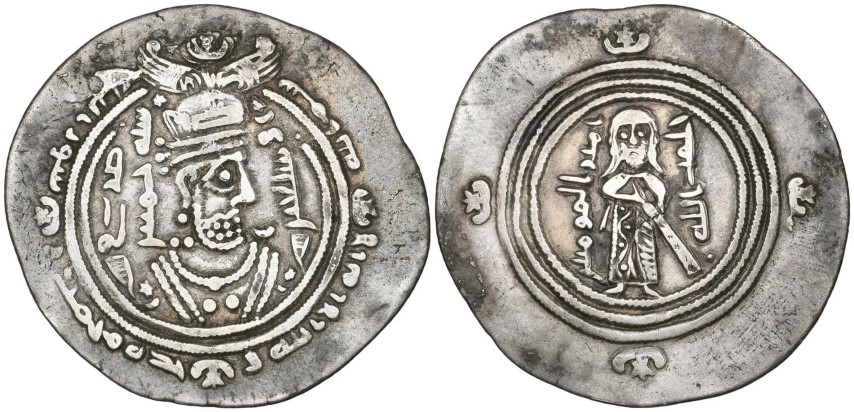
Here we present two examples of one of the rarest Arabized Sasanian dirhams, belonging to the later stages before the complete Arabization of Islamic coinage.
On the face we see a profile depiction of Khosrow II looking to the right and wearing the winged crown, and the following is written behind the head.
(He was multiplied in the year five) and before it (seventy)
And in the margin, it was written in a circular motion clockwise.
(In the name of God •• There is no god but God •• Muhammad is the Messenger of God)
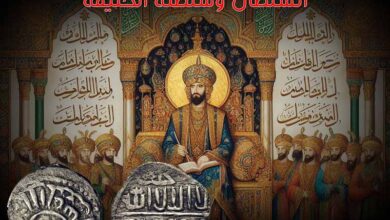
On the reverse, we see a frontal depiction of Caliph Abd al-Malik ibn Marwan wearing Arab clothing and brandishing his sword in his right hand. This is the same depiction that appeared on some dinars from that period, and it was written on the left.
(Commander of the Faithful) and on the right (God's successor)
It is worth noting that this edition is not from the city, but it is likely from the Damascus region.