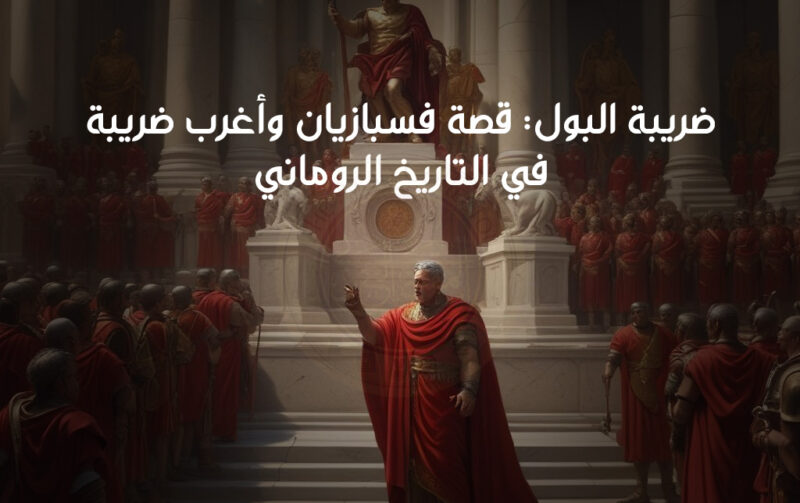
The Urine Tax: The Story of Vespasian and the Strangest Tax in Roman History
Can money have a smell? Vespasian says (PECUNIA NON OLET)
At the heart of Roman Empire history, specifically in the year 69 AD, one of the strangest taxes ever appeared: urine taxIt may seem strange, but behind this tax lies a fascinating political and economic story, led by the Roman emperor. VespasianThe man who uttered his famous phrase: “Pecunia non olet“, any “Money has no smell.”.
Historical background:
In 69 AD, the Roman general Vespasian was besieging Jerusalem with the aim of suppressing the Great Jewish Revolt. However, he decided to leave the task to his son Titus, while he himself went to Alexandria, and from there to Rome to contest the rule against his rival Vitellius.
While he was in Alexandria, he received news of Vitellius' defeat and the Roman Senate's recognition of him as the official emperor.
Imposing taxes to compensate for Rome's losses
After his installation as emperor, Vespasian sought to consolidate his power and replenish the Roman treasury, which had been severely damaged after the chaos of the "Year of the Four Emperors." He began by imposing a series of taxes on the provinces, most notably a urine tax levied on public toilets in Rome.
This tax was levied on the collection of urine from public toilets, which was used in the leather and textile industries because it contained ammonia. When his son Titus criticized this tax, Vespasian held up a bag of money and said to him: “"Can you smell it?"”He added: “Money has no smell.” Hence the famous Latin proverb was born.
The gold coin was minted in Alexandria
In 70 AD, after the destruction of Jerusalem, Titus went to Alexandria. During this period, unique gold coins appeared, believed to have been minted either during the stay of Vespasian or his son Titus in the city.
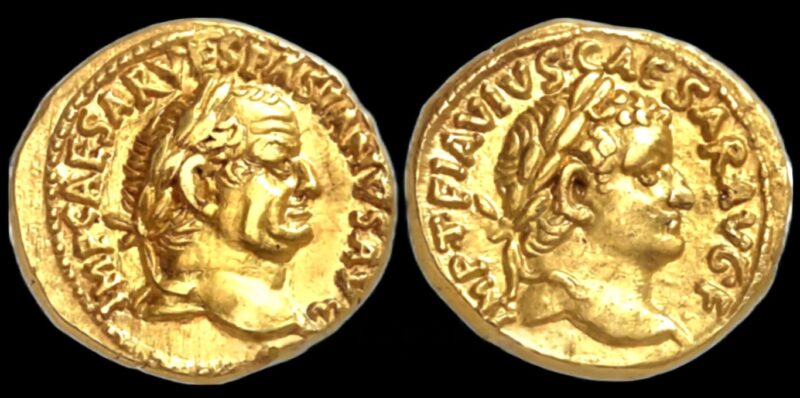
Historians believe that the minting of these coins was not for general circulation, but to strengthen the loyalty of the armies and consolidate the authority of the Flavian dynasty after years of political turmoil.
It is worth noting that Titus's name was followed by titles almost identical to those of his father, and he was crowned with a laurel wreath like his father. This led some experts to assume that he had an intention to stage a coup, assuming that the mint was indeed struck after Vespasian's departure from Alexandria. Generally, we cannot confirm this hypothesis. We can also explain the matter by the new emperor's attempt to consolidate his son's position and the rule of the Flavian dynasty after the chaos that ensued during the period following Nero due to his failure to produce sons to inherit the throne after him.
For more similar topics, you can browse the Arab collector's website through the Link the next:




 EN
EN  AR
AR