The story of a Yemeni postage stamp
India was Eastern and pre-postage stamp issuance
Let me tell you the story of a Yemeni postage stamp... when it began East India Company With expansion, and Queen Elizabeth I of Britain granted it authority Monopoly over trade in India and all colonies The British in Asia and even the Arabian Peninsula, with political and military support from Britain, continued its usual activity until it was dissolved as a result of the civil disobedience in India in 1858 AD. Before this date, it was at the peak of its era and was always looking for a new target or a new country to serve the interests of Great Britain. The choice fell on Aden, which was affiliated with the Sultanate of Lahej, or as it is called, the Sultanate of Al-Abdali.
In 1835, Britain sent Captain Haines, one of the naval officers, to the Gulf of Aden to find out the suitability of the region to be a naval base and warehouse for British ships. Haines indicated in his report the necessity of occupying Aden due to its strategic importance and annexing it to Great Britain. In 1839, Britain decided to take over the port of Aden to be a coaling station to supply steamers sailing on the Suez-New Bombay route, and a small force of warships and soldiers of the East India Company were sent to the Arabian Peninsula.
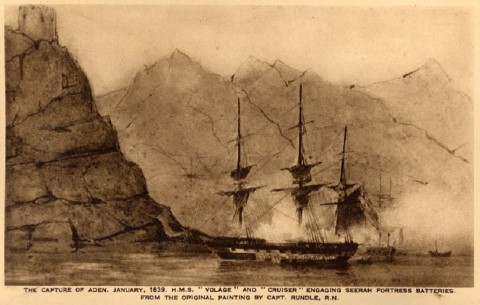
The campaign succeeded in defeating the army of the Sultanate of Lahej and seizing the fortress on Sira Island, which is considered one of the most important and prominent fortresses of the ancient and historic city of Aden. The fortress played a defensive role in the life of the city, and from it, the defensive fortifications were formed in the mountain. Many attacks and invasions that sought to control the city were repelled, until it became a symbol of steadfastness against the attacks of invaders and those coveting the port. The last of these was the battle of resistance waged by the people of Aden in defense of the city with their modest weapons against the British occupation on January 19, 1839. However, the British continued to develop and fortify the fortress after their arrival and occupation of Aden. The fortress remained standing even after the British left, and the Yemeni army later used it as a military site.
King George VI of Britain issued a decree transforming Aden into a colony, granting it the same legal system and legislation as other British colonies. It became a self-governing entity under a direct colonial model, staffed primarily by Englishmen. Its port remained a free port for trade.
Aden's location helped make it a transit point for mail passing through the Indian Ocean and Europe, as ships coming from Suez and heading to Bombay could leave mail for East Africa in Aden until ships going to Africa arrived, as it became a stop and transit point for ships.
After the loss of the Suez Canal in 1956, Aden became Britain's main base in the region. On January 18, 1963, the Aden Colony was merged with the Federation of South Arabia. Following South Yemen's independence from Britain, Aden remained a British protectorate for 129 years until 1967, when the People's Democratic Republic of Yemen was established.
Aden Special Postage Stamp
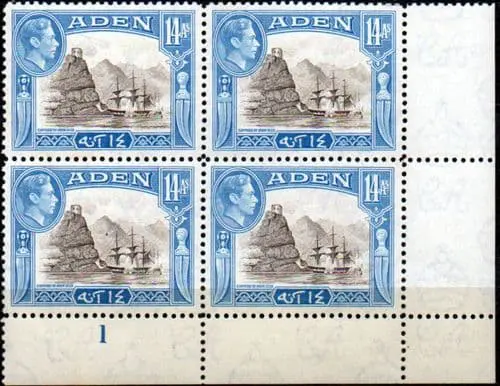
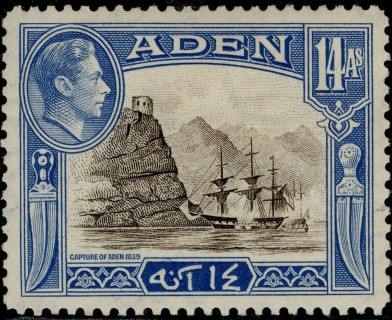
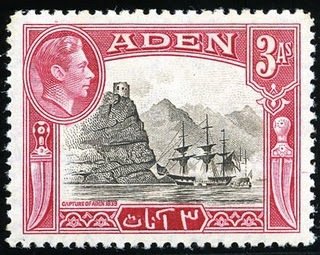
On January 19, 1939, the centenary of the British occupation of Aden, Britain issued a postage stamp commemorating the capture of the city and the seizure of Sira Fort. The stamp's design was based on a drawing by J.S. Rundle, a British naval officer who participated in the campaign to capture Aden and attack the fort. They had departed from Bombay on December 29, 1839, under the command of Captain H. Smith, accompanied by the 24th Bombay Infantry. They arrived in Aden on January 16 and officially took control on January 19, 1839. The stamp was thus issued to mark the 100th anniversary of the capture of Sira Fort in Aden.
In conclusion: Every postage stamp is not just a picture, but represents a story or an important event that happened previously or commemorates an occasion dear to us. Therefore, the stamp is considered part of the history and heritage of any country, and it always leads us to search and learn the most minute details that went through a certain stage and were embodied through the drawing or picture on the stamp.
For more similar topics, you can browse the Arab collector's website. the Link the next:
Royal Opera House Muscat: 10 Years of Excellence