Air MailPostal HistoryPhilately
The story of Egyptian aviation and airmail
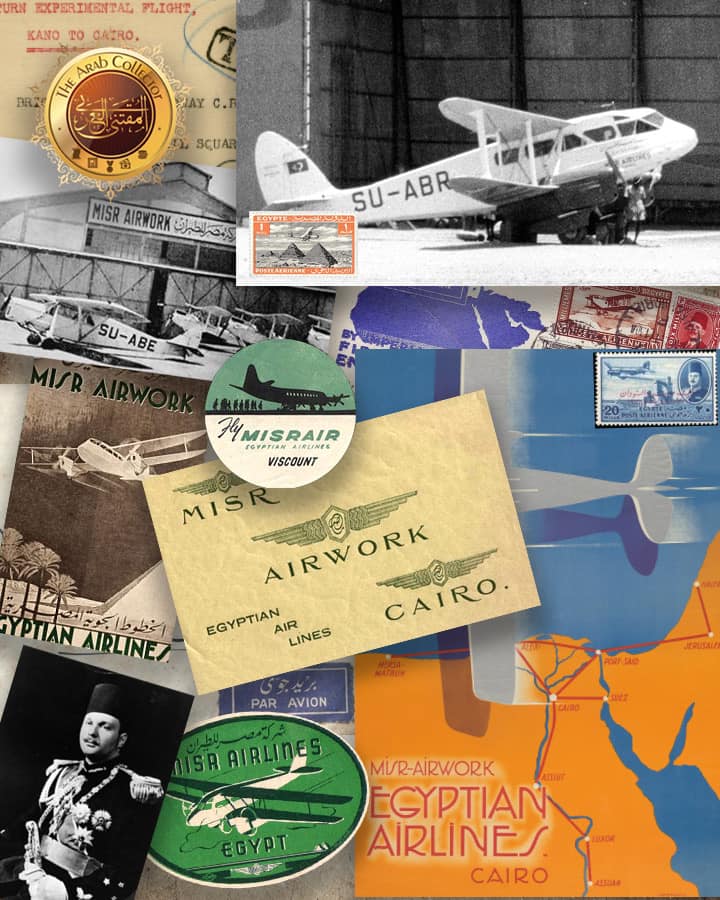
EgyptAir was founded in 1932 by Bank Misr, led by its national economic leader, Talaat Harb. He was the son of a junior employee of the Egyptian Railways Authority, but he grew up antagonistic to the foreign presence that controlled Egyptian finances at the time. However, with determination, perseverance, and steadfastness, he finally managed to fulfill the dream of many Egyptians by establishing Bank Misr in 1920 to compete with the National Bank and the Ionian (Greek) Bank.
Anyone who examines Talaat Harb's history will realize that while he was opposed to foreign "control" of the Egyptian economy, he never objected to "cooperating" with Britons—provided they were affiliated with the British private sector and not British government employees—in establishing Egyptian national industries. In the 1930s, his bank began financing numerous Egyptian companies, including Misr Airwork. It's worth noting that Imperial Airways had expressed interest in establishing an Egyptian airline in partnership with Talaat Harb, but their request was rejected by the Egyptian bank. However, the same bank readily agreed to collaborate with a private British airline, Heston Airwork Ltd., to establish Misr Airwork.
The agreement stipulated the training of Egyptian pilots, the establishment of airports, and some other logistical tasks, with the bank owning a 60% stake in the new company and Heston owning 40%.
One of the oddities of the fledgling company is that – as is the custom of governments in all times and places – it was forced to offer a 15% discount on airline tickets to all Egyptian government employees (even if it was for a trip unrelated to work) in exchange for winning annual government support and a monopoly contract for airlines within the Kingdom!
The company's first headquarters was in Almaza, Cairo, but it also established pilot training centers in Alexandria and Port Said. The core of its fleet consisted of a small number of de Havilland 89 and 86 aircraft, all of which were small planes; one had a capacity of 14 passengers and the other only 6, in addition to a mail transport service.
The national company quickly began developing its service routes. In July 1933, it operated a weekly route between Cairo, Alexandria, and Marsa Matrouh. Then, in July of the same year, it announced the operation of two daily trips between Cairo and Alexandria, which were increased to three trips in 1935 and then to four trips in 1944. Also, in December 1933, it established a winter route operating between Cairo, Luxor, and Aswan twice a week, as well as the Alexandria-Port Said-Cairo-Minya-Assiut route in 1936.
In 1934, “Egypt Airwork” turned its attention outside of Egypt, and at that time it opened the Palestine line to operate twice a week between Cairo, Lod and Haifa, followed by lines to Cyprus (Nicosia) and other countries.
One of the pioneering pilots, J. Fleming, wrote in his memoirs about the company: “It is one of the most successful airlines, with many British pilots and Egyptian trainees, in addition to a considerable number of Egyptian engineers.” He also mentioned that during the 5 years he spent with the company, EgyptAirwork’s planes covered 7 million miles without a single accident or injury to any passenger, and that this was due to the skill and dedication of the engineers.
With most of the aforementioned routes, the company worked to transport mail by air alongside passengers, and we find that it carried envelopes from Cyprus to Cairo between 1935 and just before World War II.
As for the establishment of the Haifa line, its purpose was to transport mail by air to Palestine and then ship it to Beirut and Damascus by car. However, the Syrian authorities apparently could not guarantee daily transport, which led to delays in mail and consequently to the closure of the line on September 22, 1935.
The company faced numerous difficulties with the Egyptian government. It considered itself the national airline of Egypt and therefore demanded that the government treat it as most foreign governments treat their national carriers, especially given the rising costs of service, which led the company to rely increasingly on the government's monopoly contracts. The problems were further complicated by the government's intransigence, insisting that any contract be for only one year, requiring renewal negotiations to begin as soon as the contract expired—a process that proved exhausting for both parties.
As if the company needed more obstacles, one of its board members, the nobleman Muhammad Tahir Pasha (who was also a member of the royal family and president of the Egyptian Aviation Club), conspired to establish a new, competing airline called "Horus Airlines" to operate on the Cairo-Berlin route. Tahir Pasha, who was vice president of Siemens Middle East and had strong German connections, did everything possible to obtain the necessary approvals, but ultimately the Egyptian government intervened and prevented Horus Airlines from becoming operational.
On September 16, 1936, the Port Said-Baghdad postal line was established, which one pilot described as the worst flight route imaginable due to the weather disturbances in both summer and winter!
On September 3, 1939, with the outbreak of World War II, EgyptAir's operations were briefly suspended. Most routes were then reopened in stages and cautiously by Egyptian officials, taking into account the changes brought about by the war. Instead of transporting only passengers and private mail, it began transporting army officers, military mail, and diplomatic mail. After the fall of France to the Axis powers, mail destined for Greece and the Balkans was transported to the Turkish city of Adana, from where it was then transported overland. The Iraq route was forced to be suspended for a period due to the outbreak of demonstrations there, as was the Syria route during the battles with the Vichy French government forces allied with the Nazis in 1941. Finally, the Cyprus and Turkey routes were also briefly closed.
But the small company refused to accept defeat and close its doors. In 1942, it worked on opening new routes such as Cairo-Beirut twice a week, Cairo-Khartoum once a week, and also the Cairo-Damascus route twice in mid-1944.
When the war ended, the company had proven to be a great success, especially given the circumstances of the war, and it had acquired a considerable fleet of 14 aircraft, through which it was able to control the express mail route between the major cities within Egypt.
In 1949, Heston's shares had fallen to only 10%, and in a huge celebration, the company was completely nationalized and became known as MisrAir.
EgyptAir maintained its headquarters at Almaza Airport until 1956 when it was moved to Cairo International Airport - which was formerly an American airport known as Payne's Airfield. This airport has a story that may not be known to many, as after the war ended, King Farouk decided to buy it from his own pocket and put it at the disposal of the Egyptian government, which in turn named it “Farouk Airport” Aeroport Farouk and established a post office there that continued to operate under this name from July 1947 until August 1952. However, the residents of the area called it “Payne’s Airport” until the 1960s.
The airport was then converted into a military airport, and the last envelope was sealed with the stamp of the Almaza post office, dated September 1966. As for the company, in 1958, after the union of Egypt and Syria to form the United Arab Republic, Syrian Airlines also merged with “Egypt Air” and together they formed “United Arab Airlines.” However, the political separation between the two countries, which occurred in 1961, led to Syria withdrawing its planes, but Egypt kept the name as it was until 1971 when the company’s name was changed for the last time to become EgyptAir.
In the 1960s and early 1970s, the company relied on Soviet models for most of its aircraft due to the political and military closeness with the Eastern Bloc at that time. However, in the 1980s, it moved closer to the West. Currently, EgyptAir is one of the largest air navigation companies in the Middle East and a member of the Star Alliance group of airlines, serving dozens of routes, despite its humble beginnings in the imagination of Talaat Harb.
Moheb Rizkalla
Sources:
John Sears, “Egyptian Airmail,” 1990
– Egyptian Postal Studies Circle QC 200
– The Blue Sky – J. Fleming, Memoirs of a Former Pilot in Egypt
For more similar topics, you can browse the Arab collector's website through the Link the next: