The idea of issuing a 500 pound banknote
Did you know that a long time ago, the Egyptian government considered issuing a 500-pound banknote but changed its mind due to rumors about the economy?
New banknote idea
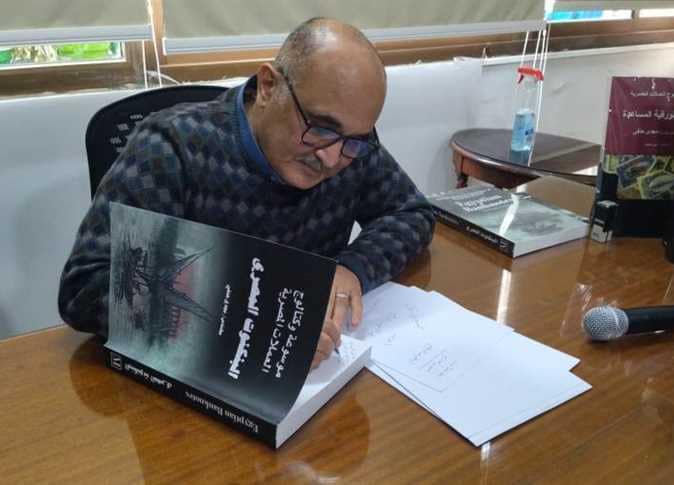
The story dates back to 2004 when engineer Magdi Hanafi, a historian of Egyptian currency, met with the governor Central Bank of Egypt At that time, Farouk El-Okda was being honored at his office on the occasion of the publication of Magdi Hanafi's book on banknotes and his winning the IBNS Book of the Year award. During the meeting, he had the opportunity to present the idea of introducing new denominations to Egyptian currency, such as a 500-pound note and coins of half a pound, one pound, and five pounds. Furthermore, he proposed modifying the design of the banknotes in circulation at the time due to concerns about counterfeiting.
Farouk El-Okda was fully prepared to understand the idea, especially because of his trust in Magdi Hanafi, the owner Encyclopedia and Catalog of Egyptian Money This project documents Egyptian coins and banknotes. The Central Bank of Egypt initiated plans in 2005 to commission artist Magdi Ahmed, then one of the most renowned designers of Egyptian banknotes, to create a new 500 Egyptian pound note. However, the government reversed its decision before the announcement due to concerns about rumors of an economic crisis and the potential inflationary impact on the markets.
Designing a 500 Egyptian pound banknote – an experiment
The front of the 500 pound banknote
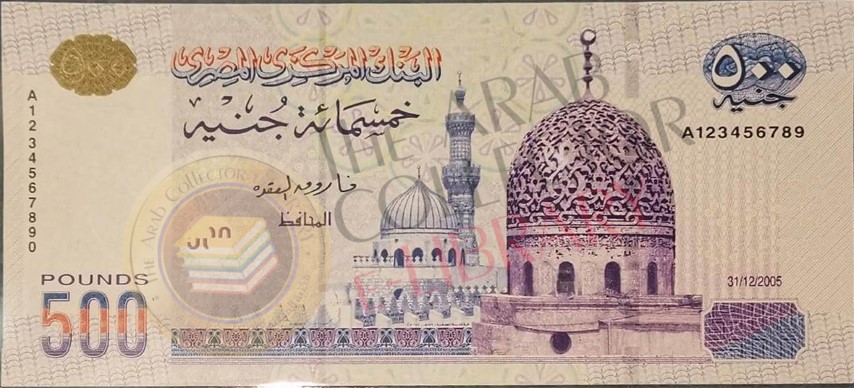
The artist Magdi Ahmed excelled in designing that banknote, as the front design of the 500 Egyptian pound note carried Islamic motifs. In the middle appeared a picture of the dome of the Al-Jawhariya School in Al-Azhar Mosque, and next to it was a picture of the minaret and the main dome of Al-Azhar Mosque in Cairo. The 500 Egyptian pound note was written in the upper right corner of the note in blue, and in English in the lower left corner of the note in three different and graduated colors, which are blue, orange, and purple.
 The category name was explained in Arabic below the words "Central Bank of Egypt" and it reads: “five hundred pounds”Islamic decorations in the form of circles with a rose in the center were added next to the Arabic words, and below was an Islamic decorative band in the width that was engraved with extreme precision to prevent forgery. The number 500 was also drawn in English and appears in full through the light passing through it.”.
On the other side, the serial number of the new banknote was written on the margin of the paper on the left in a horizontal manner, which was introduced for the first time in Egyptian banknotes. Above it is the number 500 in gold as a security mark for the paper. In the lower right corner of the paper is a picture of a cartouche bearing Islamic security decorations that show the number 500 when the paper is tilted. Above it is the date of issue, which was mentioned on the trial paper, 31/12/2005.
The back of the 500 pound note
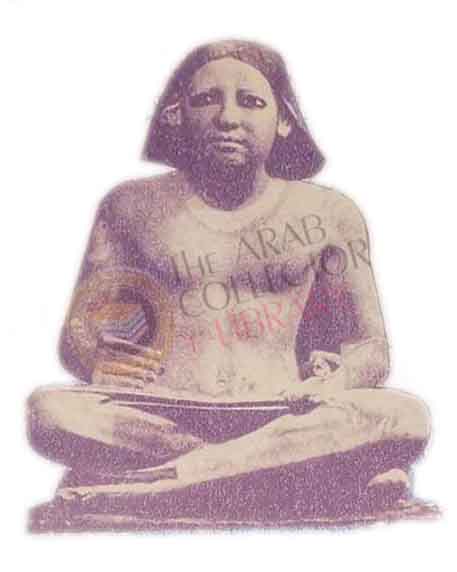
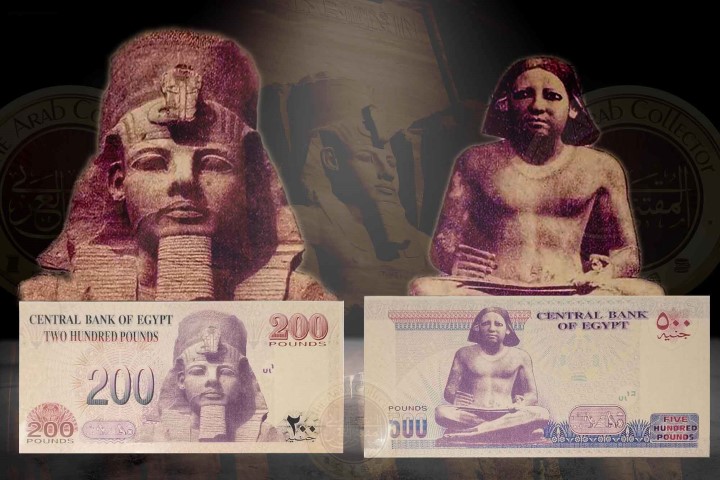
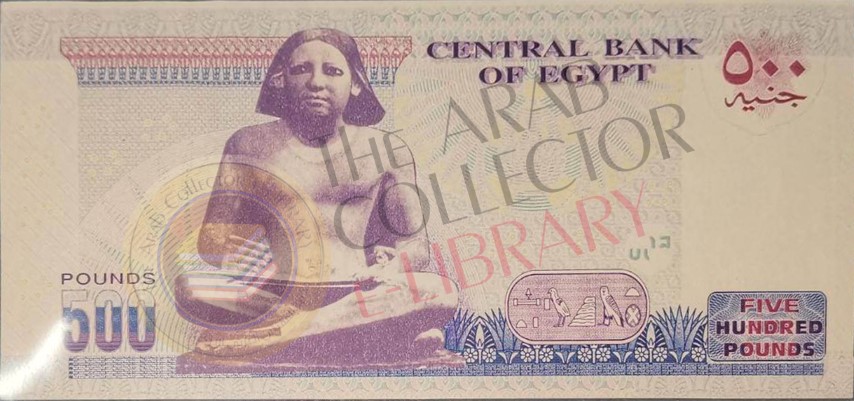
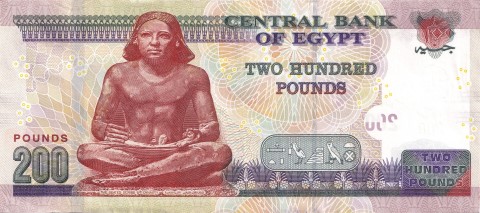
The reverse side of the banknote, as is customary for Egyptian currency, features an image of an ancient Egyptian monument. The artist Magdi Ahmed chose the statue of the seated Egyptian scribe, one of the most famous statues from the Fifth Dynasty. This statue, displayed in the Egyptian Museum in Tahrir Square, was discovered in a necropolis in Saqqara and is made of limestone. It is considered one of the most famous and detailed statues that expresses the cultural life and its importance in ancient Egypt.
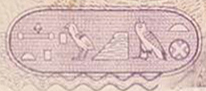
Next to the statue of the Egyptian scribe, a pharaonic cartouche was drawn with the words (Hetep-bu-Kemet) written inside, which means peace upon Egypt or Egypt is peace.
On the upper right of the paper, the denomination 500 pounds is written in orange, and below on the right, in English, the denomination FIVE HUNDRED POUNDS is written in blue and orange, and on the left, the denomination 500 Pounds is written in purple, blue, and white.
A blue strip with Pharaonic motifs was added across the width of the paper, and trees of the distinctive Egyptian lotus tree were added, in addition to Pharaonic motifs in the background of the paper and an image of the motifs of one of the Pharaonic column capitals in ancient Egyptian temples at the top of the paper.
The 200 pound design experiment
In the same year, Al-Aqdah assigned the task of designing a 200-pound note to the artist Magdi Ahmed, who did not hesitate to showcase his talent in design.
The front of the 200 pound banknote
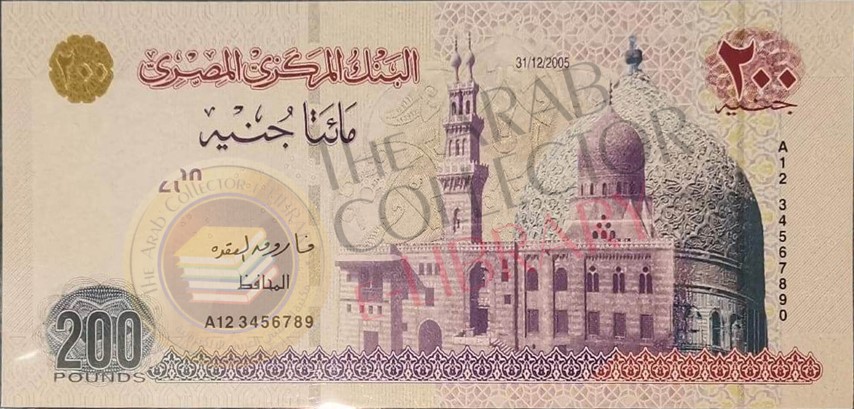
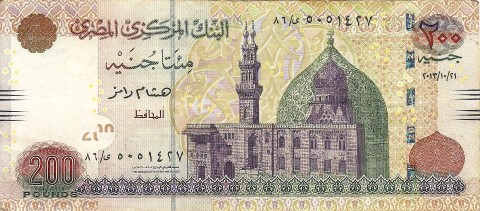
The front of the 200 Egyptian pound banknote features an image of the Qaitbay Mosque and a picture of its famous dome in the background. The denomination 200 Egyptian pounds is written in orange in the upper right corner, and the number 200 is written in gold in the upper left corner as a security mark. The denomination 200 Pounds is written in English in blue.
The paper also featured multiple Islamic decorations on the background, a decorative band across the bottom of the paper with a gradient of color, and the date was placed at the top of the paper above the image of the mosque, with the number 200 appearing in full penetrating color.
The back of the 200 pound note
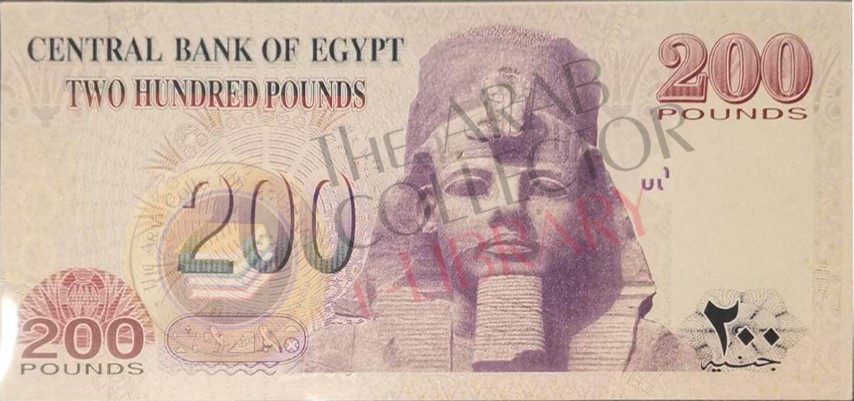
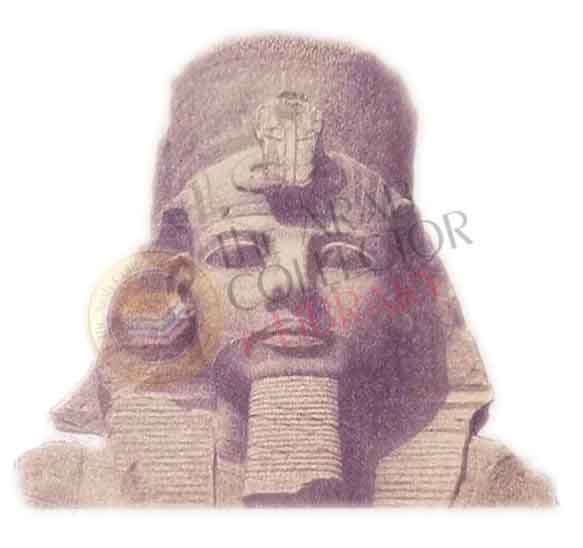
The back of the paper featured a picture of one of the statues of Ramses II located at the entrance of the Abu Simbel temple in Aswan Governorate, next to it a pharaonic cartouche in which the word (Hetep-bu-Kemet) was written, and below it a decorative image of the waves of the Nile River.
The category was written in English twice in the corners of the paper in orange and once in Arabic in black, and the number 200 in English was in a gradient color and surrounded by a circle with lotus flower edges.
The designs are similar to the 200 pound note.
For undisclosed reasons, the 500 pound note was not issued. Since the designer of the 200 pound note is the artist Magdy Ahmed, there is a similarity in the design, as the image of the seated Egyptian scribe statue was retained on the back of the note, as were other decorative elements such as the pharaonic cartouche and the lotus flower.
As for the front of the banknote, the design elements of the front of the 200 banknote were retained using an image and the dome of the Qaitbay Mosque in Al-Rimah.
Currency denominations and inflation
According to engineer Magdy Hanafi, the introduction of a 500-pound banknote has nothing to do with inflation, especially considering that both Saudi Arabia and the United Arab Emirates already have 500 and 1000-pound coins in circulation.
Magdi Hanafi highlighted the fact that the first banknote produced in Egypt with integrated features was the 100-pound note, issued in 1994 and designed by the artist Saber Saida. In 2005, a 500-pound note was also designed; however, this note was not put into circulation due to concerns about high inflation.
Hanafi emphasized that the meticulous attention to detail in the work of the original Egyptian designer makes it extremely difficult for counterfeiters to imitate their work. He also noted that Egypt benefited from German expertise in teaching and training currency designers since the 1960s, which allowed Egyptians to excel in design by the 1990s.
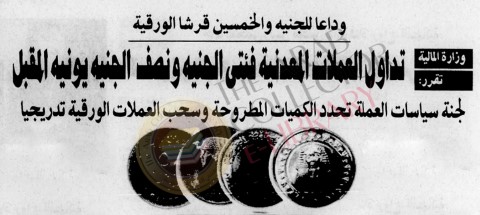
It is worth noting that in April 2006, the Currency Policy Committee in Egypt, affiliated with the Ministry of Finance, announced the decision to issue coins of the half pound and the one pound coin denominations, and in 2007 the 200 pound paper currency was introduced into circulation with its current design (large size).
For more similar topics, you can browse the Arab collector's website. the Link the next:
Arab currencies in the Spink auction, April 2023