The features of Egyptian society on a lottery ticket
Egyptian society
With the increasing influx and migration of foreigners to Egypt since the beginning of the nineteenth century, Egypt witnessed many strange patterns and manifestations of modernization, as well as different forms of practices that these people brought to Egypt, such as the wearing of European clothing by the increasingly large class, the effendi class, as well as the adoption of Western lifestyles in furniture, food and clothing, which created a thriving market for all these items.
The manifestations of Western life that came to Egypt did not stop at this point, but rather developed rapidly to witness more images, including the printing and selling of lottery tickets, which were introduced by some members of the Greek community to Egypt at the end of the nineteenth century after they found a thriving market for them. It is noted that the phenomenon of lottery tickets began in Europe since the eighteenth century, which spread rapidly from that time, as it appealed to the dreams of the poor and middle classes, and the authorities in charge of it at that time sought to make huge profits from selling those tickets, which moved with lightning speed to other countries, coming with the foreigners who came to these countries as a result of the wars and conflicts that began to haunt them in their homelands.
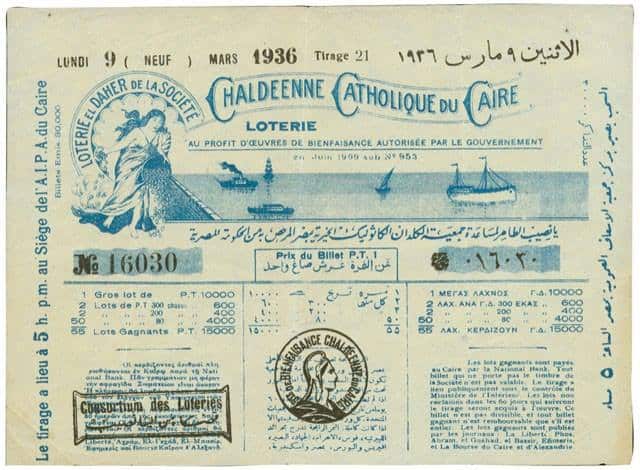
As soon as the Greeks began promoting those papers in Cairo and Alexandria, members of foreign communities and non-Muslim sects quickly found an opportunity to increase their income by promoting such papers. At the forefront of these sects was the Jewish sect, which, with the establishment of the Karaite Jewish sect school in 1897, established a lottery institution in 1899. It owned a complete printing press for printing lottery papers, and the quantity of papers printed monthly through that institution reached 40,000 papers, from which the sect achieved financial profits that reached more than 30,000 pounds per month, which is a very large amount at that time.
sectarian phenomenon
With the growth of this phenomenon, which began to take on a sectarian form that generated abundant profits for a particular sect, the Minister of the Interior in Egypt in 1903 found that there was no way to avoid preventing these papers and prohibiting their circulation except with the approval of the Egyptian government, which succeeded in forcing the Jewish sect and other sects that print and distribute these papers to comply with the orders and to restrict the activity of distributing these papers to the scope of charitable societies.
In 1928, the Egyptian Ambulance Association, which operated under the supervision of the royal family, presented a new project stipulating the necessity for those involved in the lottery to form a union responsible for printing and selling those tickets. The Jewish community found itself compelled to join this union, as the tickets were sold and their profits were distributed among the different communities according to the number of tickets sold and the agreed-upon percentage. After the community had been generating substantial profits from those tickets, the gains decreased to only 800 pounds per year. Gradually, the community and other non-Islamic communities began to lose their share of the lottery profits for reasons that some interpreted as political and religious.
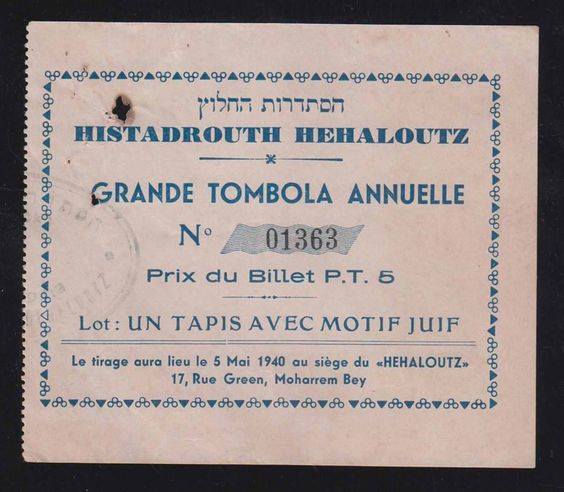
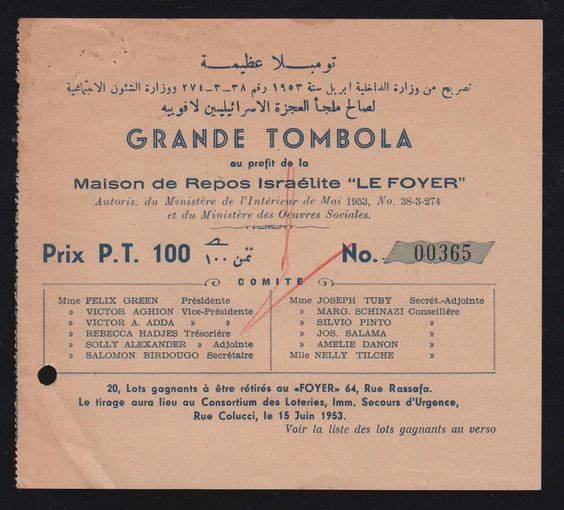
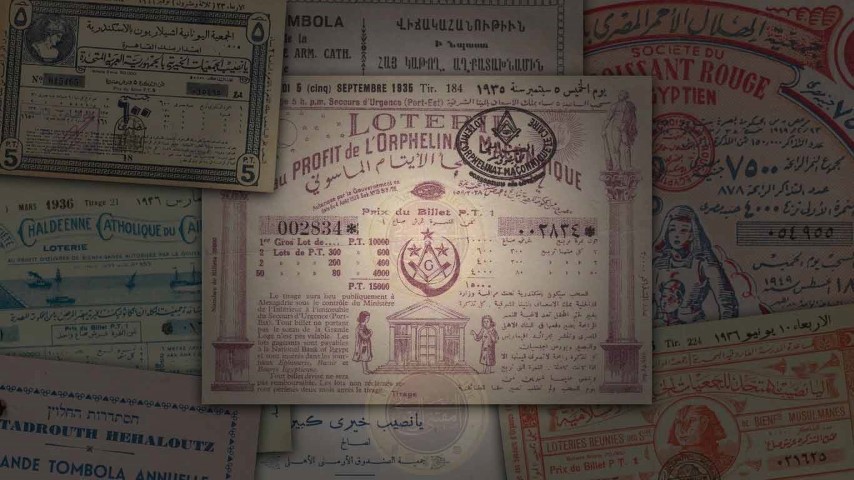
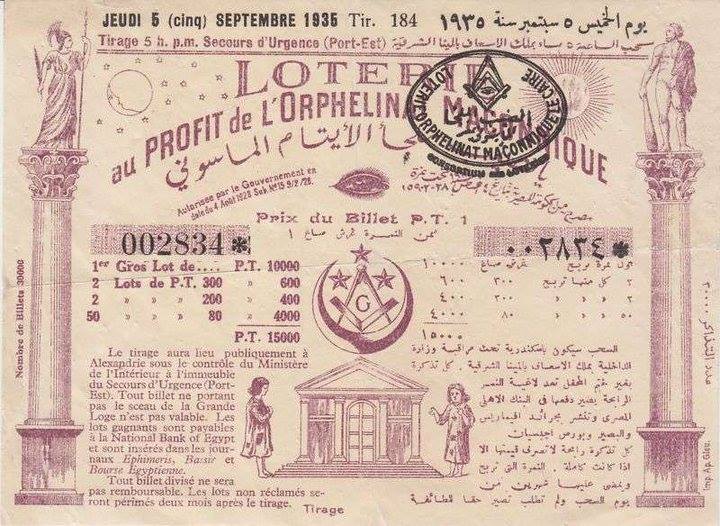
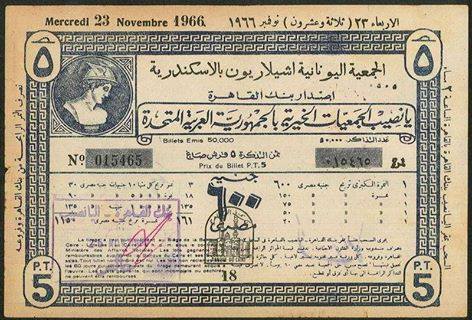
Despite this decline, the lottery tickets available now, which are owned by some enthusiasts, show that the lottery was issued by sectarian charitable institutions, including Jewish associations and institutions, such as the Israeli Rescue Union, based in Muharram Bey in Alexandria, and its tickets were written in Hebrew and French and issued until 1940. Lottery tickets were also issued by the Masonic Orphanage in Alexandria, one of the charitable institutions affiliated with the Masonic Lodge in Egypt, and the draw was carried out under the supervision of the Egyptian Ministry of Interior. Tickets were also issued by the Israeli Elderly Home “Lafoyeh” with a permit from the Ministry of Interior in April 1953, and the price of the ticket was one Egyptian pound.
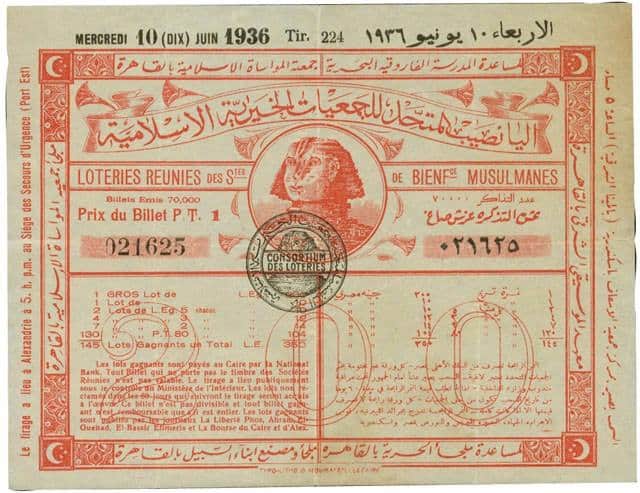
The names of other sectarian institutions also appear, including the Chaldean Catholic Charitable Society in Egypt, which issued lottery tickets that were distributed in 1936, with a value of one piaster, and were written in three different languages: Arabic, French, and Greek. Also noteworthy was the increased distribution of lottery tickets issued by the United Lottery for Islamic Charitable Societies in 1936, and their profits were distributed equally among several Islamic charitable institutions, including the Al-Farouqia Maritime School Aid Foundation, affiliated with the Islamic Al-Muwasaat Society in Cairo, as well as the Islamic Al-Muwasaat Society Shelter in Cairo, the Institute of Oriental Music in Cairo, the Freedom Shelter in Cairo, and the Shelter and Factory of the Wayfarers in Cairo. The price of one ticket was one piaster.
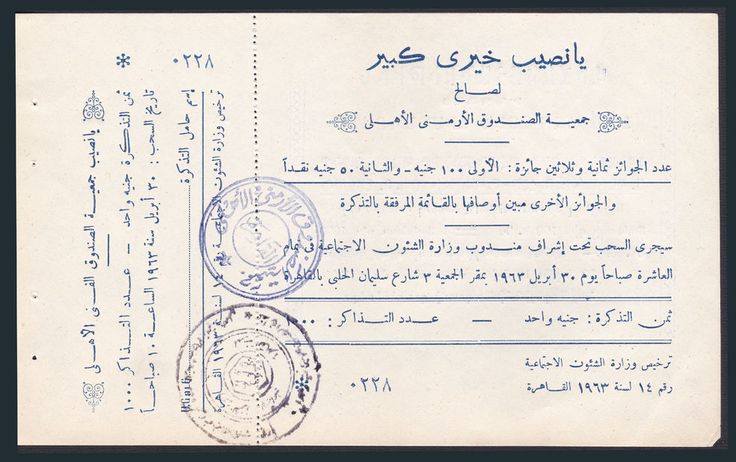
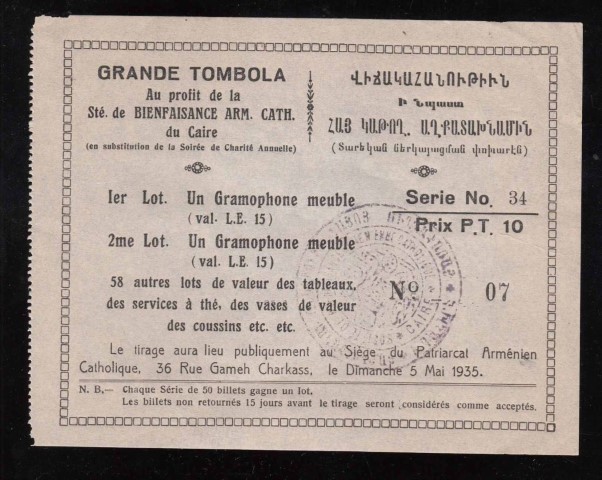
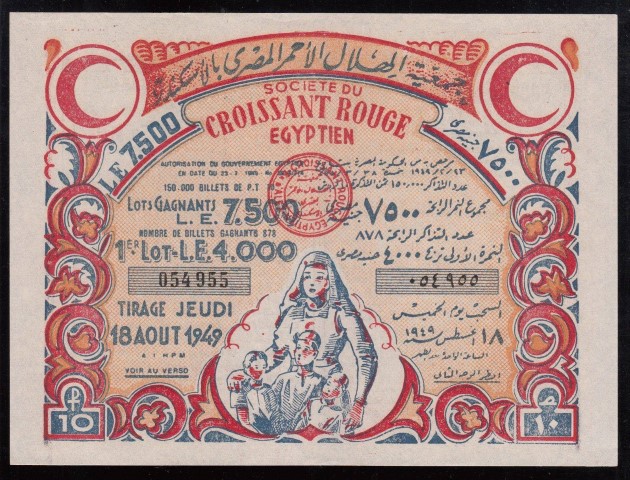
Another set of lottery tickets issued between the 1940s and 1960s shows that the phenomenon of sectarian institutions sponsoring and distributing these tickets continued remarkably. Tickets were issued by the Armenian National Fund Association, as well as by some Islamic associations and institutions, including tickets issued by the Muslim Youth Association in Cairo, the Coptic Catholic Association in Alexandria, the Egyptian Red Crescent Society in Alexandria, and the Greek Achilla Rion Association in Alexandria. With the beginning of the 1960s, the lottery transformed from a mere ordinary trade into a trade with a number of offices in various governorates. In 1967, the Egyptian Ministry of Social Affairs established a lottery sellers' association as a central association of public benefit in accordance with the provisions of Law No. 32 of 1964 concerning private associations and institutions.
Some documents pertaining to the Jewish community in Egypt show that the sale of these lottery tickets was not limited to Jews only, but it may have been aimed at appealing to the dreams of the poor and simple people in many of Cairo's poor neighborhoods, as some of them indicate that Muslims, Armenians, and Copts won lottery prizes, including citizens from the residents of Sayyida Zeinab, Bein El Sourein, Ataba, the Jewish Quarter, and other neighborhoods of the poor and common people. This matter continued for a long time, especially with the announcement of large financial prizes that were not limited to winnings in Egyptian pounds only, but also included prizes in French francs and Italian bentos, as these documents confirm.
linguistic phenomenon
It is also noted that lottery tickets were known to the general public by several names that attracted their attention and drove them strongly towards them. Some called them “primo,” which is an Italian word of Latin origin, meaning “first.” Like other Italian words, it found its way into Egyptian colloquial Arabic. It was also known as “tombola,” a French word that entered Egyptian colloquial Arabic with the increasing influx of French people to Egypt. Then, the use of the word “ya nasib” became common among Egyptians, preceded by the word “nasib” and preceded by the word “ya,” a call, perhaps as a speech to request winning money.
A cinematic phenomenon
The phenomenon of lottery tickets, which remained popular for a long period that extended for decades, also received a great deal of attention from Egyptian cinema, which expressed it and highlighted it as a general phenomenon at that time that was a reason for tempting the common people of Egypt who dreamed of quick wealth and abundant profit. Egyptian cinema began to pay attention to it through the film “The Delegates” directed by “Togo Mizrahi” and starring the Jewish actor “Shalom” who appeared in the film with his real name as in the rest of the films in which he played the leading role. This film was produced in 1934.
Then came the film “El Primo” in 1947, directed by Kamel El-Telmisani, starring the late artist Mahmoud Shokoko and the Jewish artist Gracia Kassin. The film ”Abu Halmous” was also produced, starring the late artist Naguib El-Rihani. In the same year, the film “The Lottery Seller” was produced, starring Ismail Yassin and Mahmoud Shokoko. These films ranged from discussing the impact of lottery tickets on the dreams of the poor and simple people and their pursuit of wealth, to the social hypocrisy that suddenly appears on some people if one of them is blessed with abundant money. This quantity of films shows that the phenomenon of lottery tickets was like a dream at that time that many people have always sought. Naturally, these films played a role in promoting this phenomenon and its spread in Egyptian society, most of whose people at that time suffered from financial crises that drove them to search for dreams of quick wealth.
Technical Features
Lottery tickets circulating among amateurs show some features and artistic characteristics that distinguished those tickets and for a long time carried European characteristics, whether in terms of imitating the shapes of the tickets issued in Europe or through the introduction of some aesthetic elements to them, such as the artistic drawings that spread at that time, such as pictures of Greek gods, as well as drawings of some Egyptian historical symbols such as the Sphinx, the pyramids and ancient temples, as well as some distinctive drawings of Freemasonry. Those tickets were also distinguished by the beauty of the colors and the accuracy of the printing, making them distinctive and attracting the attention of passersby, as they were sold on the sidewalks of the main streets in Cairo, Alexandria and all the Egyptian governorates.
It can be said that the growth of this phenomenon within Egyptian society may be primarily due to economic reasons, especially with the spread of poverty among many Egyptians, who were driven by financial circumstances to seek any opportunity to achieve even a small part of wealth by purchasing these papers. It can also be said that the control of some religious sects over this phenomenon came about because of the prohibition of dealing with it and the prohibition of trading or buying it, as it falls under the games of gambling that are forbidden by Sharia. This prompted some sects to exploit this prohibition to increase their activity and control the minds of the poor and play on their dreams. It also highlights a real phenomenon that money breaks all restrictions and breaks all barriers and drives ambitious people to do anything, even if it is by transgressing prohibitions and turning a blind eye to them, which may have been a prelude to legalizing the status of these papers later and giving them a cover of legitimacy.
A phenomenon among amateurs
Despite the fact that more than a century has passed since these papers were first issued in Egypt and have gradually disappeared, they remain a source of interest for many collectors of distinguished old papers, both inside and outside Egypt. They are still sold and traded extensively through major international online marketplaces, and some are sold for large sums of money, especially those belonging to certain religious sects in Egypt, such as Jewish community Likewise, lottery tickets issued by some Greek, Armenian and other associations, and well-known international galleries hold auctions to sell complete sets of them, as they remain a focus of interest for hobbyists, researchers and experts.
Even though those papers have faded and disappeared, they remain a noteworthy phenomenon, especially as they embody the characteristics and features of Egyptian society, which has known religious, cultural, and sectarian diversity and has borne witness to it for a whole century.
Ahmed Abdullah – Researcher in Contemporary Egyptian History
For more similar topics, you can follow the Arab collector's website. the Link the next: