The Arab Collector, Issue 08 – April 2019
Al-Muqtani Al-Arabi, Issue 8 – April 2019
The Arab Collector, Issue 08 – April 2019
Al-Muqtani Al-Arabi, Issue 8 – April 2019
The Arab Collector – Issue 08 – April 2019
Dirham of Caliph Abu al-Fadl al-Abbas al-Musta'in Billah
At first glance, a reader of this post might think that this dirham is attributed to Al-Musta'in Billah, the Abbasid Caliph in Baghdad. However, upon closer examination, the reader will find that the dirham's style is Mamluk Burji, thus making it impossible to attribute it to the Abbasid dirhams of Baghdad. So what is the reason?
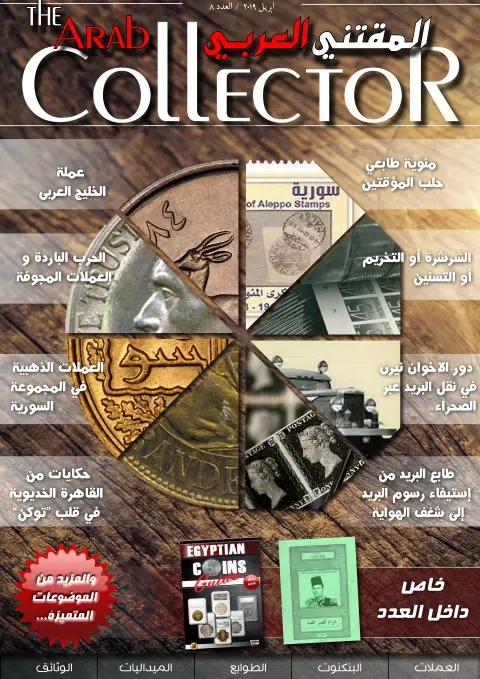
Arabian Gulf currency
In the 1960s, the Royal Mint's advisory committee proposed minting a common currency for Bahrain, Qatar, Abu Dhabi, and Dubai. This was motivated by their desire to replace the Indian currency circulating in these countries, whose value had become disproportionate to the increasing oil investments. Consequently, the Royal Mint established a special committee, headed by Christopher Ironside, and commissioned him to submit prototype designs for these coins.
Centenary of Aleppo's temporary stamps
To commemorate the centenary of the issuance of the temporary Aleppo stamps, the General Postal Corporation in Syria issued a postage stamp.
10,000 stamps were printed (Image 1), and 1,000 cards (Image 2) were printed on 85 x 63 mm paper with a watermark. This article will discuss the circumstances of the issuance of these two stamps, their specifications, and what is known about them so far.
The Comprehensive Guide to Syrian Criticism
Gold coins in the Syrian collection
From postage stamps to hobbyist passion
The first postage stamp was issued on May 6, 1840, bearing the drawing chosen by Sir Rowland Hill, designed at the time by the artist William Wydon and revised by the artist Henry Culburd, of the image of the head of Queen Victoria, which represented the head of the English Empire.
Tales from Khedival Cairo in the heart of "Token"“
Behind every coin is a story and a history. Any coin (whether it's a currency, a medal, or a token) is not just a mute piece of metal bearing drawings, pictures, or writings, but is much more important than that. Perhaps it is a time machine that takes you on a historical journey to a bygone era, or a mysterious magic box that only reveals its secrets to those who love it and fall in love with it.
The story of a dream that came true and was immortalized on a stamp after 23 years
The Iraqi Development Board was established in 1950, whereby oil revenues were allocated to carry out well-studied and meticulously planned strategic projects. Nuri al-Said (the Prime Minister at the time and the founder of this board) adopted the expansion and modernization of Baghdad, so he entrusted the Swiss architect Charles-Édouard Jeanneret, famously known as Le Corbusier, with designing an Olympic sports city that included a comprehensive sports stadium, covered stadiums, and an Olympic swimming pool.
Egyptian Coins Guide
Issue 05
The role of the Nairn brothers in transporting mail across the desert
The Nairn brothers decided to stay in the Middle East after the end of World War I, where both had served in the New Zealand Reconnaissance Group of the British Army, and to start a business project related to the modern means of transport at that time. They had extensive experience in the work and operation of transport machinery for cars and motorcycles, as they owned a shop for selling and repairing motorcycles in their country, New Zealand, before the World War. Their father was one of the first car owners in his country in 1905.
Under the lens
New secrets revealed about the 5 millieme coin of the United Arab Republic, 1967
The Cold War and Hollow Currencies
On June 22, 1953, 14-year-old Jimmy Bosart was delivering newspapers in an apartment building in Brooklyn, New York City. Bosart noticed that a five-cent coin he was given felt rather light, and when he dropped it, it split in two, revealing a case that captivated the American public at the time, known as the Hollow Nickel Affair.
The story of a rare postage stamp
The postal service in Oman was managed through political offices affiliated with the British government. Previously, the postal services in these offices received instructions from the India Office, then from the Pakistan Postal Administration, and finally under the supervision of the British administration. This service was operated from the residence of the political resident in the country, through an office opened in Muscat in 1856. Although no documentation exists for this, an official document was found in the Postal Museum in Delhi, India.
serration, perforation, or teething
It is an important factor that many novice hobbyists overlook, but the expert hobbyist does not overlook - the completeness of the teeth is one of the factors in evaluating the stamp, and the loss of one of them, or its bending, or even the cutting of a part of it, damages the stamp or makes it lose a great value. .
The Egyptian Mosquito Eradication & Cholera Epidemic Medals
Early in 1942, Egypt was threatened with two invasions – one from the west across the Libyan Desert, the other from the south from Wadi Haifa. The first invader was repulsed and thoroughly defeated at El Alamein. The second, Anopheles Gambiae, was stopped at Asyut and eradicated by 19 February 1945.
CIA upside-down candlestick
In a famous stamp series called (Americana) issued between 1975-1981, this stamp was issued, representing a candlestick and its value is 1 dollar. A whole sheet of 100 stamps was issued bearing the (brown color), i.e. the candlestick, and the writing is upside down, while the candlelight is white and yellow and correct. About 95 stamps were counted remaining and bear the number 1610c in the Scott catalog. .
Dawn of the Mamluks
The Mamluk state was established in the year 648 AH (1250 AD) after the killing of Sultan Turan Shah, son of King Al-Salih Najm Al-Din Ayyub, at their hands, because the Sultan intended to eliminate their princes, but they succeeded in turning the tables on him ((they had lunch with him before he had dinner with them)) and they appointed Sultana Shajar Al-Durr, because she was the widow of King Al-Salih, to rule as the first of the Mamluk sultans.
Appendix – Qubba Palace Auction 1954
A reading of the Royal Coin Collection file

 EN
EN  AR
AR