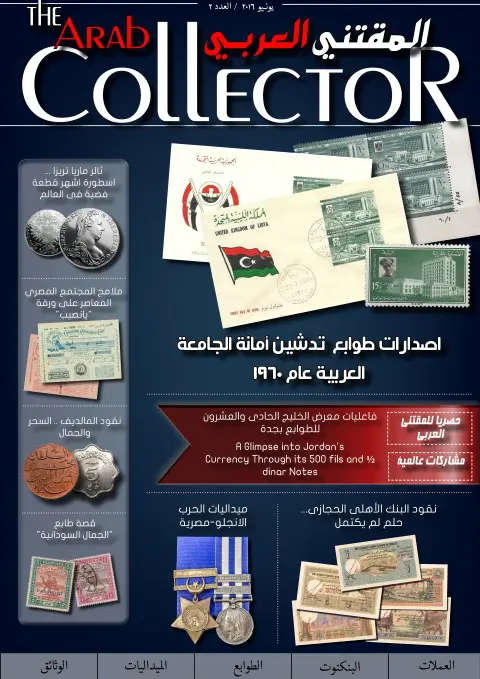
The Arab Collector, Issue 02 – June 2016
Al-Muqtani Al-Arabi, Issue 2 - June 2016
The Arab Collector, Issue 02 – June 2016
Al-Muqtani Al-Arabi, Issue 2 - June 2016
The Arab Collector – Issue 02 – June 2016
Currency evaluation: its concept, terminology, and historical development
Evaluation is the process of assessing how close or far the piece being evaluated is, in terms of its condition, from its original state at the moment of minting. It is based primarily on five important criteria to ensure a comprehensive evaluation.
The Gulf Philatelic Exhibition concludes in Jeddah
The 21st Gulf Philatelic Exhibition concluded in Jeddah from May 15 to 19, 2016, with broad Arab participation.
Abe Kossoff, the most famous American currency trader”
Abe Kossoff remains one of the most important coin dealers and collectors not only in America but in the entire world. He also remains one of the eyewitnesses to the sale of the coin collections belonging to King Farouk of Egypt and Sudan, which he collected throughout his reign and which continue to be of interest and interest to collectors worldwide.
Stamp issues commemorating the inauguration of the Arab League Secretariat in 1960
With the increasing number of stamps issued, the diversification of their themes, and the rise in their prices, the need for specialization became pressing. Many collectors, especially Arab collectors, turned to specialization, and among the major specializations with a thriving market and high demand are joint Arab issues. These are valued for commemorating important shared occasions between countries, for their beautiful designs, for the possibility of exchange with other Arab collectors, and for the valuable cultural information they contain. One important joint Arab issue is the 1960 issue of the Arab League headquarters.
Thaler Maria Theresa… The Legend of the World's Most Famous Silver Item! Part 1
On Tuesday, November 5, 2002, workers at the Austrian Mint in Vienna were nearing completion of their two-day work producing approximately 2,000 proof coins featuring a woman wearing a headscarf against a mirror-like silver background. These coins were individually preserved and packaged. In addition, over 12,900 other coins in non-circulating condition were packed in 500 burlap sacks, ready for dispatch to banks in Germany and Austria, as well as to currency dealers abroad.
“The story of the Sudanese beauty mark
English officers often found themselves responsible for designing stamps for occupied countries, especially if the officer had a passion for drawing, a hobby not common among British army officers. I believe this is why the leadership chose me to execute one of those designs, and that has a story behind it.
“"Features of contemporary Egyptian society on a lottery ticket"
With the increasing influx and migration of foreigners since the beginning of the nineteenth century, Egypt witnessed many strange patterns and manifestations of modernization, as well as various practices they brought to Egypt, such as the wearing of European dress by the increasingly large class, the effendis, and the adoption of Western lifestyles in furniture, food, and clothing, which created a thriving market for all these items.
Anglo-Egyptian War Medals Part 1
The Anglo-Egyptian War broke out in 1882 between Egyptian and Sudanese forces led by Ahmed Orabi against British and Irish forces, after Orabi's forces decided to revolt against foreign occupation, especially after debts strained the Egyptian economy and destabilized the rule of Khedive Ismail.
Former US President Franklin Roosevelt was the most passionate about stamp collecting!
Most of us know that King Farouk was one of the world's greatest stamp collectors, but perhaps not all of us know that US President Franklin Delano Roosevelt was also a huge avid collector.
National Bank of Hegazi money… an unfulfilled dream
In March 1954, during a public auction held at Qubba Palace for King Farouk's coins, 360 banknotes were offered for sale, including these, for $160. These banknotes were overlooked at the time by most of the auction participants, but they soon became a mystery among banknote collectors worldwide.
"The 'Swars'... the most famous means of transportation in Egypt at the end of the 19th century."
“What’s wrong, Amina?”… ”The wind hit me, Mr. Sayed… So you went down from the house, Amina?“ ”I made a mistake, Mr. Sayed. Hussein called me and I went to him… Well, when you can walk on your own two feet, then you can go to your father’s house.“ Everyone knows this famous line that came within the context of the film ”Between Two Palaces” by the late writer Naguib Mahfouz… But where did the word “swers” come from?”
News on the sidelines”
A Glimpse into Jordan's Currency Through its 500 fils and ½ dinar Notes
Despite the short history of Jordan, its banknotes are diverse and colourful. There are six major issues, two by the Jordan Currency Board and four by the Central Bank of Jordan. The currency unit of the Hashemite Kingdom of Jordan has always been the Jordanian dinar, which equals 1000 fils (or 100 piastres in more recent times).

 EN
EN  AR
AR