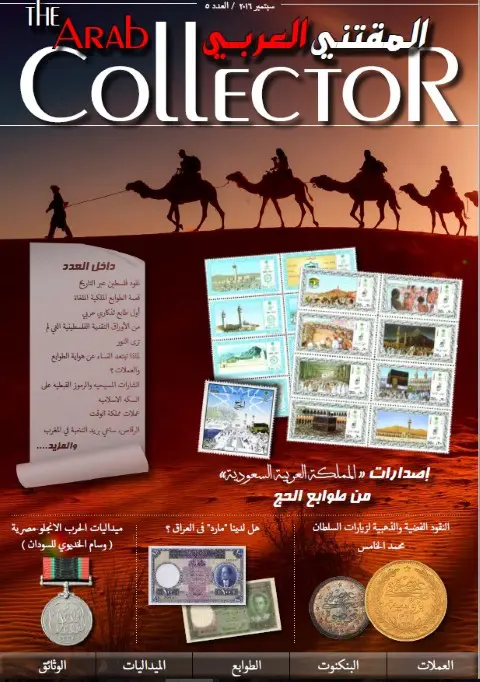
The Arab Collector, Issue 05- September 2016
Al-Muqtani Al-Arabi, Issue 5 – September 2016
The Arab Collector, Issue 05- September 2016
Al-Muqtani Al-Arabi, Issue 5 – September 2016
The Arab Collector – Issue 05 – September 2016
Palestinian currency throughout history
Palestine, like other parts of the world in the pre-coinage era, relied on a barter system for grains and livestock, especially bulls. However, this system had many drawbacks, including the often unequal value of the exchanged items, the difficulty of preserving and storing goods due to their susceptibility to spoilage and the need for a large storage space, and the inability to divide them as needed without spoiling them.
The story of the cancelled royal stamps
Most Egyptian collectors know the story of the royal stamps with the wrong scalloping, and many useful articles have been written about it, but perhaps we haven't discussed much the story of the royal stamps with the reverse side marked "cancelled back".
Do we have a genie in Iraq?
A true story from engineer Mazhar Al-Sajafi from Iraq, a coin collector since the 1980s, recounts his experience through words born of the emotions he has accumulated over more than twenty-five years in the hobby, reflecting on the current state of coin collecting in Iraq. The story tells of the collector's struggles with the current market situation, particularly in Iraq, but similar circumstances (albeit with different terminology) may exist in other Arab countries, mirroring the reality faced by Arab coin collectors from the Gulf to the Atlantic. .
Anglo-Egyptian War Medals
Some resistance movements emerged from some Sudanese tribes against the British colonizer, which necessitated sending small campaigns to eliminate them. As a result of those battles, the Khedive Abbas Hilmi Medal was used to honor the efforts of the soldiers in those battles, and pins were placed with the names of each battle.
Palestinian banknotes that never saw the light of day
In 1941, Europe was in the throes of World War II, and Germany and its allies largely controlled most of the continent.
Classifying some Saudi coins into types, and the emergence of variations within the same type
Collectors enhance their knowledge and understanding of the coins they seek to acquire through dialogues among themselves, in addition to referring to references and catalogs, as these books open horizons for the collector to know the beginning and end of the collections he seeks to complete within his holdings.,
Is this a good investment?
Most collectors consider collecting rare stamps and coins to be one of the best investment methods, and this is true in many cases, but not all.
Christian symbols and Coptic emblems on Islamic coinage
In the first part of this article, we discussed the concept of coinage in general, the types of coins prevalent in the Arabian Peninsula before, during, and after the early Islamic period, the history of each type, and its description. We then addressed the attempts made by the Rightly Guided Caliphs and the Umayyad state to partially Arabize coinage, especially coins of Byzantine origin that bore Christian symbols and emblems due to their origin. We also touched upon the concept of weights and the most important and famous figure credited with the Arabization of currency, Abd al-Malik ibn Marwan.
News on the sidelines
Saudi Arabia's Hajj stamp issues
In it, Muslims celebrate Eid al-Adha, and this annual occasion has a spiritual significance that every Muslim's heart aspires to, so that he may return from it without sins, like the day his mother created him. Therefore, the Kingdom of Saudi Arabia has issued a special annual publication for this occasion since 1978, and it continues to this day. In it, we see pictures of the Hajj rituals, pictures of places of worship, prayer times, and other things.
What do you know about the Bermuda Triangle?
Bermuda Triangle Collection of Token Coins * : (Fantasy Coins)
THE HASHEMITE KINGDOM OF THE JORDAN
But regarding the reason behind this change, opinions were divided, some considering it a mistake and others that it was merely a linguistic change. As long as the reason is unknown, the opinions will remain mere points of view. As for us, we will have the pleasure of satisfying our curiosity and knowing the logical argument. Through our knowledge, we will gain another perspective that reveals to us the nature of the rule upon which our friends and acquaintances, from among the amateurs and those interested, base their opinions.
The most common mistakes in the seals and covers of the first day of Egyptian monarchy
The truth is, it wasn't a mistake in the conventional sense, but rather an experiment to produce a special stamp for the first day of the 1931 Agricultural and Industrial Exhibition. The initial stamp (shown in the image on the four stamps) didn't indicate the exhibition's location, so it was modified with the round stamp shown at the bottom of the envelope, altered to read "In Egypt." It's worth noting that this modified version wasn't used, so the stamp was completely redesigned! However, as far as we know, no other copies exist.
Why do women shy away from stamp and coin collecting?
At some point, the proportions of women and men in collecting hobbies may be equal. However, we find that women do not collect stamps or coins. The vast majority of stamp or coin collectors have been male, as most studies have indicated since 1860, and to this day only a few women have appeared in these fields.
Silver and gold coins from the visits of Sultan Muhammad V
Sultan Abdul Hamid was deposed from the Ottoman throne on April 27, 1909, after a joint council called the "National Assembly" issued a fatwa removing him from office. The Grand Vizier informed the Sultan of the news, but he refused the deposition and sent a delegation of four prominent figures to pressure him. His younger brother, Mehmed V, was installed in his place. Abdul Hamid was exiled to Salonika with his entourage and family by train and remained under heavy guard in the Alatini Palace.
The dancer: Morocco's elite postman
For centuries, Moroccans exchanged messages among themselves, both orally and in writing, by delivering them to travelers. Messages to other countries were delivered to passing ships with the request that they reach their destination safely.
A brief overview of the Egyptian postal service in 1918
Simple offices were opened in both cities (Cairo and Alexandria), and their purpose was to deliver letters to the European community, hence they became known as Posta Europea later on. There are still some elders who fondly remember the small room in the Muski district of Cairo and their frequent visits to it.
Kingdom of Time coins
In the sea of identities, the passion of some enthusiasts turned into madness in creativity, as a series of banknotes and coins began to be issued in 2007 as symbolic currency for imaginary countries, the most famous of which was in America, the ”Kingdom of Time” issues, where the categories of these currencies were the paper categories such as second, minute, hour, day (and the back of the paper is night), week, month, year, decade, century, millennium, and others such as the category of all life and the category of eternity.

 EN
EN  AR
AR