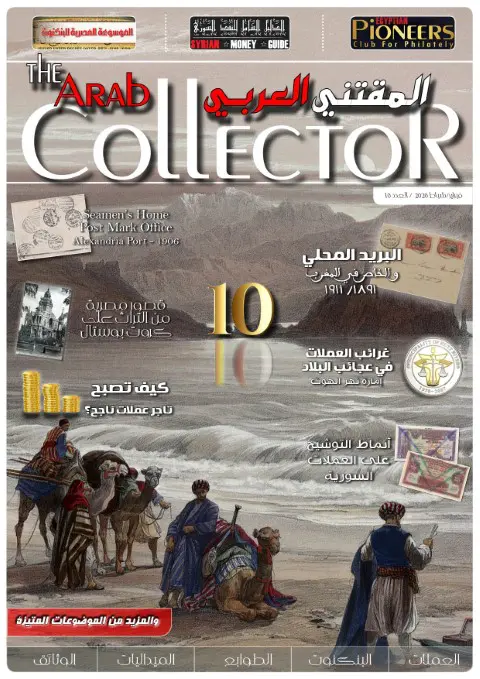
The Arab Collector, Issue 10 – February 2020
Al-Muqtani Al-Arabi, Issue 10 – February 2020
The Arab Collector, Issue 10 – February 2020
Al-Muqtani Al-Arabi, Issue 10 – February 2020
The Arab Collector – Issue 10 – February 2020
Nabataean coins
A new publication in numismatics
The Orders, Decorations and Medals of the Lebanon
Researcher Elie Ghosoub has published a unique book entitled «Orders, Medals and Decorations of Lebanon», which is the first book to show Lebanon’s decorations from the French Mandate until today.
Algerian dinar
The Algerian dinar is the basic unit of currency in Algeria and a symbol of the republic. It is divided into 100 centimes and was first introduced into circulation in 1964.
Dirham of Al-Hashimiyah City
Abu Ja'far al-Mansur, whose full name was Abdullah ibn Muhammad ibn Ali ibn Abdullah ibn al-Abbas ibn Abd al-Muttalib ibn Hashim, is considered the true founder of the Abbasid Caliphate. He ruled for approximately 22 years, from 136 AH until his death in 158 AH. Al-Mansur worked to strengthen the rule of the Abbasid dynasty and eliminate any threat to their control, even from former allies such as Abu Muslim al-Khurasani, who led the Abbasid revolt against the Umayyads in Khurasan.
The story of the coin collector's title
These are not just theses, or even just questions that only need some answers. Here, dear amateur, is the content of these following lines, which has been formulated for you, so that we may all be aware and understand, even if only a little, of much.
Experimental tablets (pollination)
Beginning in 1282 AD, a system was established for what is known as the coinage court of the British Royal Mint, or what is called
Trial of the Pyx
Or the trial of the fund
The currency denominations of Sultan Ahmed III "struck in Egypt"«
The Ottoman Sultan Ahmed III, son of Mehmed IV, assumed power in 1115 AH (1703 CE) and remained on the throne until his abdication in 1143 AH (1730 CE). His long reign was marked by defensive wars against European powers, with the Ottoman army defeating the Russians in 1710 CE and forcing Tsar Peter the Great to surrender the strategic port of Azov to the Ottoman Empire.
Andalusian dinar
This Andalusian dinar is on display at the Madrid Museum. It is one of the strangest and rarest Islamic coins I have ever seen, for several reasons.
Arabic coin designs series
Robert Elderton
Robert Elderton from the records of Egyptian currency documents
Napoleon the Satirist
Some believe it's a forgery because of a clear error in the medal's owner's name, while my professor believes it's genuine due to its strong imprint and because he's experienced and can easily distinguish authenticity at first glance. Ultimately, however, it remains a mystery to everyone.
Curiosities of currency in the wonders of the land: River Hout Emirate (River Hout Province)
In 1970, a major dispute arose between Leonard Casley and the Australian government, specifically with the state of Western Australia, as the government at the time issued a limit on the quantity of wheat supplied, of which Leonard was cultivating about 4,000 hectares, and because of the government’s decision, he could only supply 40 hectares. .
Qalawun and his sons, silver coins of the Bahri Mamluks
Episode 4
Under the lens
The enigmatic Sphinx and its mysterious, magical enchantment?
Libya's magical plant
In the third and fourth centuries BC, the kingdom of Cyrenaica (present-day Libya) was famous for a wondrous plant, the likes of which the world had never known before or since. The Greeks said that it was worth its weight in gold and silver, and the Romans considered it a gift from the god Apollo himself, while the ancient Egyptians symbolized it with a special symbol that was unique to it among all other plants in their writings.
The Comprehensive Guide to Syrian Criticism
The slogans appearing on Syrian coins
Types of coins and the differences between them
Differences between the three versions of the 1000 Lira denomination issued in 1997
Patterns of ornamentation on Syrian currency
The History of Banknotes in Malta under British Rule - Part 2
As the Allies’ fortunes improved in the second half of the war, the British Royal Navy achieved great successes in delivering supply convoys to Malta, and thus was able to transport larger quantities of banknotes. Indeed, the new one-shilling banknotes appeared on April 13, 1943, to replace the overprinted banknotes of the 1918 issue. Single-sided printing without a watermark was the dominant feature of all banknotes issued in that era.
Collecting banknotes: a culture, a pleasure, an investment (Part 2)
The first step in determining the condition of your banknote is to verify its authenticity. You should conduct a thorough examination of the currency to identify watermarks and security features.
Encyclopedia of Egyptian Banknotes
The Beginning and the End - Part One 25 piasters
Egyptian Pioneers Club for Philatelic Collectors – Field Activities in 2019
[Video game world stamp set]
A few days ago, the British Royal Mail unveiled its first release of the new year: a large set of 12 stamps celebrating classic British contributions to the video game industry during the 1980s and 1990s. These stamps will be available for sale to the public starting January 21st and are expected to be popular among thousands of video game enthusiasts.
A new error by the French offices, among the errors of local mutual endorsement between the Alexandria and Port Said offices.
The French post office in Alexandria was opened in 1830 and operated for a long time, more than one hundred years, longer than any other foreign office in Egypt, until it closed in 1931. The French office in Port Said was also opened in 1867 and closed in 1931 as well.
Farouk and Sheikh Al-Maraghi
According to ancient Egyptian legend, the Egyptian Postal Authority had prepared stamps to celebrate the millennium of Al-Azhar Mosque, but King Farouk had a disagreement with the Sheikh of Al-Azhar, the esteemed scholar Muhammad Mustafa Al-Maraghi. When he divorced his wife, Queen Farida, he asked the Sheikh to issue a fatwa preventing her from marrying another man. The Sheikh refused the royal order, and the dispute between Al-Azhar and the palace intensified when the Sheikh shouted at the top of his voice, "Al-Maraghi cannot forbid what God has permitted!" Consequently, the King did not approve the new postage stamps as a form of punishment.
Tripoli International Fair
The Tripoli International Fair is located in Tripoli, Libya. It is an international trade fair where Libyan and foreign companies showcase their products across various sectors. It is considered an international industrial, agricultural, and commercial exhibition. It takes place annually in April, and several ministers and business figures attend the event each year.
Great Bitter Lakes Corporation
Fifteen merchant ships were detained in the Egyptian Suez Canal due to the outbreak of war between Egypt and Israel on June 5, 1967, and these ships were ordered to dock in the Bitter Lakes and not to move.
History of postage stamps in the Gulf countries
Before World War I (1914-1918), most Arab countries applied the postal systems in place in the Ottoman Empire. From the time Europe reformed its postal system until 1862, mail in most Arab countries and the Ottoman Empire was stamped with distinctive seals by each post office after payment of the postage. Some of these seals are dated 1258 AH/1841 CE. At the beginning of 1863, the Ottoman postal service issued its first postage stamps, which were distributed to all post offices. .
Sultan Qaboos, the builder of modern Oman
He is Qaboos bin Said bin Taimur bin Faisal bin Turki bin Said bin Sultan bin Ahmed bin Said Al Busaidi, the builder of the modern Omani renaissance. He was born in the city of Salalah on November 18, 1940 AD and received his education up to the secondary level there. After that, he traveled to the United Kingdom where he continued his education in a private school. Then, in 1960 AD, he joined the Royal Military Academy Sandhurst, where he spent two years, which is the period stipulated for training, during which he studied military sciences and graduated with the rank of second lieutenant. Then, he joined one of the battalions operating in West Germany at that time for a period of six months during which he practiced military work.
The story of an upside-down letter N stamp
The 1960 Evacuation stamp depicts the French occupier's attack on the Syrian Parliament on May 29, 1945, with text in Arabic and English:
“Seamen's Home Post Mark OFFICE – Alexandria Port – 1906
The earliest reference is that in 1860, there was a Scottish Mission established in an old hospital ship from the Crimean war.
A local committee was formed and raised sufficient funds by 1898 to build a permanent home on the site in the Alexandria docks near Gate no 22, Quay no 33
Local and private mail in Morocco 1891/1911, Part 2
When we talk about local and private mail in Morocco, we are talking about a period when postal services were competitive and thriving among Moroccan cities. To make these services appealing, the founders of the postal lines had to choose themes for the stamps that reflected the history, culture, and diverse nature of Moroccan society. The selection of Moroccan landscapes, authentic Moroccan architecture, and the established social life of Moroccan society was not accidental; rather, it stemmed from the desire of foreigners to live in a conservative society within a prosperous economic environment.
Highlights and key events of 2019 for the Arab stamp community
Egyptian palaces from the heritage on postcards
Capital of Islamic Culture
Similar to the issuance of the Arab Capital of Culture, the Islamic Capital of Culture is celebrated by the Islamic Educational, Scientific and Cultural Organization (ISESCO) from the member states of the Organization of Islamic Cooperation, and three cities are chosen to represent the Arab, African and Asian regions.
How to become a successful currency trader? – Special supplement
During my recent visit to the American Numismatic Society, I met various individuals specializing in numismatics, including collectors, shop owners, researchers, mint representatives, writers, publishers, and photographers. I will attempt to summarize what I learned from them in the following pages, presenting it in specific points. I hope this will be beneficial to the readers of Al-Muqtana Al-Arabi magazine.

 EN
EN  AR
AR