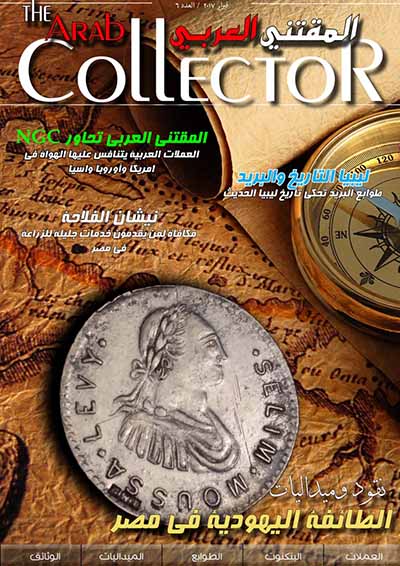
The Arab Collector, Issue 06 – February 2017
Al-Muqtani Al-Arabi, Issue 6 - February 2017
The Arab Collector, Issue 06 – February 2017
Al-Muqtani Al-Arabi, Issue 6 - February 2017
The Arab Collector – Issue 06 – February 2017
FAO / Food and Agriculture Organization
Perhaps one of the specializations that we may encounter in the hobby is collecting the world’s commemorative issues related to a specific occasion, whether in stamps or coins, such as issues for Children’s Day, UNICEF Human Rights, and others. Perhaps one of the most famous of these international commemorative occasions that has enthusiasts and lovers who seek everything new and old to complete their collections is the FAO occasion, but what do we know about the FAO?.
Sharjah Air Envelopes (Aerogram)
It is a thin, lightweight, foldable piece of paper with adhesive edges that stick upon contact with water. This paper is intended to serve as both a postal envelope and a letter; it is a sheet on which the message is written, and then, after folding, it transforms into an envelope sent via airmail at preferential rates. This article provides a brief overview of the history of airmail envelopes, their use at the Sharjah Post Office, and documentation of the postal envelopes specifically issued by the Sharjah Postal Department.
Coins and medals of the Jewish community in Egypt
The reality compels those interested in the study of numismatics, commemorative medals, and coins to uncover the truth about certain non-circulating coins, also known as "fantasy" coins (nioC ysatnaF), tokens (nekoT), and medals (noilladem), minted and issued by Jews in Egypt from the end of the 19th century until the mid-20th century. While some Israeli researchers claim that there was a precedent, exclusivity, and distinction in this matter, it can be asserted that it was merely a tradition and imitation of what was customary at that time among all the communities that had migrated to and lived in Egypt.
Petra, the city of the Nabatean Arabs and one of the Seven Wonders of the World
The Wonders of the World are cultural landmarks presented in a list containing the most important creations made by humankind. The number seven was chosen for them in ancient times because the Greeks believed that the number seven represented abundance and perfection.
Palestinian currency throughout history - Part 2
In the late period of the Phoenician-Canaanite rule of Palestine, Greek power began to emerge and spread, and with it, of course, economic power, the image of which reached us through its silver coins of high purity, fixed weight and specific denominations, which were found and used in most regions of the ancient world in the Mediterranean basin, so they became like a unified international trade currency. They had several forms (see pictures 1-4 from the author’s collection), but the most famous and best of them were the ones with the image of Athena on the front and the image of an owl on the back.
Agricultural Medal
The history of this order is divided into two main phases. First, it was a two-class order from its inception until 1932. The second phase began in 1932 when it was modified into a three-class order. This order was awarded as a reward to those who rendered distinguished services to agriculture in Egypt, whether they were Egyptian or foreign. The first class of this order had a diameter of 57 mm (see Figure 1), and the second class had a diameter of 35 mm (see Figures 2 and 3). It was stipulated that the order be returned upon the death of its recipient.
The Blue Sultanate
The Blue Sultanate was founded through an alliance between the Funj tribes of southeastern Blue Nile, led by Amara Dunqas, and the Abdallab tribes, led by Abdullah Jamma. It was also known as the Funj Kingdom, the Sennar Sultanate, and the Sennar State. Its subjects were called Sennarians. The Sennar Sultanate is considered the first Arab-Islamic state established in Sudan after the spread of Islam and the Arabic language, resulting from increased Arab presence and intermarriage between Arabs and Nubians in the north.
The first exhibition of old phone cards and mobile phones in Mauritania
Phone cards are considered a mirror reflecting civilization, with each country striving to design them attractively and reflecting its heritage, culture, and history through images or information. Examples include heritage cards, landscape cards, event cards, bird cards, and sports and social cards. This hobby is widespread in some regions but very rare in the Arab world. Among those interested in this technological heritage is Abdul Latif Sayed Muhammad, a collector of postage stamps, coins, and cards.
The Arab Collector interviews NGC
Al-Muqtani Al-Arabi noticed the interest of Arab collectors in currency valuation companies and their numerous questions regarding valuation in general, which was clearly evident on social media recently. Therefore, we contacted one of the world's leading valuation companies, NGC, and conducted the following interview with one of its senior employees, Mr. Turner.
Egyptian Khedivial Post Office in Alexandretta
Aleppo was the second most important and prosperous city in the Ottoman Empire after the capital, Istanbul. This was because it was a global transportation hub in the 19th century and earlier. It was one of the most important centers of world trade, and a crucial link between the East, from China to India and Iran, and the West, Europe, as well as between the North, Russia, and the South, Yemen.
Under the lens
Secrets of the 10 millime coin of the United Arab Republic
Variations and differences in Hussein Kamel's silver coins
Variations and differences in Hussein Kamel's metal coins
gold banknote
Of the six different denominations of Palestinian banknotes issued in 22 issues over a specific seven-year period, the 100-pound note, in its three issues, is the rarest denomination and is considered to be of gold value.
Answer degrees
Readers often ask with great surprise and indignation, “How can this coin be considered genuine when it is so full of scratches in such an ugly way! Those who evaluate coins know absolutely nothing!” To answer this question, we must study the journey of coin making at the mint.
Libya: History and Post
Libya's story with the Italian occupation began in 1911. At that time, Libya was under Ottoman rule and consisted of different regions, not a unified state. These regions were Cyrenaica, Tripolitania, and Fezzan in the south. The name "Libya" had not yet come into existence.
Muslims were influenced by the foreign monetary system
During the time of the Prophet and the Rightly Guided Caliphs, Muslims did not have an independent monetary system to represent them, and they were not in a position to think about establishing such a system as they were in the stage of the emergence and development of the young state. So the Muslims and the Islamic state continued to adopt what the Arabs had adopted in the pre-Islamic era from the foreign monetary systems of the great powers at that time.
Abe Kossoff's memoirs on the Qubba Palace auction 1954 – Part 4
After that, we armed ourselves with enough warnings from Fielding's travel guide and several articles about Egypt in general, and we realized that a trip to Egypt would truly be the experience of a lifetime; constantly watch your pockets for pickpockets, only travel in groups, women should not go out alone, make sure to leave a message with someone in your group if you go anywhere, if you take a taxi ask the hotel clerk to write your destination in Arabic - whatever you do, be careful!
Encyclopedia of Egyptian Banknotes - 200 Egyptian Pounds
It is the highest denomination currently in circulation of Egyptian banknotes, and it has been issued in two versions:
The first edition: It was first published in 2007 and is known for its large size and paper dimensions (8 cm x 17.5 cm). .
The second version: It was released in 2009 and the size was modified to become (7.2 cm × 16.5 cm), which is the version still in circulation. .
The secret behind the difference of the 2-millime coin of the Kingdom of Egypt, issue of 1924
Have you ever examined the surface of the Egyptian Milliman coin issued in 1924? Did you notice that it looks slightly different from the other coins of King Fuad? The coin was minted in late 1924 by the Heaton mint in Birmingham, and it seems that the mint director sent a few samples to the Director of the Royal Mint in London as a gesture of respect and to solicit his opinion (although he was neither a party to the matter nor an observer, as Heaton had the right to mint foreign coins at that time without involving government representatives). Below is the text of the letter sent by the Royal Mint to Heaton Mint on November 25, 1924.
Egyptian Stamp Designers in 1961
Of all the stamp printing plants in the world which I have had a chance to visit and inspect, that of the Egyptian Postal Administration is the only one which I have seen that has a complete staff of artists whose sole job is concerned with the creation of art work to be used for postage stamps. This accounts for what I regard as the consistently high quality of modern Egyptian stamps.

 EN
EN  AR
AR