Nubnefer, an Egyptian coin from the last Egyptian pharaoh
Recently exhibited at an auction house Spink On April 3, 2023, a gold coin of King Nectanebo II, known as “Nub Nafar“Nectanebo II was the third and last king of the Thirtieth Dynasty, as well as the last original ruler of ancient Egypt, ruling for 10 years between 360-342 BC before being expelled by the Ptolemies.
Nobnefer coin – the first Egyptian currency
The gold coin is considered the only known coin to date that uses hieroglyphic letters, and according to a statement by Dr. Moataz Billah El-Shahawy – an antiquities restoration specialist at the Egyptian Ministry of Tourism and Antiquities – the importance and rarity of this coin is due to it being the first Egyptian coin in history in its functional sense.
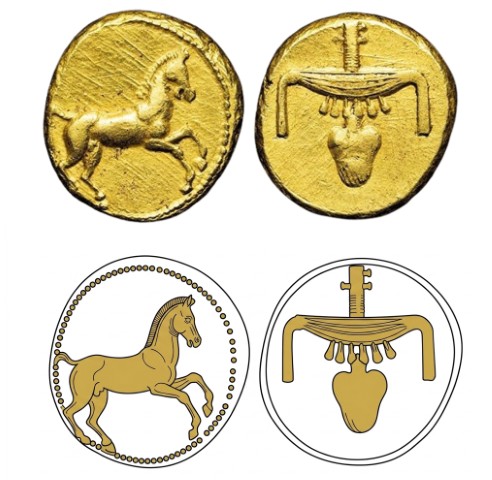
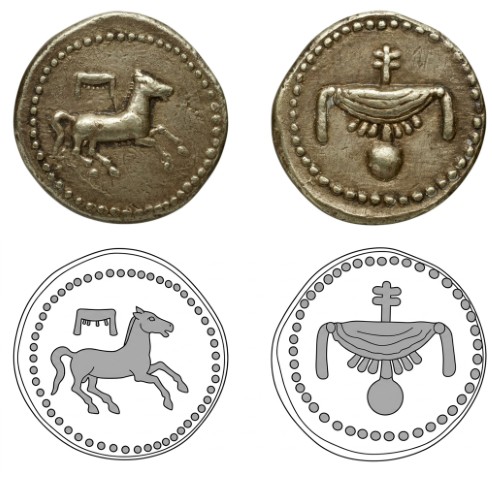
The coin's obverse features an image of a horse leaping to the right, while the reverse side bears the hieroglyphic inscription "Nub Nefer," meaning "Nub Nefer."good or pure goldA necklace with six dangling beads ('nebew' = 'gold') that cross over a heart and windpipe ('nepher' = 'good'). The piece is made of pure gold and weighs 8.36 grams.
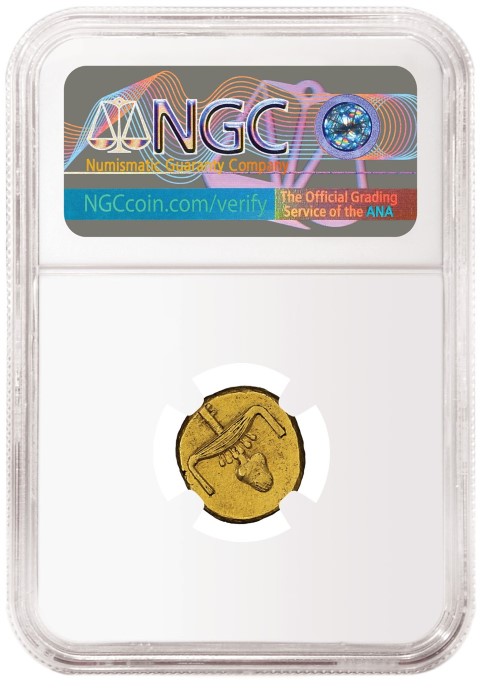
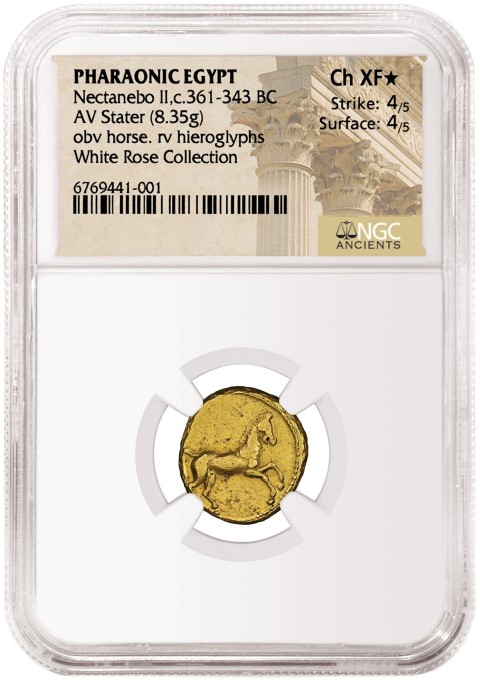
The sold piece was minted regularly and there was no shift of the image from the center of the coin. A total of 48 models of the Nubian Nefer coin were documented in general and two different minting dies were observed, including 3 pieces preserved in the Egyptian Museum in Tahrir, but the internationally known minting dies for this coin are less than 20 models.
However, the piece that was sold was distinguished as one of the best pieces in terms of condition and appearance quality, as the minting quality of the piece achieved 4 out of 5 marks, and in terms of the regularity of the surface of the piece, it achieved 4 out of 5 marks, and the piece was evaluated by the American company NGC with an XF* rating.
There is also another example of a coin from Nectanebo II made of silver, which was a rare metal in ancient Egypt.
Dead hostage (Winter 1919/1920)
In his 1923 article, *Lesrouvailles de monnaies egyptiennes a legendes hieroglyphiques*, Chanesat reported that at least 38 coins had been found at al-Azizia, near Mit Rahina, following the discovery of other coins at individual sites in the 1890s. Joseph Khawam, in collaboration with Chanesat, studied at least 27 of these new coins discovered at Mit Rahina and essentially confirmed that they were not forgeries, as had been previously attributed to the individual site discoveries.
Although not every coin was identified in the report detailing the discovery of the hostage's remains, the surviving tablet confirmed its connection to the piece that was sold, as the surfaces of the current coin also perfectly match those of the tablet mentioned in the hoard. The British Museum acquired a coin in 1926 and noted that at least four coins had passed into the hands of the renowned French dealers Rollin and Fordent, who were active participants in the London coin market in the early decades of the 20th century.
This remarkable piece, struck according to the Macedonian standard of weight, is the only genuine Egyptian gold coin to feature hieroglyphic inscriptions. It represents one aspect of Nectanebo II's numerous attempts to unify and revive traditional Egyptian culture and religion in the face of Persian invasion, and is thus one of the few ancient Egyptian coins that did not directly imitate Greek or Persian coinage.
In his attempt to preserve Egypt's independence, Nectanebo secured the support of the Egyptian priesthood and maintained an army of Greek mercenaries. The coinage itself is symbolic of Nectanebo's predicament as a national leader with a regime backed by foreign military power. While it is generally believed that this gold was used to pay soldiers, the hieroglyphic inscription identifying it as "good gold" was likely only legible to Egyptian priestly scribes.
It is worth noting that Nectanebo I (c. 379–362 BC), the dynasty's founder and grandfather of Nectanebo II, repelled the Persian invasion in 374 BC with the help of a skilled mercenary army. Nectanebo II spent the rest of his life in exile, and Egypt never again minted coins with hieroglyphic designs.
The most expensive Egyptian coin
The piece was offered at Spink auction number 23004, which featured a distinguished collection of old coins and a private collection, and its estimated value ranged between £80,000 and £120,000 (approximately $98,000 to $147,000).
Despite this, it broke the record for the most expensive Egyptian coin, previously held by a Sultan Fouad riyal sold in 2018. The Nub Nefer coin fetched £180,000 (equivalent to $223,500 USD) plus the auction house's commission of 20%. It's worth noting that the Sultan Fouad riyal sold for $120,000 USD excluding the commission, which is almost double the price. Sultan Fuad's Riyal To occupy the throne of the most expensive Egyptian coin to date.
Sources:
NGC coin
Numisbids
Spink Auction House
For more similar topics, you can browse the Arab collector's website. the Link the next:
Egyptian currency and record prices in Eritrea 2023 Part 1