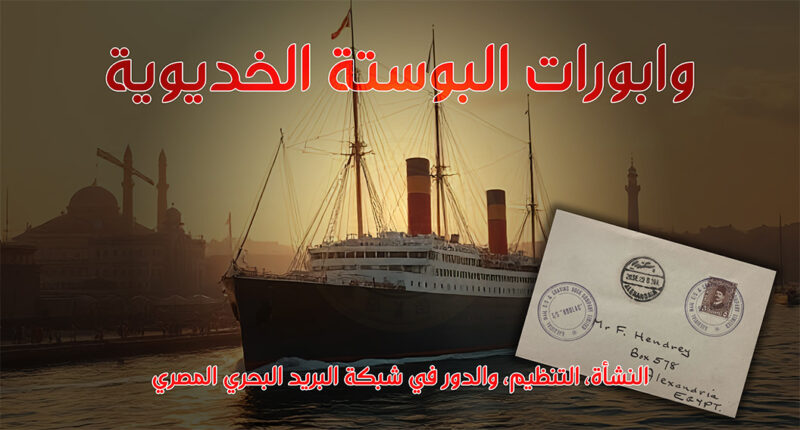
Khedivial post office steamers
Maritime mail represents a central aspect of the development of communication networks in Egypt during the second half of the nineteenth century, and the “Khedival Post Steamers” were one of the most prominent tools of this transformation, as they played a pivotal role in linking Egypt’s ports with regional and international trade centers. In this research, we highlight the organizational and functional dimensions of these ships, and the rare postal documents and seals that reflect the nature of the service, its operating conditions, and the political and economic contexts that accompanied it.
This work aims to provide an accurate documentary reading based on original stamp sources and postal documents, contributing to a deeper understanding of Egypt’s role in the maritime postal field during the Khedival era and beyond.

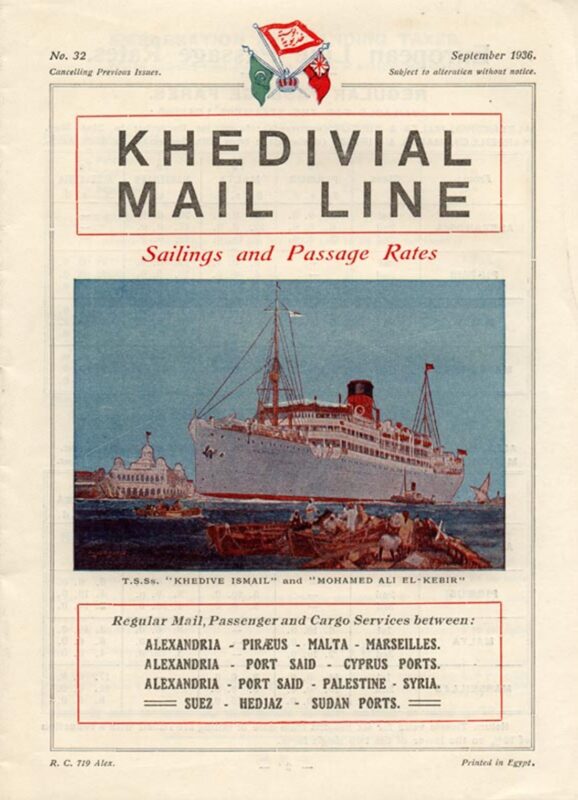
The origins of the Khedivial Post Office
The company was founded Khedivial Post Office Under the name Al-Majidiyah CompanyMedjidieh Company) On February 1, 1857, it flew the Ottoman flag, and its main activity was centered in the Red Sea ports. Upon assuming Ismail Pasha The Khedive's position was established by a mandate issued on May 4, 1863. Egyptian Steam Navigation Company (Egyptian Company for Steam Navigation).
Although it was nominally a private company, the Khedive had a direct financial stake in it, and it was subject to strict government control.
The new company acquired the fleet of the Majidiya Company, which at the time consisted of six ships. On April 7, 1864, the company was granted a monopoly on the transport of passengers and goods via the Nile River and Egyptian canals, and the Ottoman Sultan authorized it to use the name Al-Azizia Egyptian Company (Azizieh Misri Company). The fleet quickly expanded by purchasing new ships, enabling the company to extend its operations to include inland navigation, in addition to the Mediterranean and Red Seas.
A postal announcement dated May 3, 1865, announced weekly sailings from Alexandria and Suez; sailings from Alexandria reached Constantinople in three and a half days. Red Sea services became less frequent, with sailings occurring approximately every ten days by 1867. Despite this expansion, the company continued to incur financial losses.
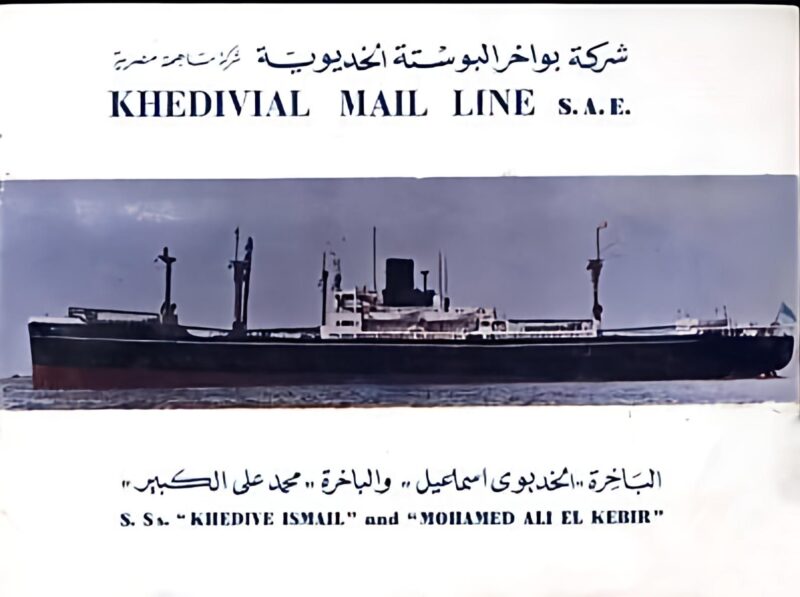
In 1870, the Egyptian government decided to take full control of the company, changing its name to Khedivial Mail Steamer AdministrationAdministration des Paquebots Postes Khediviaux). The service was temporarily suspended in 1877 due to the Russo-Turkish War, but resumed in June 1878. With losses continuing, it was eventually decided to sell the company to a British firm in 1898, and its name was changed to The Khedivial Postal and Dock CompanyKhedivial Mail and Graving Dock Company).
For simplicity, historians often refer to this company as Khedivial postal line (Khedivial Mail Line – KML)Regardless of the official designations that have changed over time.
Khedivial post office seals
Official maritime postal services (the Khedivial Post Office) and private services can be distinguished based on the service provider. In cases where no government post office operated on board ships, the ship's employee would (Purser) with postal duties, and was often equipped with a special postal seal. These seals identified the ship's name or the name of the operating company, but mostly did not include dates. The oldest known seals for a private shipping line are those of Ottoman steamships.Piroscafi OttomaniIt was an Italian company that primarily served Constantinople and the ports of the Aegean Sea. It had a short-lived agency in Alexandria, and there are envelopes without stamps, but bearing its seal, examples of which have been documented dating back to 1863. Finding such envelopes is very rare (fewer than five pieces have been recorded).
These seals served as an informal identification tool for the maritime postal service, but they are of great statutory importance, as they reflect transport routes and service operators. It is noted that some of these seals were later used for internal or promotional purposes within the same companies, which opens the door to distinguishing between genuine postal use and administrative or commercial use. Despite their rarity, studying these seals enables the researcher to trace the development of informal maritime mail and the extent of its overlap with official postal networks in Egypt and abroad.
Khedivial postal ships
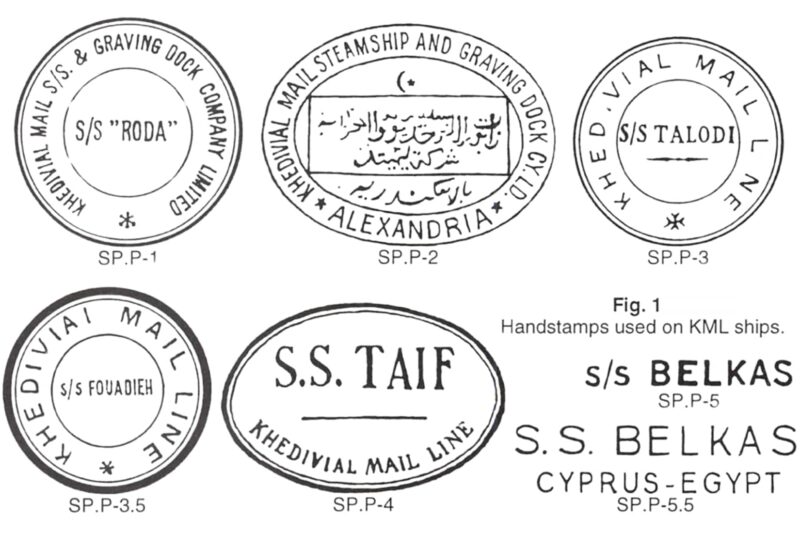
The Khedivial postal service ships, which operated on the Mediterranean and Red Seas, used at least five types of promotional stamps. Some enthusiasts even used these stamps as tools for invalidating stamps, although they were not part of the official postal system. These stamps were classified under the category known as the symbol. SP.P– (Abbreviated as Sea Post – Private), which is a category used for informal documentation in philatelic studies.
The registered seals included the names of the following ships:
- RODA
- BOULAC
- RASHID
- TAIF
- TALODI
- BELKAS
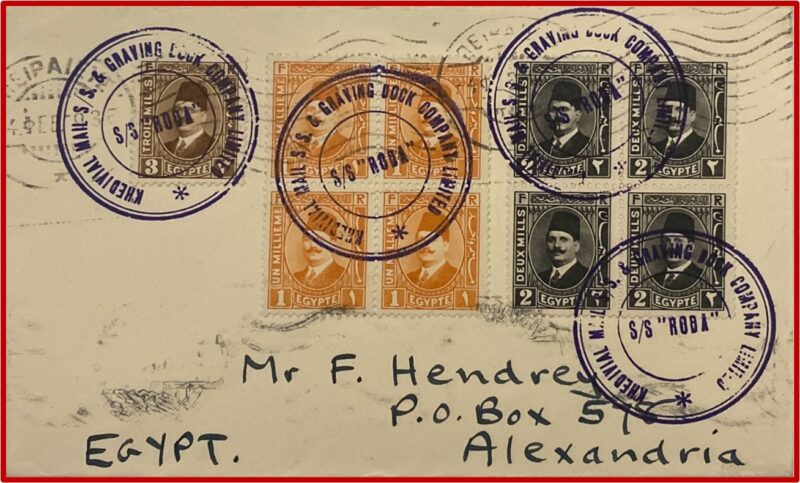
Envelope F. Hendrey sent with the seal of the ship S/S RODA from Greece dated 4 February 1929, arrived in Alexandria on 9 February 1929.
Most of the envelopes available on the market come from a well-known stamp dealer in Alexandria named F. Hendrey. Between 1928 and 1932, he produced a large quantity of envelopes stamped with these seals, often with handwritten addresses, either to himself (Barclays Bank or a post office box) or to other customers. Although these envelopes appear to be forgeries, they did travel through the postal service and were stamped with valid, valued stamps, making them genuine postal items rather than entirely fabricated. Later, Hendrey became more daring, using stamps from countries other than Egypt. For example, envelopes stamped with Belgian Equatorial (Belgian Congo) stamps have been recorded. Although Hendrey produced a diverse range of envelopes, those that survive are now rare, and very few have traveled with postal seals. Some seals have only six envelopes, and others have only three.
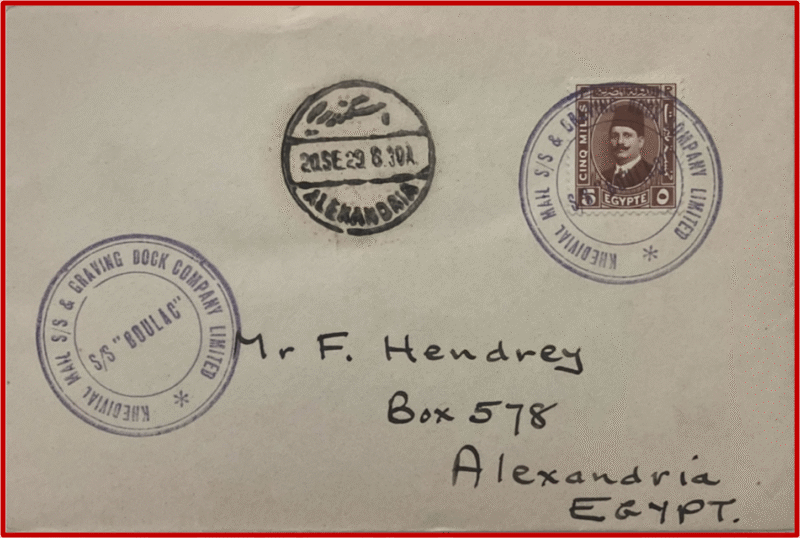
F. Hendrey envelope, stamped S/S BOULAC, sent to Alexandria, arrived on 20 September 1929.
The reason these envelopes were approved for sending was that during the Vienna Congress of the Universal Postal Union (UPUIn 1891, a special convention for mail outgoing from ships was developed to regulate the handling of mail sent from the high seas (outside territorial waters). The agreement stipulated that letters sent from aboard ships would be considered properly paid if they bore the stamps of the country whose flag the ship flies, or the stamps of the country where the ship last called, provided that they were delivered to the post office in the port by a ship's officer.Purser).
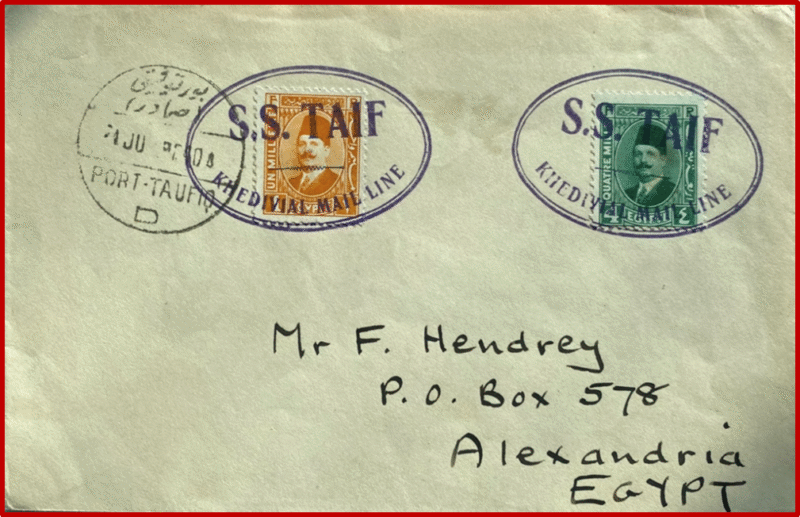
F. Hendrey envelope, stamped S/S BOULAC, sent to Alexandria, arrived on 20 September 1929.
Sources:
- Smith, Peter AS.
Egypt: Stamps & Postal History – A Philatelic Treatise.
Lichtenstein Press, 1999. - Union Postale Universelle.
Procès-verbaux du Congrès de Vienne, 1891.
Berne: Bureau International de l'UPU, 1892. - Hogarth, David.
The Khedivial Mail Line and the Egyptian Steam Navigation Company.
Egyptian Philatelic Society Bulletin, Vol. 17, No. 4, 1982. - Mahmoud Hassan.
An archival and documentary study of the Arabic records in the Diwan of the Khedivial Post Office.
The Arab Researcher Portal “I Want”, 2021. - National Archives - Egypt.
Archives of the Khedivial Post Office, Correspondence Register 1865–1898.
(Unpublished official documentary stock, available to researchers for direct viewing).
For more similar topics, you can browse the Arab collector's website through the Link the next: