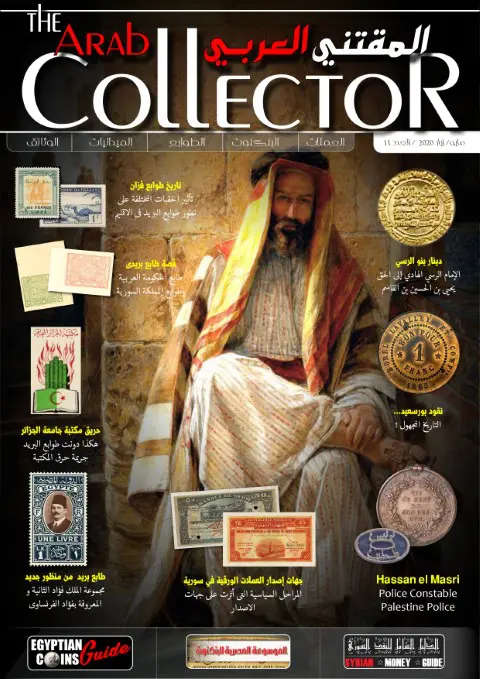
The Arab Collector, Issue 11 – May 2020
Al-Muqtani Al-Arabi, Issue Eleven – May 2020
The Arab Collector, Issue 11 – May 2020
Al-Muqtani Al-Arabi, Issue Eleven – May 2020
The Arab Collector – Issue 11 – May 2020
Arabic coin designs series
David Cornell
David Cornell
An English artist and sculptor born in London in 1935. As a young man, he studied at the Central School of Art in London and at the Academy of Fine Arts, Philadelphia, USA.
The Arab Collector: Unveiling the Secrets of “Restrike”
There has been much talk lately about restrikes, especially with the emergence of Egyptian-made pieces from NGC, which seemed strange to many enthusiasts. This article will not present all the theories, but rather focus on the well-established facts about restrikes in general.
From the currencies of the Mutawakkilite Kingdom of Yemen
Imam Yahya bin Muhammad Hamid al-Din (1322 AH - 1367 AH) (1904 AD - 1948 AD)
Money during the Syrian Kingdom period
Following the declaration of independence and the formation of the Syrian Kingdom, the Arab government issued a law on April 12, 1920, published in the Official Gazette (Al-Asima Gazette) in issue number 120 dated April 26, 1920, establishing the Syrian gold currency.
Dinar Banu al-Rassi
Port Said's currency… the unknown history!
Syrian silver coins
The minting of silver coins in Syria began with Decree No. 2507 issued on April 16, 1929, which included the minting of silver pieces with nominal values of 25 and 50 piasters.
The Doro in the heritage of our Algerian currency
The coins of the sons of Al-Nasir Muhammad ibn Qalawun
"Ass Katori Maru"”
The ASS Katori Maru was a Japanese merchant ship launched in February 1913 (note number 13) by the Nippon Suisan Company. It was used as a medium transport ship, but immediately after the outbreak of World War II, it joined the Imperial Japanese Navy and was refitted with cannons.
Hassan el Masri
Police Constable Palestine Police
Royal Humane Society Bronze Medal – Successful
The Comprehensive Guide to Syrian Criticism
Thabet family coins
Authorities issuing banknotes in Syria
Signatures on Syrian banknotes
Long well
Encyclopedia of Egyptian Banknotes
The Beginning and the End - Part Two 50 Piastres
Local and private mail in Morocco 1891/1911, Part 3
The first stamp for Kurdistan.”
The Suez Canal... the Yellow Fleet was here
Despite all the talk about the Suez Canal recently, one of the incredible stories that unfolded there is rarely, if ever, mentioned. Even when articles are published about stamps commemorating the canal, the stamps of the Yellow Fleet, which are perhaps the most important for stamp collectors worldwide, are consistently overlooked. This article is an attempt to clear away some of the sand—from which this fleet acquired its color—from the story that deserves to be told: a true maritime voyage whose length is rivaled only by the Odyssey in the realm of fiction.
Fire at the University of Algiers library
History of Fezzan stamps
Arab Titanic
A postage stamp from a new perspective
Nearly a century later, Egyptian postage stamps remain a rich source of study and new discoveries. The King Fuad II collection, also known as the Fuad the French collection, is among the most beautifully designed and produced collections of old Egyptian stamps, and was used extensively for ten years, from 1927 until King Fuad's death in 1937.
THE FIRST BUTTERFLY RECORDED IN HISTORY
How to participate in international stamp exhibitions
Arab government stamps and Syrian kingdom stamps
With the first official decisions related to the printing and issuance of Syrian postage stamps for the year 1920, the official Capital Gazette published in issue 97 dated 1/29/1920 the text of an announcement for a tender to make clichés for postage stamps, in accordance with the decision of the Board of Directors regarding postage stamps, published in issue 96 dated 1/26/1920 in paragraph five thereof.
History of Gulf Currency – Special Supplement
In this chapter, we examine the story of the Gulf currency from a different perspective by creating a historical narrative and translating official correspondence and reports from the British National Archives. These events took place between the government bodies and institutions of King George VI’s government between 1947 and 1952. This is done through my acquaintance with Ken Hallenbeck, one of the top currency dealers in the United States, who also served as the director of the American Numismatic Society in the 1980s. He proudly mentions that he no longer owns a shop as he used to, as he sold it to his son, Tom. He—the father—now works as an employee for his son, who in turn held a high position in the Society at the beginning of the 21st century.
Egyptian Coin Guide – Issue 9

 EN
EN  AR
AR