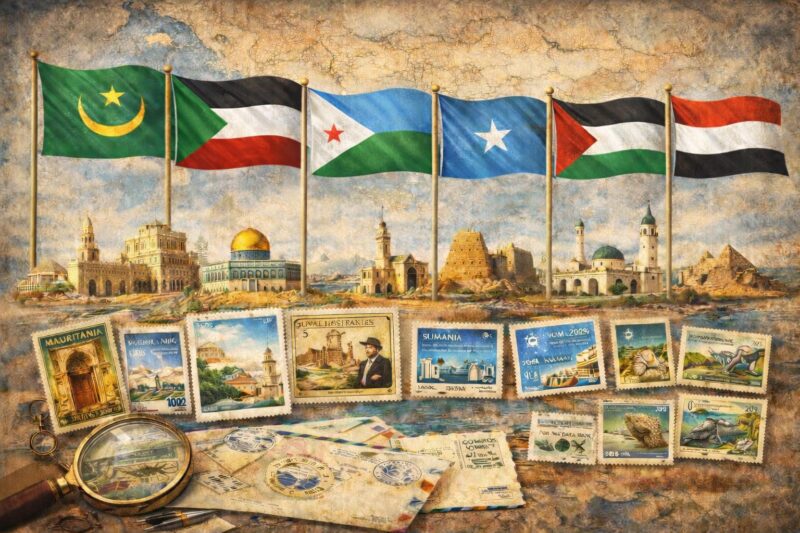
Philatelic Service in East African Countries
This article provides a cultural and documentary reading of the reality of the philatelic service in a group of East African countries, along with Mauritania, Palestine and Yemen, during the year 2025, focusing on five interrelated axes: the performance of official postal administrations, the announcement and documentation of the year’s issues, the availability of purchase and dispatch for philatelists, the role of collectors’ societies wherever they exist, and the structural gaps that still affect the presence of the postage stamp as a cultural and historical document.
This article is based on independent research conducted through direct observation and practical experience browsing the official websites of postal administrations and available stamp departments, as well as monitoring developments on international philatelic documentation platforms during 2025. This effort has adhered to presenting only publicly available and declared information, without making assumptions or relying on unverified commercial sources. Given the cumulative nature of philatelic research, this work remains open to any additional information, corrections, or professional opinions from postal administrations, philatelic societies, researchers, and interested parties, which will contribute to enriching the content and enhancing the service for philatelists.
In Sudan, the Sudan Post Company manages the postal sector through its official website. sudapost.sdA dedicated section for stamps, known as Stamps Corner, is featured, including informational materials such as Stamp Story and Stamp Gallery. This digital presence gives Sudan a relatively better position compared to the other countries studied, but it has not translated into an announced annual stamp program or documented, up-to-date issue bulletins by 2025. Furthermore, there are no official stamp purchasing mechanisms or clear information regarding international shipping for philatelists. At the societal level, a local philatelic society exists in Khartoum, albeit with limited visibility, while more regular research and documentation activities are carried out by international study groups, reflecting a partial reliance on external support for preserving philatelic heritage.
In Somalia, the Somali postal service operates via a website. posta.soThe year 2025 marked a significant turning point with the resumption of national and international postal services after a long hiatus. This development holds considerable symbolic and operational value, but it was not accompanied by the launch of dedicated philatelic content or the announcement of new stamp issues. The website lacks a section for stamps or collectors, and there are no locally recognized philatelic societies listed—a situation that can be understood within the context of rebuilding the postal infrastructure itself before addressing the cultural and philatelic dimensions.
In Djibouti, La Poste de Djibouti operates postal services via its website. laposte.dj. During 2025, a clear focus emerged on modernizing digital and financial services with international support, but postage stamps did not receive a similar attention in these efforts. There is no publicly announced stamp issuance program, nor is there a clear section dedicated to collectors. Historically, Djibouti has had philatelic societies in the past, but in the current landscape, there does not appear to be an active national society playing a clear cultural or documentary role.
In the Comoros, the postal service falls under the National Postal and Financial Services Company, with general information available via snpsf.com/poste. The digital presence of stamps is very limited, and there are no specialized sections or announcements about the 2025 issues. There is also no role for local philatelic societies, while external researchers and study societies undertake the task of documenting Comoros stamps historically, which is culturally important but does not compensate for the lack of a local institutional service for philatelists.
As for Mauritania, the Mauritanian postal service (Mauripost) manages the postal sector through its official website. mauripost.mr. It is noticeable that the website focuses primarily on postal and financial services, lacking a clear philatelic section or a dedicated digital archive for stamps. There are no announcements regarding the 2025 philatelic program, nor are there any documented issue bulletins available for collectors to consult. At the societal level, there is no clear indication of an active national philatelic society, leaving philatelic interest largely dependent on individual initiatives or external documentation.
In Palestine, the Palestinian postal service plays a vital symbolic and cultural role, as postage stamps serve as a tool for affirming national identity and documenting Palestinian memory. Despite political and logistical challenges, its presence remains prominent. Palestinian Philatelic Society As a vibrant and active model, the association uses its Facebook platform to exchange knowledge, showcase collections, document Palestinian philatelic issues, and build a cross-border community of philatelists. This active presence partially compensates for the limited official announcements and digital documentation, and underscores the vital role of philatelic civil society in preserving Palestinian postal heritage and enhancing its international presence.
In Yemen, the philatelic issue presents a more complex picture, as political circumstances and institutional divisions have impacted the regularity of the postal service itself. There is no publicly announced philatelic program for 2025, nor is there a modern official platform to document issues or allow philatelists to purchase them. Furthermore, there are no indications of active philatelic societies within the country, meaning that Yemeni philatelic interest is primarily maintained through international documentation platforms and individual efforts outside the institutional framework.
Comparing these countries reveals that publicity and documentation for the 2025 issues were weak or nonexistent in most cases. There are no published annual philatelic programs, nor are there standard issue bulletins that include the date of issue, value, subject, and artwork. This absence is reflected in international documentation platforms, which are slow to list issues or keep 2025 records incomplete, creating a knowledge gap for philatelists and researchers.
Regarding purchasing and shipping, most of the countries studied lack official channels for online stamp sales, international order forms, and registered mailing policies specifically for philatelists. Consequently, collectors rely on intermediaries and informal markets, a practice that weakens the connection between collectors and national postal services and negatively impacts the documentation of issues.
Philatelic societies play a pivotal role here. Wherever an active society exists, as in the Palestinian case, there is a direct and positive impact on documentation, communication, and building philatelic awareness. Conversely, the absence of such societies in other countries has led to a fragile philatelic service and its reliance on external or individual initiatives. These societies are not a secondary element, but rather an integral cultural partner in the postal and stamp system.
Based on this analysis, several practical cultural recommendations emerge, foremost among them the necessity of establishing clear philatelic sections or pages within postal administration websites, announcing annual philatelic programs, even if limited in scope, and publishing a standardized issue bulletin for each stamp, along with cumulative digital archiving. It is also advisable to provide simple stamp sales channels and clear international shipping policies, encourage the establishment or support of philatelic societies and link them to formal partnerships with postal administrations, and draw upon the Palestinian experience as a successful community model for preserving philatelic heritage.
In short, 2025 revealed a clear gap between the operational development of some postal administrations in these countries and the absence of a cultural vision for philately. Postage stamps remain outside the realm of cultural and economic planning, and philatelic societies are either nonexistent or have limited influence, with the exception of a few active community-based models that emphasize that investing in the hobby is an investment in memory and identity. Nevertheless, the opportunity remains to transform this reality through simple, low-cost steps into a dynamic cultural movement that restores the stamp to its rightful place as a document of memory and identity, serving both stamp collectors and researchers.
For more similar topics, you can browse the Arab collector's website through the following link:
Khedivial post office steamers