HistoryNumismatics
Personal union in history
We have all heard of cases where two or more countries unite, voluntarily or forcibly, to form a single state. Personal unions have occurred in our modern Arab history; for example, Syria and Egypt entered into a merger in 1958, forming a single state. United Arab Republic. Our article today discusses another form of this unity, a form usually associated with the monarchical system of government, and the focus of this union is the person of the king himself; it is the personal union.
A personal union occurs when two or more states are ruled by the same monarch while retaining their distinct borders, laws, and interests. These unions are often formed due to exceptional circumstances in the laws of succession, treaties, or political arrangements of the states prior to the union. Just as they are formed by exceptional circumstances, other exceptional circumstances may lead to the dissolution of such unions.
Since the best way to explain is by talking about some examples from history, we will try through three cases to give a better idea of these personal unions and the reasons for their formation and eventual separation.
1. Great Britain and Hanover
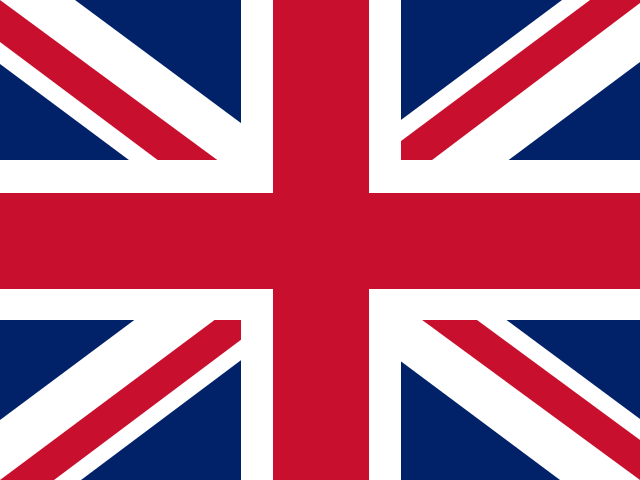
The personal union between Great Britain and Hanover lasted from 1714 to 1837. This union began when George I of Hanover ascended the British throne upon the death of Queen Anne. The Act of Settlement of 1701 stipulated that the monarchy should revert to Protestantism, bypassing several Catholic heirs and favoring the Protestant Prince George I of Hanover, who was then a member of the British royal family. The union continued through successive monarchs until Queen Victoria's accession to the throne in 1837. Hanoverian succession laws, based on the Saletic Code, did not permit female rulers if a male heir was available. Consequently, the Hanoverian throne passed to Victoria's uncle, Ernest Augustus, Duke of Cumberland, thus ending the personal union between Britain and Hanover, as the same monarch no longer ruled both states.
2. Sweden and Norway
Sweden and Norway were in a personal union from 1814 to 1905. This union was established following the Treaty of Kiel, which transferred Norway from Danish to Swedish rule. The union was characterized by shared monarchs but separate governments and institutions. It ended in 1905 when Norway declared its independence from Sweden. The separation was peaceful, driven primarily by rising Norwegian nationalism and a desire for full sovereignty. King Oscar II agreed to abdicate the Norwegian throne, along with his descendants. Norway then elected its own monarch, Haakon VII.
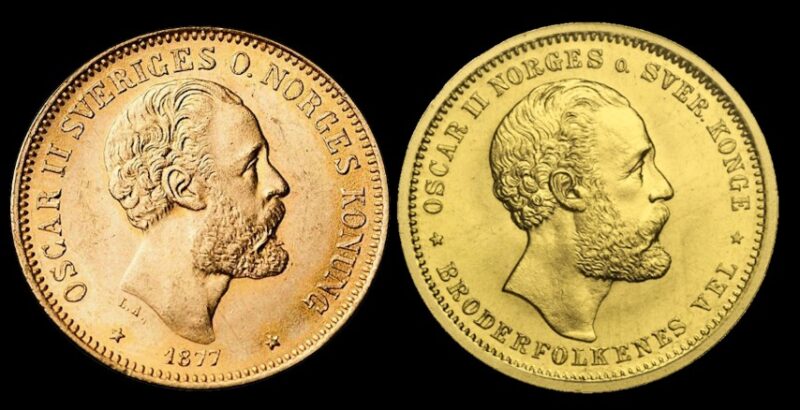
We see a picture of two gold coins of the twenty kroner denomination from the time of the personal union between Sweden and Norway in 1877. On the right we see the Norwegian coin which mentions the name of King Oscar II, King of Norway and Sweden, and on the left we see the Swedish coin of the same denomination which also mentions King Oscar II, but this time as King of Sweden and Norway (note the difference in order).
3. Portugal and Brazil
The Portuguese Empire faced a succession crisis in 1826 when Emperor Pedro I of Brazil became King Pedro IV of Portugal. The political landscape at the time was already complex, following the Napoleonic Wars and the independence movements in South America. Pedro I had declared Brazil's independence from Portugal in 1822 and become its emperor. Later, when his father, King John VI of Portugal, died in 1826, Pedro inherited the Portuguese throne as Pedro IV. To resolve the conflict and avoid ruling two separate empires, Pedro was forced to abdicate in favor of his daughter, Maria II. However, succession laws and political instability led to Brazil's separation from Portugal. Pedro I's abdication in 1831 further solidified the separation, as he returned to Brazil to abdicate in favor of his son, Pedro II. The complex issues of succession and Brazil's desire for independence played significant roles in this division.
Personal alliances have formed fascinating chapters in history, often leading to significant changes in the governments and territorial boundaries of the participating states. They have also transformed local rulers into emperors of major powers, as was the case with the Hanoverian kings who ruled the empire on which the sun never set for a time.
Do you also know of other personal union cases throughout history?
Key difference: What is the difference between personal union and fusion?
| Comparison point | Personal Union | Real Union |
| Head of State | One person rules two independent countries | One government and one head of state for a new state |
| Laws | Each country retains its own laws and parliament. | Unified laws and shared institutions |
| example | Britain and Hanover (1714) | United Arab Republic (1958) |
| Reason for separation | Often due to laws of succession or death | Often due to revolutions or political decisions |
For more similar topics, you can browse the Arab collector's website through the Link the next: