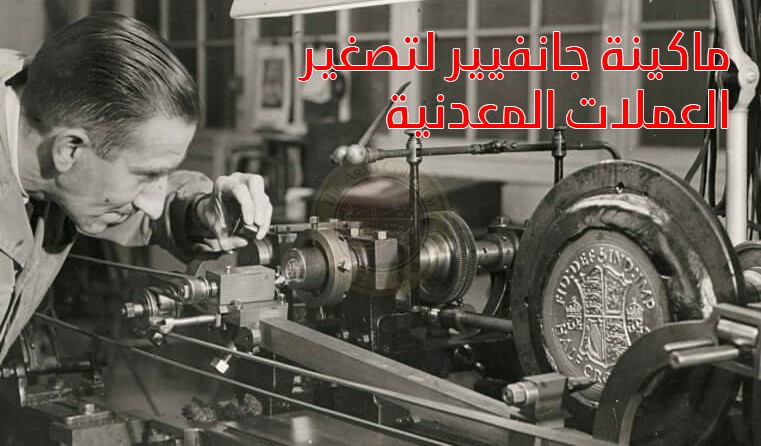
Janvier coin minting machine
This is perhaps the most accurate method currently known for counterfeiting currency: returning to the original using Janvier miniaturization machine …
Janvier machine
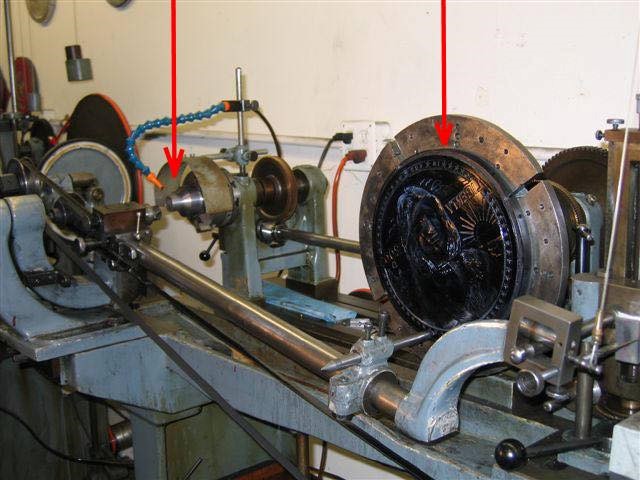
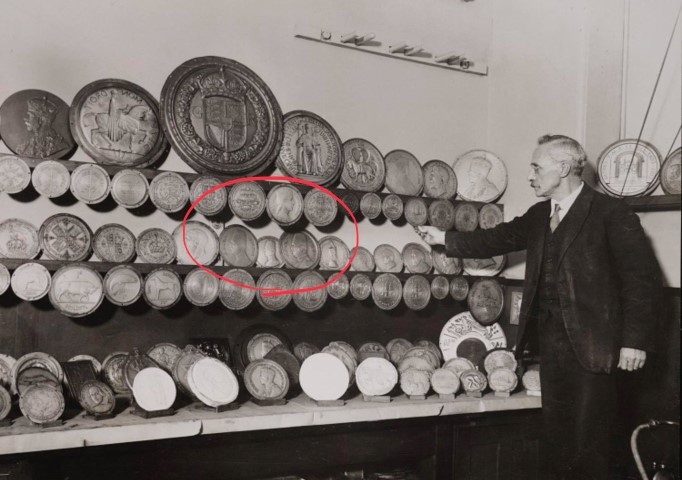
The Janvier machine is an invention of the French sculptor Victor Janvier in 1899, as he wanted to invent a machine that could reduce the design from the plaster mold made by the sculptor to the steel mold used for minting coins.
In simple terms, the plaster mold (and of course the final design on it) is installed on one side of the machine and the smooth steel mold on the other side, and they are fixed on gears that move at the same speed and in the same direction… A pen-like object is placed on the surface of the plaster mold and moves very slowly over each point of the design in a circular motion, starting from the center point until it ends with the groove. On the other side, there is a very hard tooth attached to this pen and fixed over the steel mold, and it moves with it, rising with the design and falling with it. Thus, the design is transferred completely to the steel mold.
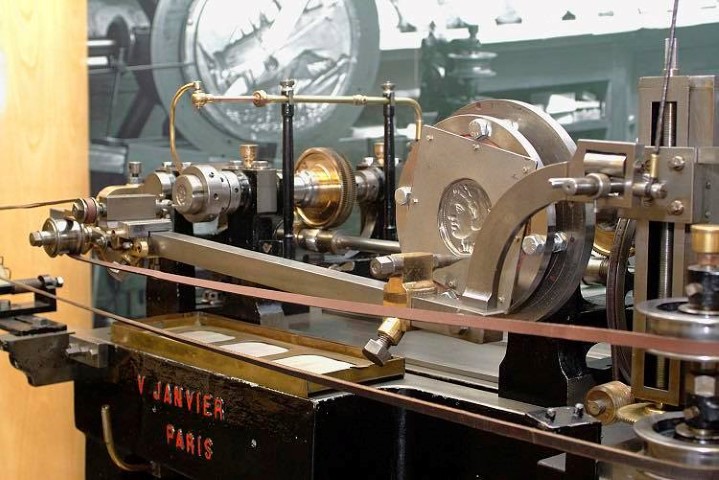
In the early machines, this took many days, and the machine was placed in a quiet room away from the minting machines, because any tremor, however slight, could move the solid tooth, leading to damage to the design on the mold.
The idea is simple, as we can see, yet the device was used in some US mints until 2008! Today, with technological advancements, this device is still available and sold to those who want it. Currently, the counterfeiter places a real coin in place of the plaster mold and the blanking disc on the receiving side – and the resulting pieces are dangerously accurate replicas of the real coin, but despite everything, they can still be detected: It is noted that the molds for each coin contain very fine details that may not appear on the final coins – likewise, transferring details from a coin that has already been minted to a new disc also leads to the loss of more of these details… so the coin appears as if it was poorly minted.
Most valuable pieces are somewhat old, and most old ones do not get a score of 70 in the evaluation due to the presence of a scratch or dents here and there… These scratches and dents are transferred from the original piece to the counterfeit piece exactly and are therefore detected (imagine if 50 counterfeit pieces suddenly appeared in the market, all with the exact same dent in the same place - wouldn't this make you suspicious?) - also, you must train your eye to differentiate between the shape of a real dent that occurred after minting (and appears with a different shine and is usually more shiny than the rest of the surface) and a dent “transferred” from an original piece (and looks exactly like the rest of the surface, as the machine thinks that the dent is part of the design).
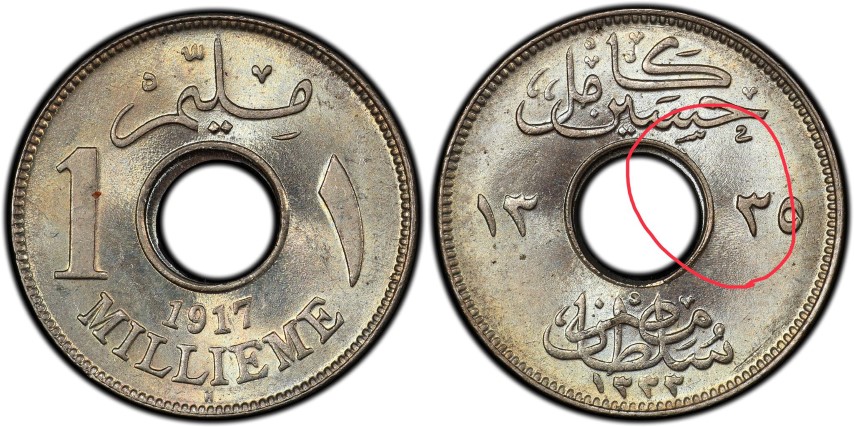
This method of transfer cannot transfer the very, very small lines that appear on the surface of the molds due to frequent use… (for example, the lines on the back of the 1-millime coin of Sultan Hussein, because this particular mold was used for a long time until it was completely worn out.) - The alloy used to make the modern disc usually has different impurities than the old alloys – it suffices to know today that Ottoman silver differs in its composition of impurities from the silver of the Egyptian sultans (Hussein and Fuad), and also from the silver of Fuad and Farouk, and the reason for this is the development of methods of separating and smelting metals during that period. - Other methods include differences in the color and texture of the counterfeit piece, in addition to the difference in the sound it makes when it strikes another surface, although I personally do not prefer this method of testing.
It's also worth noting that some counterfeiters deceive by offering what they call "experiments" and selling them to collectors at high prices (and an inexperienced collector might be delighted by these rarities and proudly display them). For example, a counterfeiter might offer a copper piece instead of a genuine gold piece, thus avoiding the issue of chemical composition altogether. However, the dents and scratches are still present, testifying to the piece's forgery, in addition to its overall poor design. It's crucial to remember that no counterfeiting method, regardless of its method, can produce pieces that are identical to the originals – the important thing is to know what you're looking for and continue to arm yourself with knowledge.
For more similar topics, you can browse the Arab Collector website through the Link the next: