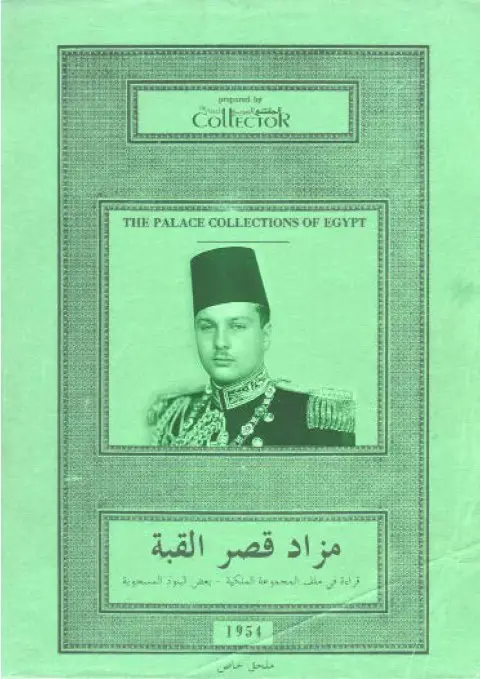
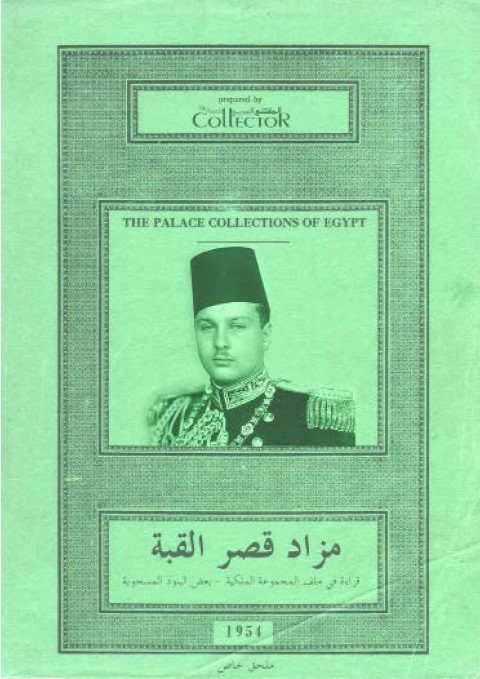
Qubba Palace Auction 1954
- Version
- Download 2550
- File Size 3.4 MB
- File Count 1
- Create Date 02/05/2023
- Last Updated 02/05/2023
Qubba Palace Auction 1954
The Palace Collection - Qubba Palace Auction
King Farouk (11 February 1920 – 18 March 1965) ascended the throne in Egypt in 1936 on the death of his father, King Faud I. Young Farouk – just 16 when he took the throne – was “wild” by the standards of his time and was an avid collector of many things, including coins.
The king's numismatic holdings were near-legendary. At one point he owned a 1933 double eagle and a pair of 1913 Liberty nickels. In 1954 the government of Egypt held an enormous auction sale of the Farouk coins. Dubbed the Palace Collections of Egypt by the sellers, the coins attracted worldwide attention. Americans – as well as others from around the globe – flocked to Cairo for the sale. The collection was cataloged by London coin dealer Fred Baldwin under harsh conditions imposed by the Egyptian authorities. Therefore some extremely rare coins were lotted up with more common pieces; This held true for the sections of United States coins as well as coins issued by other countries.
Many enthusiasts learned a great deal about the treasures of King Farouk that were sold by the Egyptian republican regime - but what is the beginning of the story? And what prompted the Free Officers to hold an auction to sell stamps, coins, snuffboxes, crystal, and watches - all very small things and certainly not attracting attention amidst the luxury of the palaces, the extravagance of the furnishings, the beauty of the paintings, the rarity of the furniture, the splendor of the purebred Arabian horses, and the luxury of the cars, all of which have not been subjected to similar international auctions? What specifically caught their attention in these small pieces of paper and metal, whose high prices are often not realized by the non-specialist?
A study in the form of a serialized story about the Qubba Palace auction and the withdrawn (and stolen) items, including details that may be published for the first time about the 1933 US twenty-dollar bill that disappeared between 1954 and 1994 in the possession of one of the Free Officers.
On Friday, February 12, 1954, the doors of Qubba Palace were opened to foreign visitors from all over the world to participate in an auction of the former King Farouk’s belongings, including antiques, watches, silverware, coins, rare postage stamps from various countries around the world, hats, clothes, and other items that the King owned.
When the auction began, Bimbashi Mahmoud Younis, the general supervisor of the auction, stood up and said: “In the name of God and in the name of the Republic, we open this auction in which artifacts acquired by the king with the blood of the people are being sold today so that their price may return to their rightful owner, the people.” After Mahmoud Younis thanked the foreigners who came from various countries around the world to contribute to the purchase of the exhibits, according to Al-Ahram newspaper in its issue dated February 13, 1954.
Then the auction began with the sale of a unique collection of postage stamps that Farouk had been keen to acquire and collect from various countries around the world. Among the collection sold were stamps dating from between 1864 and 1879. Some were sold for fifteen pounds, and some for two hundred and eighty pounds, which was the highest price paid for a collection that included four stamps attached to each other of the same type, written in Arabic in an unattractive script. At the end of the auction, the proceeds amounted to six thousand pounds at once.
After the unique stamp collection, the auction began with the sale of Farouk’s other collections, which included the coin collection, jewelry collection, antiques collection, watch collection, musical box collection, and silver collection.
To download different versions of the Arabic Collector, please go to Home
 EN
EN  AR
AR